The commemoration of Ashura constitutes a significant element of Lebanese intangible cultural heritage, yet it has received remarkably little scholarly attention from either an ethnographic or a heritage studies perspective, with the exception of a small number of valuable studies. (1) This gap can be explained, in part, by the demographic and social history of the Lebanese Shiite community: until the second half of the twentieth century, this community remained predominantly rural, and the documentation of rural heritage in Lebanon presents persistent challenges, as available written sources are scarce, fragmentary, or altogether absent.
This already fragile documentary record was further destabilized by the political transformations that followed the 1979 Islamic Revolution and the founding of Hezbollah in 1985. Within the broader restructuring of the Shiite community in Lebanon, the commemoration of Ashura was transformed into a mass rally, accompanied by a new ritual aesthetic, new melodies, and new ceremonial forms. Change is a natural feature of any living heritage, yet the Lebanese expression of Ashura receded before this new influence. When such a recession unfolds against a backdrop of scarce prior documentation, it takes the shape of cultural erasure.
This erasure has been compounded, in turn, by the destruction wrought on South Lebanon during the most recent war between Israel and Hezbollah. The full extent of the losses remains unknown: private collections, libraries, monuments, and personal archives that might have shed light on this heritage were swept away in the process. Where, then, can we search for a Lebanese Ashura?
The first place to turn is the written record. The al-Rukayni chronicle, composed by Haydar Rida al-Rukayni and his unnamed son between 1749 and 1832, offers invaluable insight into daily life, political change, and society in Jabal Amel from the perspective of a family of farmers. (2) The chronicle clearly establishes the “Matawila” affiliation of its authors, leaving their Shiite identity in no doubt. It includes a single reference to a “Hajj Sulayman Jaber” who “traveled to visit al-Husayn,” that is, undertook a pilgrimage to Karbala, but makes no mention of Ashura.
This absence requires careful interpretation. Public discourse has widely held that Shiite rituals were prohibited under the Ottoman Empire, a claim that may indeed hold true for urban centers. Rural areas, however, were spaces beyond direct control, where no Ottoman military presence existed to enforce such a prohibition. Moreover, Jabal Amel and the Baalbek region, both Shiite-majority areas, remained under local Shiite leadership for most of the Ottoman period, allowing Ashura rituals to be observed away from Ottoman oversight. This is corroborated by the account of the Armenian physician John Wortabet, one of the founders of AUB, who offers a rare counterpoint to prevailing victimization narratives in his 1860 Researches into the Religions of Syria. Writing of the Metawileh, the local Shiites in the Levant, he states:
“The Metawileh spend the first ten days of the month of Moharram in mourning and lamentations, as the anniversary of the death of El Hosain. During those days they read a long and pathetic history of the occasion, and do not work in them. They call them ‘The Ten Days’.” (3)
Another aspect of local observance, transmitted through oral history and private collections, was the use of a compilation of devotional texts, elegies, supplications, and visitation prayers recited during the commemoration of Ashura, known locally in Jabal Amel as al-Safina. (4) The available manuscripts, however, have never been documented academically.
Beyond Wortabet’s external observations, a more detailed local perspective can be found in the autobiography of Mohsen al-Amin (1865–1952), a leading Shiite reformer from South Lebanon, who offers valuable insight into the Ashura celebrations of his youth in Jabal Amel around 1880. (5) He explains that the Ashura readings were long, held at night, and drawn from a book called al-Majalis, produced in Bahrain. He further explains that these gatherings continued nightly through the tenth night, noting:
“…these gatherings do not require abstaining from smoking or even from speaking at all; rather, they resemble the stories told in cafes today….”
He also writes that work was suspended on the tenth day, when the martyrdom of Abu Mikhnaf was recited, followed by the Ziyarat Ashura. (6) (7) It is in his account that we find a mention of the connection between hrisseh and Ashura, along with an explanation of its social dimension. He states:
“Food is then brought to the mosques, usually consisting of hrisseh. Everyone contributes according to their means.”
This dish is among the oldest in the Levant. Wheat has been cultivated in this region for nearly twelve thousand years, and cattle were domesticated some six thousand years ago; their combination in a single communal preparation represents a considerable sacrifice, historically reserved for important celebrations. Rural communities rarely consumed meat, and the loss of livestock to slaughter was an economic decision with lasting consequences. Moreover, such a feast could only function at the community level; individual families could not prepare it alone. Al-Amin’s description captures this perfectly. He explains:
“The poor eat from it, and the wealthy eat a little for blessings. Some is also distributed to homes, all as an act of devotion to God Almighty on behalf of the soul of the martyr Abu Abdullah al-Husayn.”
This is one of the very few local testimonies describing how Ashura was commemorated before the introduction of Iraqi ritual elements. These were brought by Sheikh Musa Sharara, al-Amin’s tutor, upon his return from Iraq: he introduced a different majalis book and the Maqtal of Ibn Tawus, as was customary in Iraq. (8)
Change was also coming from Qajar Iran. Two figures contributed to introducing Qajar-period Ashura commemoration practices to Nabatieh in the early twentieth century. The first was Sheikh Abdel Hussein Sadek (1862–1942), who founded the Husayniyya of Nabatieh in 1909, the first established in Bilad al-Sham. A direct product of Persian influence, it has since become the main congregation hall in Nabatieh where Ashura readings take place. The second was Ibrahim al-Mirza, an Iranian notable who had fled with his family for political reasons. He visited Nabatieh periodically before settling there and marrying into the local Shiite community. He worked as an assistant to Dr. Post at the SPC in Beirut, (9) and is credited with introducing the practice of tatbir to the town and with holding the ceremonies in the “Baydar” square of the town. He was the first to introduce the mortification ritual of tatbir, the bloodletting. However, this was rejected by the Ameli clerics at a very early stage. Even though this represented Qajar Persian influence, it rapidly became localized. The play is much more influenced by the Iraqi version than by the well-known Iranian ta‘ziyeh, and even acquired a shared communal dimension, as Christians would gather to watch the theatrical reenactments at the town’s famous baydar.
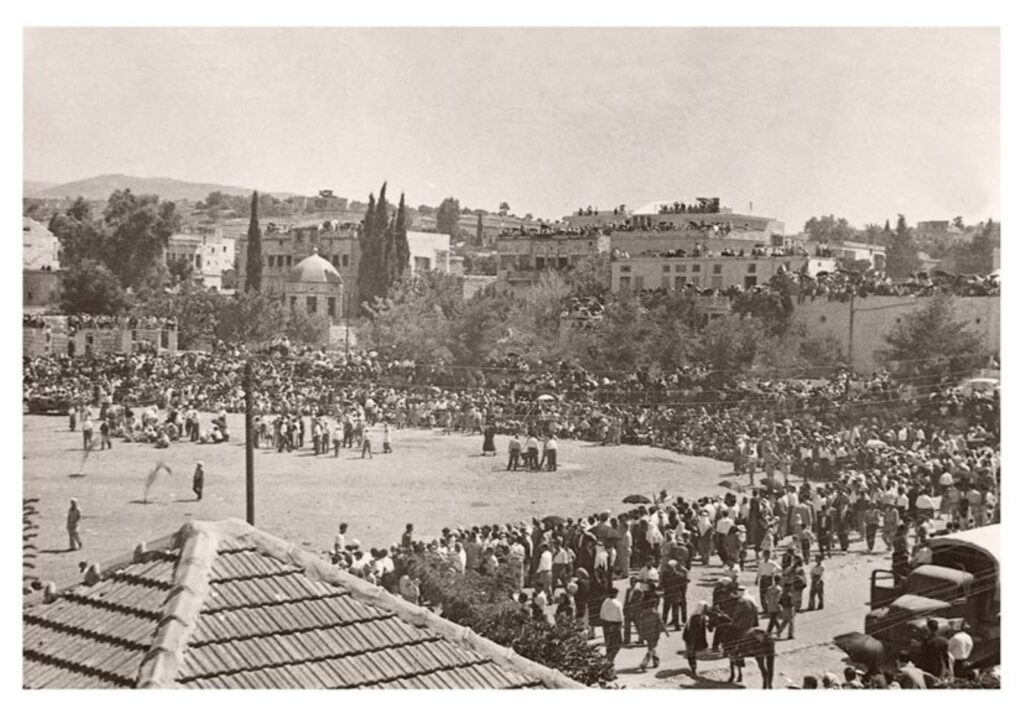
“The Battle of Karbala (Taff)” reenacted at the threshing ground (baydar) of Nabatieh in the 1960s (photo from the archive of Kamel Jaber). Taken from https://manateq.net/wp-content/uploads/2023/07/Nabatieh-005.jpg
Beyond the written record, oral history preserves another essential dimension. According to testimonies collected from communities in Jabal Amel, the qari’at al-‘aza’, the reader of laments, typically a woman, was a constant presence throughout the ten days of Ashura. She would recite laments in local dialect and local melodies, drawing on a branch of the zajal and broader Arabic literary repertoires common to all communities in the region. One remarkable visual document survives: footage of Hajja Hasiba Hashem Budayr (1926–1992), a native of Nabatieh, in one of her last public appearances, chanting in a majestic voice over the Midan where the commemoration was held. Her lament recalls a dialogue between Zaynab and Hussein.
Public and archival material on the readers of laments is regrettably scarce. Testimonies from several inhabitants of Jabal Amel suggest that the tradition has survived, though it has been displaced from the public sphere into the private one.
The heritage of Lebanese Ashura was scarcely documented to begin with, has since undergone profound cultural change, and has now suffered massive physical destruction. What remains to be done? The scarce available documentation, fragmentary as it is, opens a path toward reconstructing a Lebanese Ashura, but this path depends, above all, on oral history.
The most urgent priority is the systematic and immediate interviewing of the elderly generation, those who experienced this heritage before 1979, while their testimony can still be recovered. Their accounts hold heritage elements that connect the present to a longer past, and the project of gathering them is urgent in every sense. Recovering the Lebanese Ashura carries the potential to restore a sense of belonging grounded in local roots, and to deepen, for all Lebanese, the historical understanding of a shared yet diverse cultural heritage. After decades of political narrative and war that produced erasure, the future cannot be built on cultural amnesia. The work of listening must begin now, before this heritage is left permanently at the edge of memory.
Charles al-Hayek is a public historian and the founder of Heritage and Roots.
The views in this story reflect those of the author alone and do not necessarily reflect the beliefs of NOW.
Endnotes
(1) Sabrina Mervin, “‘Âshûrâ’: Some Remarks on Ritual Practices in Different Shiite Communities (Lebanon and Syria),” in Alessandro Monsutti, Silvia Naef, and Farian Sabahi, The Other Shiites: From the Mediterranean to Central Asia (Peter Lang, 2007), pp. 137–147. ⟨halshs-01859502⟩
(2) https://archive.org/details/1163-1247-1749-1832/page/n31/mode/1up
(3) John M. D. Wortabet, Researches into the Religions of Syria (London: James Nisbet, 1860), p. 272.
(4) https://jabalamelah.blogspot.com/2021/08/blog-post_11.html
(5) https://archive.org/details/3_20220129_20220129_2247/%D8%A3%D8%B9%D9%8A%D8%A7%D9%86%20%D8%A7%D9%84%D8%B4%D9%8A%D8%B9%D8%A9%20-%20%D8%AC10%20-%20%D8%A7%D9%84%D8%B3%D9%8A%D8%AF%20%D9%85%D8%AD%D8%B3%D9%86%20%D8%A7%D9%84%D8%A3%D9%85%D9%8A%D9%86%20%D8%A7%D9%84%D8%B9%D8%A7%D9%85%D9%84%D9%8A/page/n353/mode/2up?q=%D8%B9%D8%A7%D8%B4%D9%88%D8%B1%D8%A7%D8%A1
(6) Lut ibn Yahya ibn Saʿid al-Azdi (d. 773 CE), known as Abu Mikhnaf, was an early Muslim historian regarded as among the oldest Arab prose writers. An akhbari (transmitter of historical reports and traditions), he is considered an important source for early Iraqi historical traditions and served as a principal source for al-Tabari’s history.
(7) Ziyarat Ashura is a prayer recited by Shia Muslims to honor Imam Husayn ibn Ali and the martyrs of the Battle of Karbala.
(8) Maqtal ibn Tawus, widely known as Al-Luhuf ala Qatla al-Tufuf (Sighs of Sorrow for the Martyrs of Karbala), is one of the most famous and widely read classical Shi’a texts detailing the martyrdom of Imam al-Husayn. It was written by jurist, theologian, and historian Sayyid Raziuddin Ali bin Musa Ibn Tawus al-Hilli (d. 1266).
(9) SPC: Syrian Protestant College, founded by American missionaries in Beirut as the first modern university in the Middle East. It was renamed AUB, American University of Beirut, in 1920.