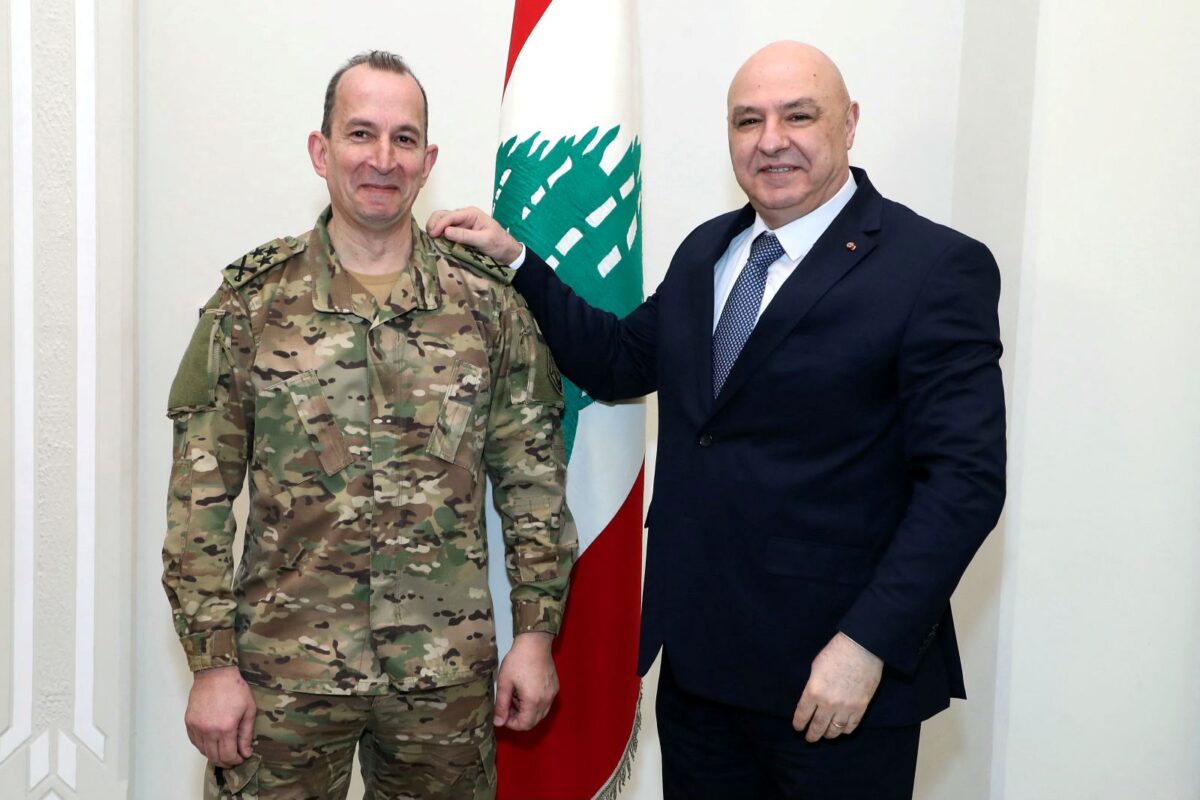
A handout photo provided by the Lebanese presidency on March 13, 2025 shows Lebanese President Joseph Aoun (R) congratulating the newly appointed Army Commander in Chief Rodolphe Haykal, at the presidential palace of Baabda, east of Beirut. (Photo by Lebanese Presidency / AFP) /
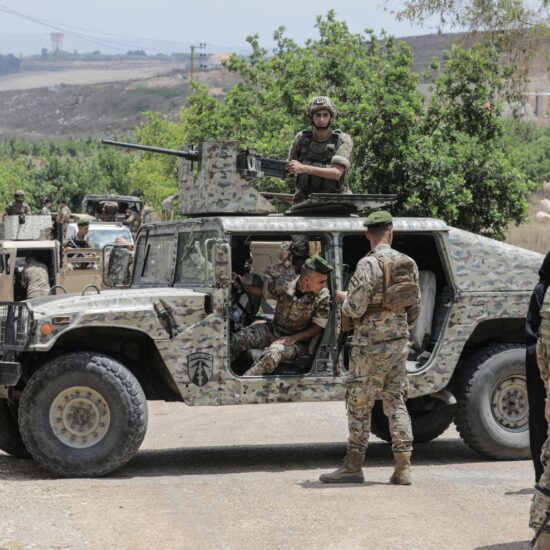
General Rodolph Haykal speaks to the Lebanese in the language of the 1990s, when Syrian tutelage turned questioning authority into grounds for suspicion and reduced patriotism to obedience. At a recent meeting at army headquarters in Yarzeh, he declared that those who criticize the military without understanding its work and seek to tarnish its image are acting in a manner “incompatible with national loyalty.” In doing so, he put criticism on trial and appointed himself the arbiter of who belongs to Lebanon.
The army commander is a public servant, paid from a treasury funded by Lebanese citizens, including those who criticize him. It is disgraceful for a public servant to treat citizens as troops under his command. His rank gives him no authority over their opinions, and their objections are not acts of insubordination. He is entitled to answer criticism with facts. He is also obliged to account for his performance. No citizen needs to graduate from staff college to ask why Hezbollah’s arsenal remains beyond the authority of the state.
Even soldiers do not surrender their rights or dignity by putting on a uniform. They are entitled to seek redress through lawful channels when the leadership fails them or undermines their standing as defenders of the country. Civilians, meanwhile, are not subject to military discipline in the first place. Lebanon’s constitutional preamble places freedom of opinion at the heart of the republic, and Article 13 guarantees freedom of expression within the limits of the law. The commander is bound by those guarantees, whatever his rank.
This is the Aounist mentality that Michel Aoun entrenched in his approach to the state and the army, reducing the institution to the person of its commander. Within this logic, questioning the commander becomes an insult to the army, and disagreeing with him an attack on the nation.
This is the Aounist mentality that Michel Aoun entrenched in his approach to the state and the army, reducing the institution to the person of its commander. Within this logic, questioning the commander becomes an insult to the army, and disagreeing with him an attack on the nation. Haykal revives that legacy when he casts doubt on his critics’ patriotism and effectively demands that they prove it through silence.
His recital of achievements recalls a student who has not finished his homework but keeps insisting that he has, then resents the teacher who asks to see it. Repetition does not earn a passing grade. Rehabilitating Qlayaat airport is worthwhile, but it does not resolve the question of Hezbollah’s weapons. Soldiers’ sacrifices deserve a leadership that is honest about its performance. Those sacrifices must never become a shield behind which senior officers evade accountability.
In January 2026, the army command announced that it had achieved the objectives of the first phase of its disarmament plan south of the Litani River. It described operational control over the areas under its authority, excluding positions still under Israeli occupation, while acknowledging that work on tunnels and unexploded ordnance continued. Haykal presented his report to the cabinet, which asked the army to prepare for the next phase.
In January 2026, the army command announced that it had achieved the objectives of the first phase of its disarmament plan south of the Litani River. It described operational control over the areas under its authority, excluding positions still under Israeli occupation, while acknowledging that work on tunnels and unexploded ordnance continued. Haykal presented his report to the cabinet, which asked the army to prepare for the next phase.
Hezbollah then returned to war. Reuters subsequently reported on its battles in Bint Jbeil and its efforts to rebuild its military capabilities with Iranian funding. The army’s assurances did not survive the test of events. The Lebanese are entitled to ask: Were the weapons never removed, or did they return? What does operational control mean if Hezbollah can once again seize the military initiative?
Nor did Israel’s renewed occupation materialize out of thin air. Hassan Nasrallah chose to open his “support front” on October 8, 2023. Hezbollah attacked Israeli positions, setting off an exchange that eventually escalated into full-scale war and invasion. Hezbollah returned to battle in March 2026 in support of Iran. Condemning the occupation does not absolve those who dragged Lebanon into these wars and denied its people the right to stay out of them.
Israel now explicitly makes its withdrawal conditional on Hezbollah’s disarmament. Waiting for that withdrawal while preserving the arsenal, even if it is rebranded as merely symbolic, is selling the Lebanese an illusion.
Israel now explicitly makes its withdrawal conditional on Hezbollah’s disarmament. Waiting for that withdrawal while preserving the arsenal, even if it is rebranded as merely symbolic, is selling the Lebanese an illusion. The weapons supply Israel with a continuing pretext for remaining in southern Lebanon. Blaming Israel alone for Lebanon’s lack of sovereignty while protecting the party that usurps it from within is a political farce that absolves Hezbollah of the consequences of its choices.
Even Haykal’s description of the UN Interim Force in Lebanon, UNIFIL, as a “living record” of the conflict exposes the limits of his vision of the state. Lebanon needs institutions capable of preventing the next catastrophe. Keeping witnesses to the last one is no substitute for exercising sovereignty.
Yet reducing this problem to Haykal alone grants President Joseph Aoun an acquittal he has not earned. Aoun is commander-in-chief of the armed forces, which Article 49 of the constitution places under the authority of the Council of Ministers
Yet reducing this problem to Haykal alone grants President Joseph Aoun an acquittal he has not earned. Aoun is commander-in-chief of the armed forces, which Article 49 of the constitution places under the authority of the Council of Ministers. Political responsibility begins at the presidential palace in Baabda and extends to the cabinet. When an army commander starts defining the limits of permissible national debate, the president must enforce the limits of the commander’s authority and take responsibility for the policies he implements.
Aoun has repeatedly framed the handling of Hezbollah’s weapons around the need to avoid civil war. Protecting Lebanese lives is a duty. Turning fear of confrontation into an open-ended excuse for delay, however, gives an armed organization a veto over the state. What is required is a plan carried out responsibly, with measurable stages and identifiable officials who can be held to account. To proclaim the state’s monopoly on force while treating its enforcement as a threat to stability is to turn the constitution into a promise that can be honored only with Hezbollah’s permission.
The cabinet has already banned Hezbollah’s military and security activities and ordered the party to surrender its weapons. Why, then, are citizens expected to applaud while implementation remains an open question? The military leadership’s job is to carry out the decisions of the constitutional authorities and provide a clear account of what it has done.
An officer swears to fulfill his duty and defend Lebanon. That oath requires him to protect the state, its constitutional order and the rights of its citizens against threats from abroad and from within. Hezbollah, by tying its weapons, funding and wars to Iran, performs an Iranian military role on Lebanese soil. Its members’ Lebanese citizenship does not confer national legitimacy on that regional project or oblige the army to accommodate it at the state’s expense.
Aoun and the cabinet must hold the military leadership accountable. Haykal must answer the questions. Our right to speak takes precedence over any claim to guardianship. We will not accept a shabby Orwellian version of Lebanon where obedience is called patriotism and asking a question becomes treason
Aoun and the cabinet must hold the military leadership accountable. Haykal must answer the questions. Our right to speak takes precedence over any claim to guardianship. We will not accept a shabby Orwellian version of Lebanon where obedience is called patriotism and asking a question becomes treason. The Lebanese are not waiting for certificates of belonging from Yarzeh. They expect a state that protects them from occupation and the rule of militias, and they will hold accountable everyone paid to serve them.
This article was originally published in Elaph.
Makram Rabah is the managing editor at Now Lebanon and an Assistant Professor at the American University of Beirut, Department of History. His book Conflict on Mount Lebanon: The Druze, the Maronites and Collective Memory (Edinburgh University Press) covers collective identities and the Lebanese Civil War. He tweets at @makramrabah