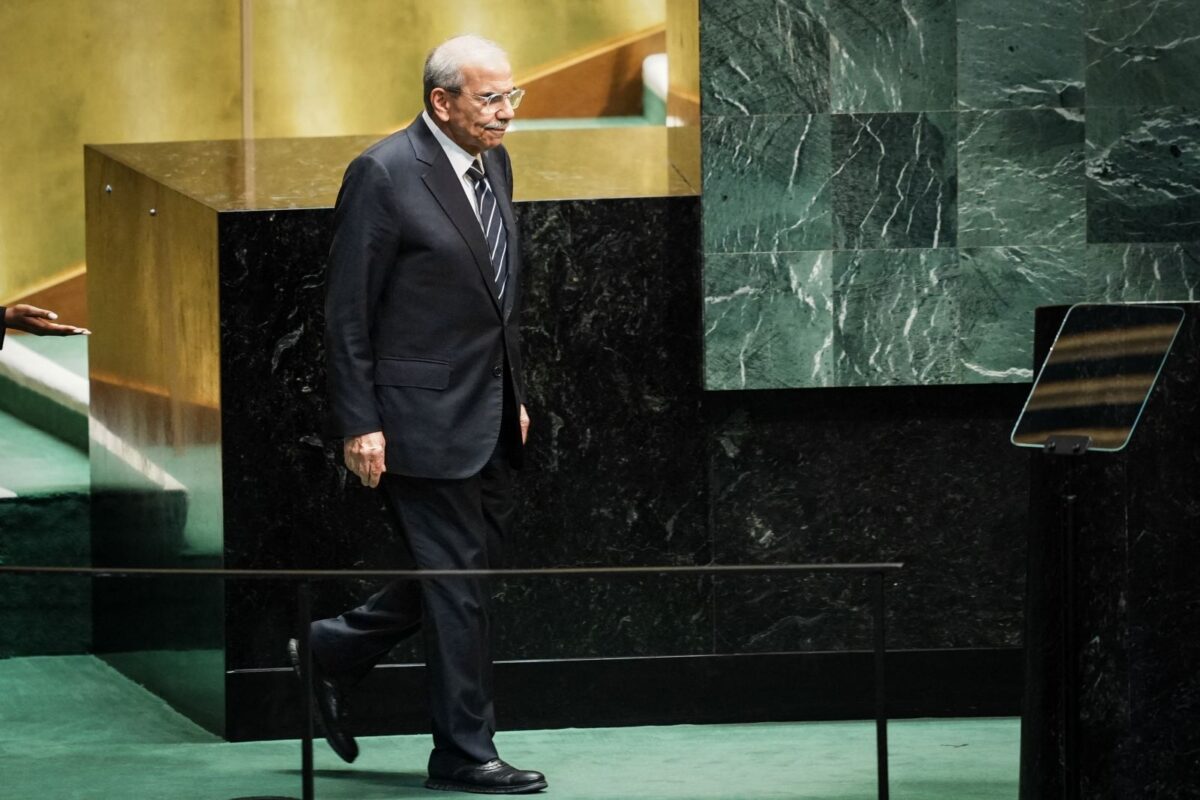
NEW YORK, NEW YORK - SEPTEMBER 25: President of the Council of Ministers of Lebanon, Nawaf Salam takes the stage during the 81st session of the United Nations (U.N.) Ryan Murphy/Getty Images/AFP (Photo by RYAN MURPHY / GETTY IMAGES NORTH AMERICA / Getty Images via AFP)
Lately, criticism is everywhere. The government reappointed Bassam Badran as president of the Lebanese University for another five years, following a compromise among the three President of the Republic the Premier and the Speaker, even though the Constitutional Council had already overturned the earlier decision to extend his term. The electricity crisis is being handled the way it has always been, with statements and promises. The new budget looks like every budget before it, an accounting exercise with the mirage of a balanced budget and no clear idea of where the economy should go.
It always feels as if this government is receiving more criticism than its predecessors. One should ask whether this is fair.
It always feels as if this government is receiving more criticism than its predecessors. One should ask whether this is fair.
Lebanon’s problems are deep, difficult, and entrenched. No one can claim to have a magic solution. Yet, to be fair to the prime minister and his cabinet, the disappointment is understandable and has a specific origin. When Nawaf Salam was named prime minister in January 2025, no one could think of a better choice. An academic, an intellectual, a jurist, Lebanon’s ambassador to the United Nations, and the president of the International Court of Justice. Can we dream of better? That was the mood. This was the best the Lebanese could hope for from their political system.
So the criticism today is not really directed at the man. It is about expectations. When you get the best possible candidate, you expect the best possible results, and the gap between the two becomes the story.
So the criticism today is not really directed at the man. It is about expectations. When you get the best possible candidate, you expect the best possible results, and the gap between the two becomes the story.
The prime minister’s supporters and the political parties defending their ministers typically offer two arguments. Both merit serious discussion.
The first point is that Lebanon needs investment, and no one should expect free money or an international rescue unless there is a genuine process to assert sovereignty and disarm Hezbollah. This is understandable, and no one could or should oppose it. But it raises two questions.
The first question is what the government is actually doing to advance this sovereign process, in tangible terms rather than through statements and decisions that are not being implemented. Government decisions on the state’s monopoly over arms make good headlines. The question is what happens on the ground the day after. Judged from this lens, the government looks more like talking the talk but not walking the walk. The decisions exist on paper. Implementation is left to time, donor support conferences, regional negotiations, and the hope that the problem will somehow solve itself.
The second question is harder. Assume the arms file is being addressed efficiently. Who really believes that investment will come without a banking sector? Without a legal system that enforces contracts, protects investors, and executes court rulings? Without a judiciary that can settle a commercial dispute before the investor retires? Investors do not put money into a country whose economy runs on digital wallets and exchange dealers. Disarmament may be a necessary condition for investment. It is far from sufficient. Bank restructuring, enforcing decisions, and legislation matter as much as Hezbollah’s weapons in attracting investment.
The second argument is more personal. The prime minister, his supporters say, is clean, honest, and a man of integrity, yet he is unable to push back against the deep state and entrenched sectarian and clientelist interests.
Those who admire Nawaf Salam and support his premiership should reconsider this defense because it evokes memories of the late Salim El Hoss and invites comparison with his government experience.
Those who admire Nawaf Salam and support his premiership should reconsider this defense because it evokes memories of the late Salim El Hoss and invites comparison with his government experience.
Salim El Hoss was honest. He was a man of integrity with an outstanding professional and academic career. He became prime minister for the first time in December 1976, after Elias Sarkis was elected president. Both came from financial institutions: Sarkis had been governor of Banque du Liban, and El Hoss had chaired the Banking Control Commission. They brought experience in managing institutions to a country torn apart by war. El Hoss tried to rebuild the state while navigating the civil war’s competing demands and divisions. His efforts failed, his disagreements with President Sarkis deepened, and he ultimately resigned in 1980. He could neither govern effectively as a technocrat nor build the popular support needed to assert himself as a political leader.
When El Hoss returned as prime minister in December 1998, after Emile Lahoud was elected president, hopes were high again. He was remembered instead as weak, uninspiring, and unable to push back against sectarian and clientelist interests, Syrian influence, and the meddling of intelligence agencies.
In the 2000 parliamentary elections, he campaigned as Lebanon’s conscience, “Damir Loubnan.” His opponents had an easy answer. They called it “damir nayem,” a sleeping conscience. He ultimately lost his parliamentary seat, a remarkable result for an incumbent prime minister against Ghenwa Jaloul, a first-time candidate.
Unfortunately, Lebanese politics does not reward politicians for integrity, honesty, or intellectual depth
The lesson of El Hoss is not that honesty is unimportant or a negative trait. It is that honesty is a personal quality, not a governing strategy. Unfortunately, Lebanese politics does not reward politicians for integrity, honesty, or intellectual depth. Politicians are more often judged by their effectiveness. The clientelist system does not fear a clean man. It knows how to wait for him, surround him, and outlast him. What it fears is a prime minister who uses the institutions to change the rules, picks his battles, names the obstacles, and is ready to pay a political price to win.
Saying “he is a good man, but they will not let him” is not an argument for the government
Projecting honesty and integrity is necessary but not sufficient. For every loyal supporter of the prime minister, this defense is simply wrong. Saying “he is a good man, but they will not let him” is not an argument for the government. It asks the public to sympathize with the prime minister rather than to assess his government’s performance.
The better defense, if there is one, would be a list of actions taken. A budget that breaks with the old logic, even modestly. An appointment made on merit rather than through a deal among the three presidencies. An electricity plan with clear figures and deadlines. The government should be judged by what it achieves, not by the prime minister’s personal qualities alone.
After all, the Arabs have an old saying for this. If you are a good man, I will give you my sister in marriage. That does not mean I will support you as prime minister.
Khalil Gebara is an academic and researcher.
The views in this story reflect those of the author alone and do not necessarily reflect the beliefs of NOW.