
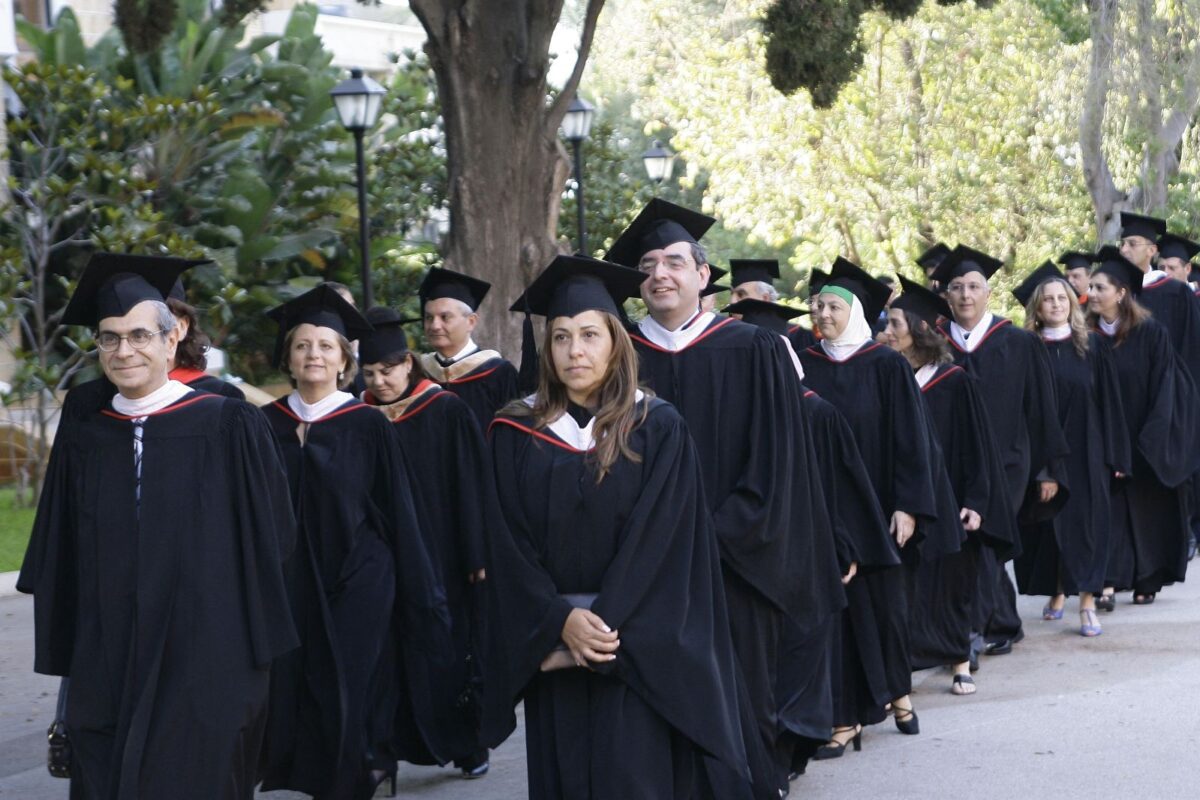
Lebanese American University of Beirut (AUB) alumni attend a special commencement ceremony for members of the classes of 1975 and 1985 who had missed out on their graduation ceremony due to the 1975-1990 Lebanese Civil War at the university's campus in Beirut on July 2, 2010. AFP PHOTO/ANWAR AMRO (Photo by ANWAR AMRO / AFP)
From mid-June through July, graduation season takes over. High school students close one chapter and prepare for the next, while university students reach a milestone they have spent years working toward.
I have been through four of these moments myself: high school, undergraduate, a master’s, and a PhD. Four times standing in a queue, waiting for my name to be called; twice with my name pronounced incorrectly. A couple of times in a robe that never quite fit. I have always thought these moments belong to different people at each stage: high school graduation is really for the parents, undergraduate is shared, and by the time you reach a postgraduate degree, the ceremony belongs almost entirely to the student. But none of my four came close to my bachelor’s graduation. The American University of Beirut, on its iconic Green Field, with its mix of humidity and the Mediterranean breeze, remains unmatched for me. There was something about that evening, that place, and that stage of life that no other ceremony could recreate.
For almost twenty years, I taught courses in economics and political economy. Along the way, I found myself giving educational and career advice countless times.
For students drawn to international affairs, my recommendation was usually clear: political science, public policy, or public administration. A solid academic foundation in these fields seemed the right path to a job at an international organization, a development agency, or a local NGO. After all, we were living in the era of NGO-ization.
In Lebanon, for example, the stalled political system, the state’s failure to provide basic services, successive rounds of war and crisis, and the Syrian refugee crisis after 2011 made NGO-ization visible in concentrated form. For Lebanese graduates with the right bachelor’s degrees, the appeal was straightforward: salaries in US dollars, some protection against the depreciation of the Lebanese pound, decent medical insurance, and, for the lucky ones who made it into the international organizations proper, a pension that actually meant something.
For students with strong quantitative skills, I often gave the same advice: economics, mathematics, or financial engineering. For a long time, combining rigorous quantitative training with economics or finance was a near-guaranteed path into investment banking. Engineering graduates were often advised to pursue management consulting, a sector that has recruited heavily from Lebanese universities for years. These were not wild guesses. They were based on decades of patterns, incentives, and institutional consistency.
Then two things happened, more or less simultaneously:
The first was the sharp contraction of the development assistance sector. The dismantling of USAID, the bankruptcy or downsizing of its contractors, and budget cuts across UN agencies and other international organizations drastically reduced demand for fresh graduates. Hundreds of thousands of jobs were reportedly affected worldwide. For a generation of graduates who had been steered, by people like me, toward development careers as a stable professional path, this was not a temporary correction. It felt like a demolition.
The second was artificial intelligence, and this one is harder to read. The big debate today is no longer only about whether AI will raise productivity, but about what it will do to the demand for jobs, especially entry-level ones.
The old equation was simple: a degree from a reputable university, a high GPA, and a few internships increased the likelihood of landing an entry-level position. Over time, a junior position could lead to a senior role. That ladder made the system predictable. You could advise someone on it. You could point to the first step and say: “Start here.”
The question now is whether AI is eliminating those first few steps entirely.
Employers are starting to ask why they should hire a junior analyst to build a financial model when an AI tool can do much of the work faster, cheaper, and without the management overhead. Law firms are realizing that the document review, legal research, and first-draft work that used to train junior associates can increasingly be automated. Consulting firms are discovering that slide-building, benchmarking, and the initial structuring of a client deliverable can also be done with far fewer junior hours.
Goldman Sachs Research recently estimated that AI has reduced monthly payroll growth in the United States by roughly 16,000 jobs over the past year, with the pressure falling disproportionately on younger and less-experienced workers. That distinction matters. AI is not only changing how work is done. It is also changing where first professional experience is supposed to come from.
This creates a structural problem that extends beyond any individual career decision. Without junior years, you cannot develop into a senior. There is no shortcut to experience, no matter how capable you are when you graduate.
The knowledge gained from being the most junior person in a room, watching others, absorbing judgment, learning how decisions are made, and failing at small things before being trusted with bigger ones cannot be acquired any other way.
If AI eliminates those positions, it does not just eliminate jobs. It disrupts the entire system by which competence is built, tested, and recognized over time.
I find myself genuinely uncertain about what to tell a student or a recent graduate today. The development sector advice is, for now, in ruins. The quantitative-skills-into-finance advice may hold longer, but the junior pipeline is narrowing fast. The famous claim that “85 percent of the jobs of 2030 have not yet been invented” has been widely challenged. The more honest answer, uncomfortable as it is, is that nobody really knows what is coming.
As an economist, I believe in adaptation. This is not optimism, certainly not the entrenched, built-in Lebanese optimism. It is pattern recognition. People adapt. Economies adapt. Political systems adapt, eventually. In some sense, history is the record of how societies absorb shocks they did not see coming: disasters, wars, famines, revolutions, and technological upheavals. The Industrial Revolution displaced agricultural and skilled manual workers. The internet era eliminated entire categories of clerical and administrative work. Over time, both created new sectors, new firms, and new forms of employment.
But the phrase “over time” is doing a lot of work in that sentence. The productivity gains from AI may well be real. What will also be real is the human cost of waiting for those gains to materialize. Adaptation is an economic process, but unemployment is a human experience. It does not capture the anxiety of structural unemployment, the widening inequality, or the wage stagnation that can affect an entire generation before the next one begins to benefit.
The movie The Full Monty captures the human side of this story. Set in Sheffield after the steel industry’s decline during the de-industrialization policy of Margaret Thatcher’s government, it follows former steelworkers left with few obvious options for what to do next with their lives. It is remembered as a comedy, but underneath it is a story about men whose skills, identities, and sense of usefulness were suddenly devalued.
Will AI produce its own Full Monty moment? Will there be enough entry-level jobs left for new graduates? Maybe it is too early to say. But the direction of the risk is clear: the costs of this transition will not be borne equally. They are likely to fall disproportionately on the young, the newly graduated, and those entering the labor market for the first time.
Without deliberate policy intervention, adequate social protection, robust skills development, and meaningful curriculum reform, the AI backlash may be worse than many expect.
Today, I find myself hesitating before offering career or educational advice. Perhaps that hesitation is its own coping mechanism. For two decades, I offered calibrated, sector-specific, reasonably confident advice. Now, I have something very different: a set of open questions and no honest way to pretend they already have answers.
The old promise was simple: study hard, choose wisely, start at the bottom, and climb. It was never perfectly true, but it was true enough to guide a generation.
I am no longer sure it is true, and I am not sure there will be enough jobs at coffee shops and fast-food chains to absorb the unemployed new graduates.
Khalil Gebara is an academic and researcher.
The views in this story reflect those of the author alone and do not necessarily reflect the beliefs of NOW.