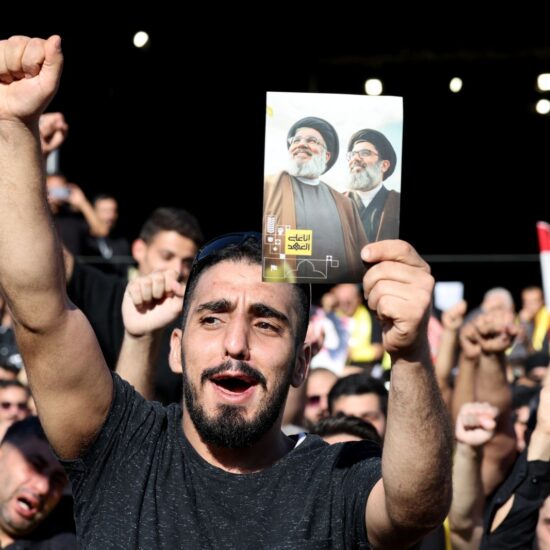
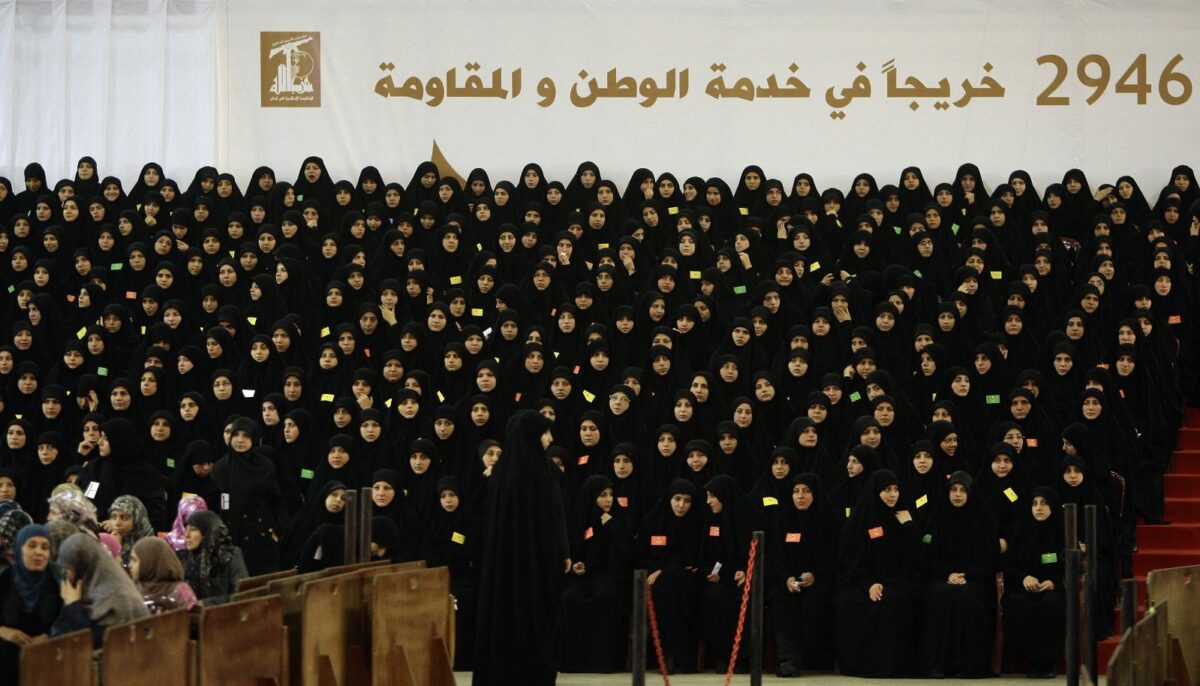
Lebanese university graduates listen to the speech of Hezbollah chief Hassan Nasrallah during a ceremony organised by the Lebanese Shiite movement to celebrate their graduation in Beirut's southern on November 28, 2010. Sign in the background reads in Arabic, "graduates in the service of the nation and resistance movement". AFP PHOTO/ANWAR AMRO (Photo by ANWAR AMRO / AFP)
For years, critics have warned that Hezbollah’s influence extends far beyond military structures, reaching into classrooms, scout groups and the socialization of children. Amid the current war, those concerns have resurfaced, as videos and local reporting fuel debate over whether youth are being drawn ever closer to the logic of war, martyrdom and extremism.
The recent circulating videos have brought attention back to organizations such as Al-Mahdi Scouts and Hezbollah-linked schools, with concerns extending beyond wartime mobilization to what some analysts describe as a decades-long system of ideological formation.
Analysts say the broader question extends beyond the battlefield itself. It concerns the long-term cultivation of identity, discipline, and loyalty through institutions designed to shape future generations
A project decades in the making
For Lebanese academic Dr. Ali Khalife, author of the forthcoming book Children of Hezbollah, the issue goes far beyond isolated allegations of youth involvement in conflict.
“This did not begin with the current war,” Khalife told NOW. “This began forty years ago. What has been built through schools and scout structures is more dangerous than weapons in children’s hands because it is a weapon planted in their minds.”
Khalife points to what he says is both testimonial and institutional evidence. “I interviewed former members who left the Mahdi Scouts,” he said. “There are combat courses, weapons training at very young ages. There are living testimonies.”
Schools, scouts and ideological formation
According to Khalife, the concern does not rest solely on scout activities but also on what he describes as ideological indoctrination embedded in educational curricula. He cites networks of Al-Mustafa Schools and Al-Mahdi Schools, which he says combine education with a broader political doctrine.
“The curriculum is not simply religious,” he said. “It promotes sectarian identity, militarized values and allegiance to Wilayat al-Faqih.”
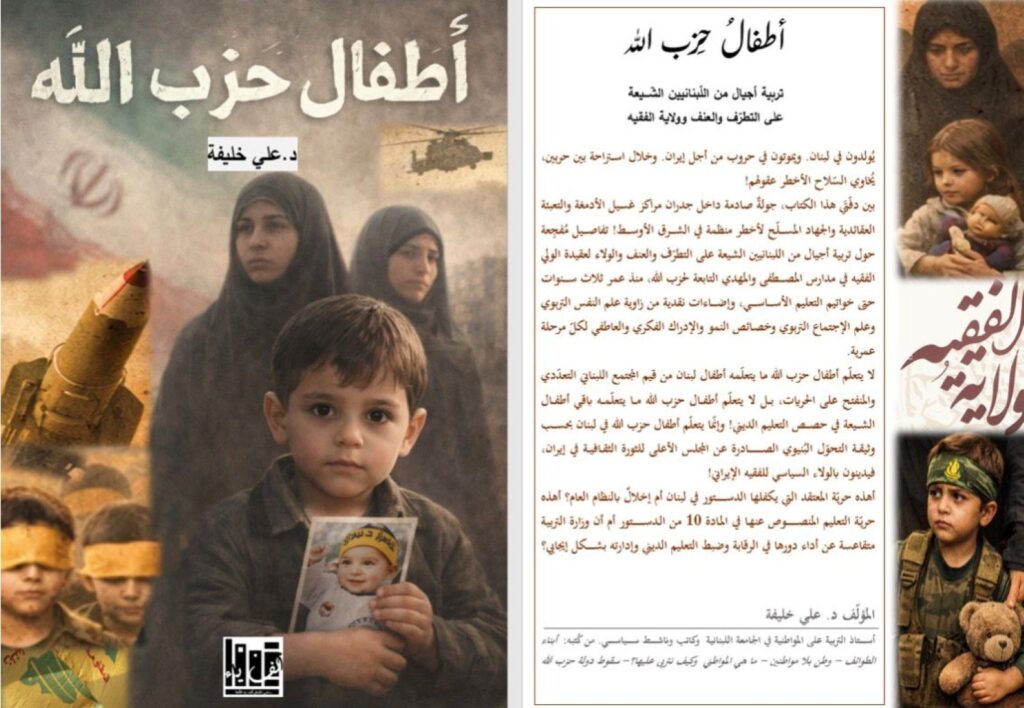
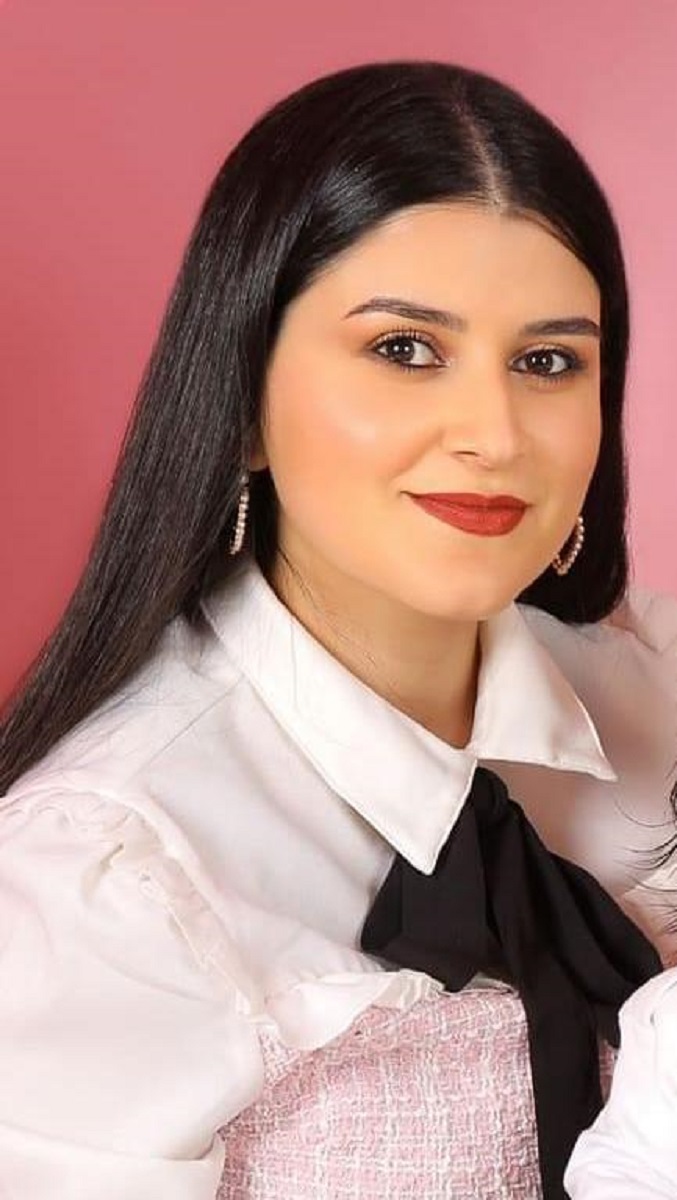
Children of Hezbollah, by Dr. Ali Khalife
For Khalife, that ideological dimension is central. “They are not merely educating children,” he said. “They are producing an identity.”
He argues the project is not temporary mobilization shaped by war, but a generational strategy. “What was planted over four decades does not disappear quickly,” he said. “You are dealing with entire generations raised within this doctrine.”
Khalife goes further, describing the process as incompatible with Lebanon’s civic framework. Referring to Articles 9 and 10 of the Lebanese constitution, he argues that ideological education tied to external political-religious authority crosses from protected belief into political socialization that challenges national sovereignty.
“The problem,” he said, “is when a child’s political loyalty is cultivated toward the Iranian faqih rather than Lebanon.”
According to his research, Hezbollah operates 22 schools in Lebanon, serving more than 47,000 students. Their significance, he argues, lies not only in numbers but in function.
“These are not ordinary religious schools,” he said. “Even compared to other private Shiite schools in Lebanon, they are different.”
That distinction, Khalife argues, also applies to the role of the Mahdi Scouts.
“The combat training in the scouts exists because they want soldiers for Wilayat al-Faqih,” he said. “The project is not confined by Lebanon’s borders.”
He points to the doctrine’s transnational dimension, citing its application in Syria and drawing parallels to the Basij in Iran.
Khalife also links the issue to broader tensions over identity in Lebanon. “There is a conflict between Lebanese civic identity and an ideological identity being cultivated through these structures,” he said.
For him, accountability remains possible but absent.
“The Ministry of Education should be exercising oversight. The Educational Center should regulate religious education,” he argued. “That is not happening.”
“The most dangerous weapon”
Still, Khalife insists the deeper danger is not armed training alone.
“The weapon in a child’s hand is less dangerous than the weapon in a child’s mind,” he said. “A rifle can be confiscated. An ideology planted in generations is much harder to disarm.”
That warning lies at the heart of his forthcoming book, Children of Hezbollah, which examines what children between the ages of three and eighteen are taught through these institutions.
For Khalife, the issue is ultimately not only about recruitment, nor even war.
“It is about generations being raised for a project that has little to do with Lebanon,” he said.
Critics say the issue goes beyond politicizing children; it is about whether future generations will be shaped by loyalty to the Lebanese state or to the ideology of Wilayat al-Faqih.