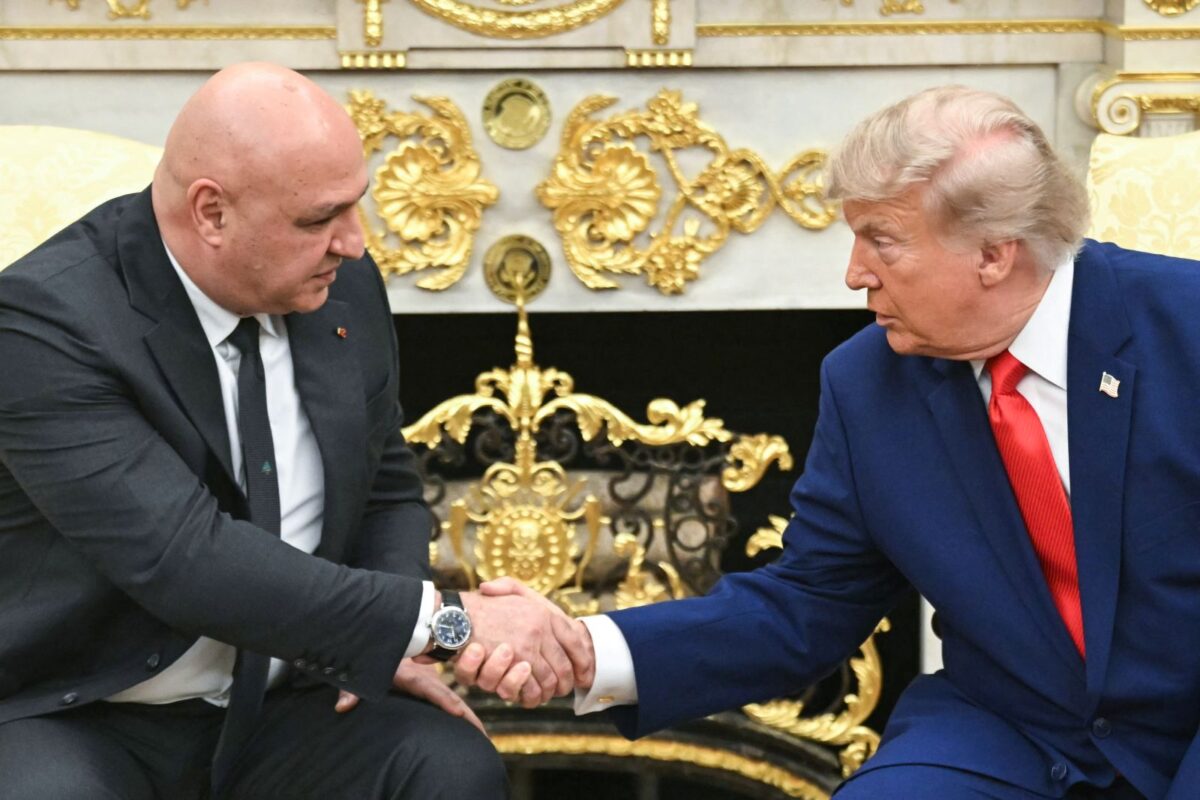
US President Donald Trump shakes hands with Lebanese President Joseph Aoun in the Oval Office of the White House in Washington, DC, on July 21, 2026. (Photo by SAUL LOEB / AFP)
Lebanon had a good week, at least in the pictures. President Joseph Aoun met the American president in Washington on July 21. The dinner at the embassy drew a guest list that would have been unimaginable two years ago. And The Economist, in its July 25 edition, gave Lebanon two slots in its weekly edition. Attention is not an achievement. But for a country like ours, it is not nothing either. It means that other people, for their own reasons, believe something is at stake here.
What the week made clear was that Lebanon’s political track has a clear shape and priorities: the state’s promise to enforce a monopoly on the use of arms, a negotiated Israeli withdrawal from southern villages, the strengthening of the army’s deployment in the south, and sovereignty as the connecting principle. The objectives are clear, and sequencing is under discussion. The opposition is equally clear, with its own supporters, arguments, and threatening points. You may support this track or reject it. Either way, you know what it is.
Politics and economics are two sides of the same coin. Unfortunately, the same clarity is missing on the economic side.
Politics and economics are two sides of the same coin. Unfortunately, the same clarity is missing on the economic side. There, we have a repetitive vocabulary: reform, recovery, growth, confidence, and the IMF program. We have a queue of draft laws and endless plans. What we do not have is an answer to the question that precedes all of them. What is this economy supposed to be?
The model we are trying to restart
After independence, Lebanon’s elite pursued a liberal, service-oriented economic model, often called the Merchant Republic, which prioritized finance, trade, and tourism over productive sectors. It cast Lebanon as an intermediary for capital, goods, and services between European markets and the oil-rich Arab states. Beirut became known as the bank of the Arab world, with an expanding financial sector and a flourishing tourism industry that underpinned a service economy.
A defining feature of this framework was a strong, stable Lebanese Lira, which benefited merchants and service exporters but marginalized industrial and agricultural producers. The 1956 Bank Secrecy Law facilitated significant capital inflows, particularly from the diaspora and the Gulf, and by 1971 deposits had exceeded GDP. The ideological foundation rested on fiscal minimalism, with Michel Chiha warning against the “fiscal disease of the West” and the “obsession with taxation.” This limited the state’s redistributive role and contributed to structural imbalances.
The model sustained growth without adequately addressing social equity. By the early 1970s, Lebanon faced not a crisis of stagnation but one of deep-seated inequality and spatial exclusion, what Salim Nasr called the crisis of Lebanese capitalism, which reflected the limits of a growth strategy detached from inclusive development.
The post-civil war model was an attempt to resurrect the old one by relying on borrowing. But this introduced a major distortion.
The post-civil war model was an attempt to resurrect the old one by relying on borrowing. But this introduced a major distortion. The fiscal size of the state expanded enormously, especially through indirect subsidies and public sector employment, and that expansion reflected the power-sharing system itself. The old model had a small state that did not redistribute. The new one had a large state that redistributed through confessional patronage and borrowed to do so.
We entered the 2019 crisis with one of the world’s highest debt-service burdens. Interest payments consumed nearly 50% of total revenues and roughly 10 to 12% of GDP each year. That lack of fiscal space left the government unable to invest in infrastructure or human capital, and reform attempts failed to gain traction amid political fragmentation, public distrust, and entrenched elite interests. When capital inflows dried up, the fiscal crisis merged with a balance-of-payments and banking crisis, leading to Lebanon’s default.
None of this is disputed. It is documented in World Bank and IMF reports and in a shelf of academic and policy analyses and research. We have an unusually well-researched death certificate. What we still lack is an official burial ceremony.
Lebanon the Entrepot
Asked by The Economist to sketch the future, the Minister of Economy looked to the past. Lebanon was once the region’s premier entrepot, a hub for banking, tourism, and trade, and perhaps it can be again. Lebanese ports might support Syrian reconstruction. Gulf states might lay pipelines and fiber-optic cables that bypass Hormuz. On what we do well: “There are certain services that we excel at… things like high-level tourism, high-level design, construction services, consultancies.”
Read against what was stated above, it is the Merchant Republic, restated in 2026 without amendment. Intermediation, high-end services, a country that earns its living by connecting other people’s economies. This is not a proposal for what should replace the failed model. It is a description of the failed model, offered as its own replacement.
But can an entrepot function without credit when lending is now minimal? Can Lebanon become a logistics hub without reliable ports, electricity, and adequate bandwidth? Can it attract foreign investment while investors continue to find red tape and an inefficient legal system? And can banking restart while the banking crisis itself remains unresolved?
I do not know whether what was mentioned in The Economist piece reflects conviction or a lack of ideas. Both are possible, but the latter worries me more. A minister who genuinely believes in the entrepot at least presents a position that can be challenged. A political elite that has never imagined an alternative offers no vision at all.
How a country actually creates a model
A country does not create a new economic model by hiring a management consulting firm to draft a strategy or by cherry-picking fashionable sectors, as the Ministry of Economy and Trade did in 2018 when it solicited McKinsey to draft an economic vision for Lebanon. It does so by changing how the economy produces, earns foreign currency, creates jobs, finances investment, and distributes gains. A model is not a document. It is a configuration of market forces, prices, institutions, and incentives that keeps reproducing itself, whether or not anyone approves of the result.
Countries that have genuinely transformed their economies tend to address questions about prices, fiscal and monetary policies, trade and investment, and the regulatory framework in a particular order.
Countries that have genuinely transformed their economies tend to address questions about prices, fiscal and monetary policies, trade and investment, and the regulatory framework in a particular order. Vietnam is the clearest example because it started from a worse position than ours. In 1986, it had inflation above 700%, export earnings that did not cover imports, extreme poverty, and a countryside that could not reliably feed the country.
Doi Moi, or renovation, was a framework that helped transition the country from a stagnant, poor, centrally planned system to a dynamic market economy. What matters is the sequence. It began with the decollectivization of agriculture and the alignment of output with market price mechanisms. Within a few years, Vietnam stopped importing rice and began exporting it. By 2005, it was the world’s second-largest rice exporter, at 5.2 million tons.
The local currency was devalued to align with market prices, and dual pricing was abolished. Trade barriers were dismantled, and reforms were introduced to create a regulatory framework highly conducive to foreign direct investment. Exports averaged less than $22 billion per year in the first half of the 2000s. They reached $371 billion in 2022 and $405 billion in 2024. The country sustained GDP growth averaging nearly 7% for decades and carried out one of the most successful poverty-reduction campaigns in modern history.
Waiting for the old model to return
The lesson from Vietnam is not that Lebanon’s only option is to replace Lebanese mezza restaurants by building electronic chip factories. It is that a country creates a new economic model by changing the rules and conditions under which economic activity takes place. Vietnam liberalized prices, the currency, trade, property rights, and investment regulations. New sectors developed as a result. These sectors were the outcome of the reforms, not the starting point.
Lebanon has done the opposite. It continues to assume that banking, tourism, trade, and services can regain their pre-civil-war competitiveness while avoiding the reforms that would make any recovery possible. It expects to reclaim its role as a regional financial and commercial center without resolving the banking crisis, restoring credit, modernizing infrastructure, reducing the cost of doing business, or rebuilding trust in the state’s institutions.
This is the problem with returning to the idea of Lebanon as an entrepot. It is not only an old model. It is an old model presented without the conditions that once allowed it to function. The country’s deepest economic challenge may therefore not be a lack of options, but a lack of serious thinking about what should replace the failed model. As John Maynard Keynes once observed, “The difficulty lies, not in the new ideas, but in escaping from the old ones.” Lebanon has turned the old model into a prophecy, focusing its attention and efforts on every sign that might confirm its return rather than on building something to replace it.
Khalil Gebara is an academic and researcher.
The views in this story reflect those of the author alone and do not necessarily reflect the beliefs of NOW.