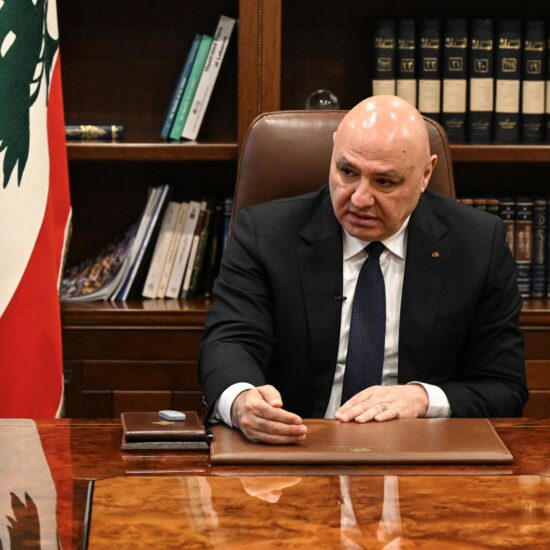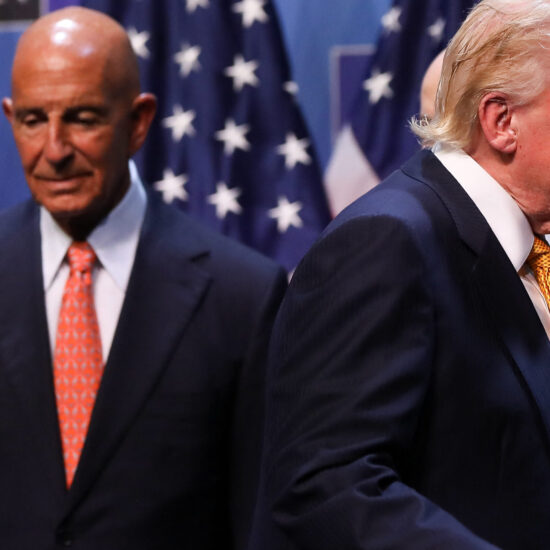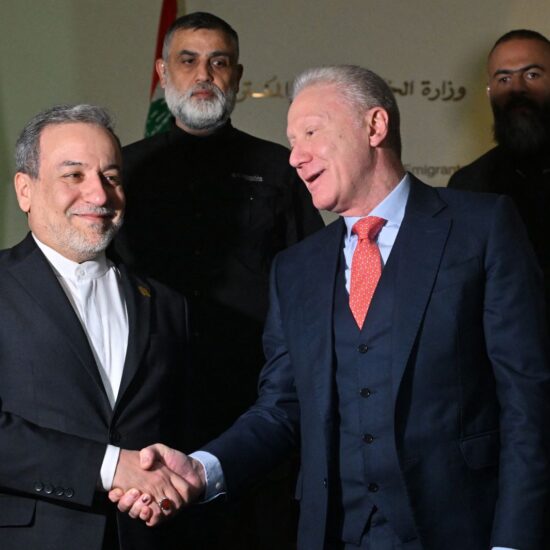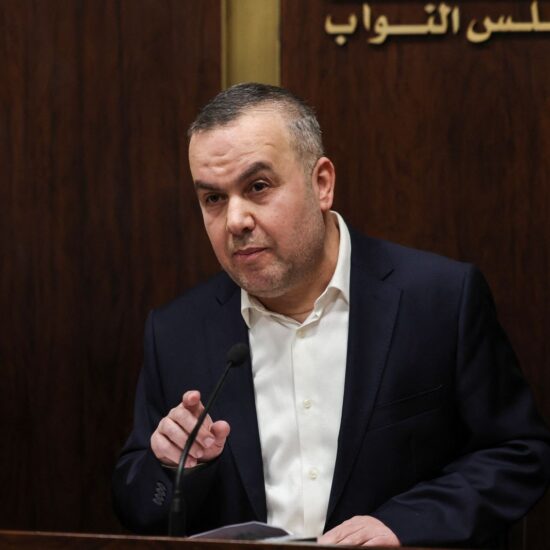
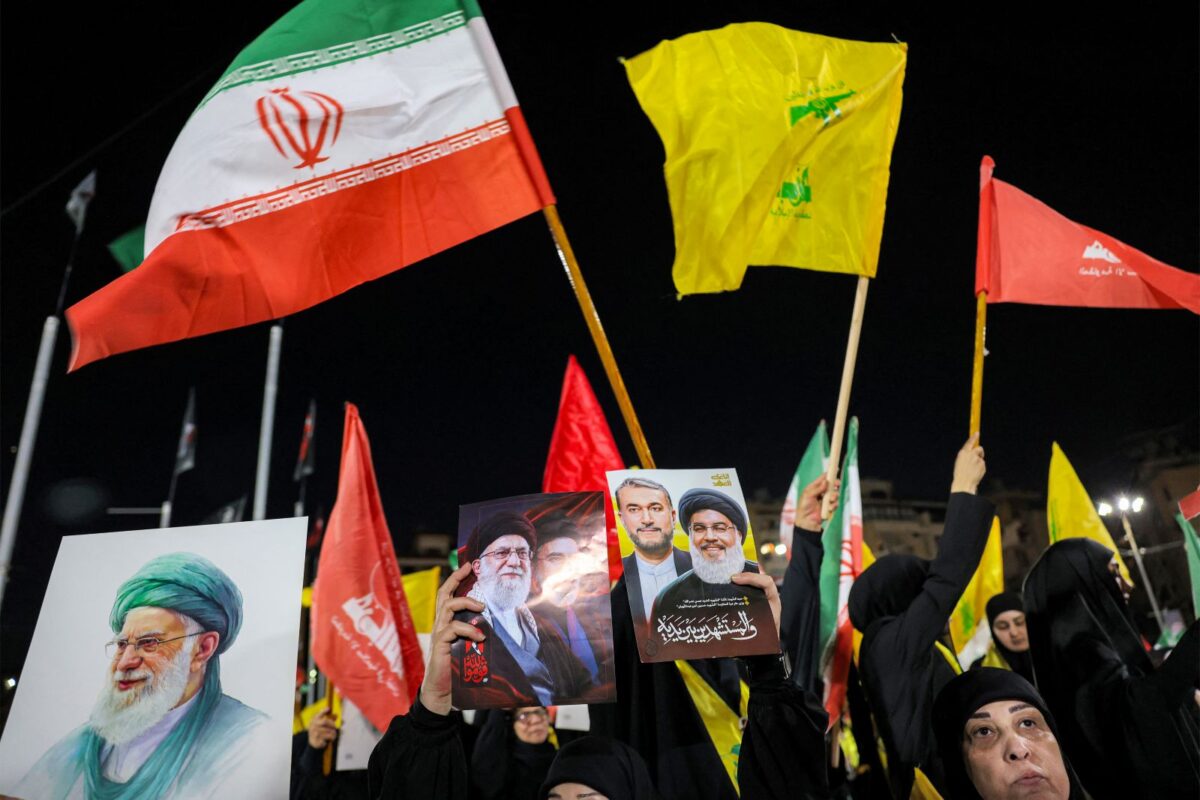
Photo by ANWAR AMRO / AFP. Supporters of Lebanese Shia movement Hezbollah attend a memorial ceremony mourning Iran's slain supreme leader Ali Khamenei in Beirut’s southern suburbs on July 8, 2026.
Washington produced two messages about Hezbollah this week. Read separately, each appeared straightforward. Read together, they exposed the unresolved contradiction at the heart of American policy toward Lebanon.
First, the United States redesignated Hezbollah for acting “in service to the Iranian regime under the command” of the Islamic Revolutionary Guard Corps’ Quds Force. Hezbollah was already designated as a terrorist organization. The importance of the new wording lies elsewhere: Washington is no longer describing Hezbollah simply as a Lebanese organization financed and supported by Iran. It is formally presenting it as an instrument operating under Iranian command.
Then came Tom Barrack. The American envoy said that Hezbollah and Iran were the two parties “missing” from negotiations over Lebanon and Israel. He also asked who would replace the financial support Iran provides to Shia communities in southern Lebanon. After the predictable controversy, he clarified that he was describing the difficulty of the problem, not proposing that Washington negotiate with Hezbollah.
Was this confusion inside the American administration? Perhaps. But the more important explanation is that the United States is speaking at two different levels. The designation reflects the clarity required by coercive policy. Sanctions need identifiable enemies, chains of command and financial networks. Diplomacy encounters something messier: an organization can be legally excluded and still remain materially present. It can be denied political legitimacy while retaining the capacity to obstruct any agreement negotiated without it.
Barrack’s quick retreat is therefore revealing. He was allowed to acknowledge Hezbollah’s relevance, but not to confer standing upon it. He could describe the organization as part of the problem. He could not publicly suggest that it might become part of the table.
Washington has decided what Hezbollah is. It has not yet resolved what Lebanon becomes without it.
Washington has decided what Hezbollah is. It has not yet resolved what Lebanon becomes without it. The redesignation signals that the American objective is moving beyond containing Hezbollah’s weapons. Washington is attempting to separate Hezbollah from Lebanese legitimacy itself. The organization is being recategorized: less a Lebanese resistance movement with an Iranian alliance, more a local branch of an Iranian military project. That distinction matters. It reframes disarmament from a domestic compromise over a Lebanese organization’s weapons into the termination of a foreign chain of command operating inside Lebanon.
Hezbollah understood the threat immediately. Its response was that it did not need an American “certificate” proving its Lebanese identity. This was not simply defiance. It was an attempt to preserve the psychological merger between the organization, the resistance narrative and the Shia community. If Hezbollah can convince its constituency that denying the organization’s Lebanese identity means denying theirs, pressure against the party becomes experienced as pressure against the community.
Barrack’s question exposed the vulnerability inside Washington’s strategy. Hezbollah’s power has never consisted only of missiles, tunnels and fighters. It also rests on salaries, hospitals, schools, compensation, reconstruction and the promise of protection when the state is absent. Iranian financing does more than purchase military capacity. It sustains a social relationship in which material dependence becomes political loyalty and political loyalty becomes identity. Acknowledging this does not vindicate Hezbollah. It explains its endurance.
The emerging American plan can already be inferred: sever Iranian financing, close Hezbollah’s regional cash networks, increase military pressure, transfer territorial control to the Lebanese Army and attract Gulf financing to rebuild the South. On paper, the sequence is coherent. In Lebanon, its missing component is enormous.
Who governs the interval between Hezbollah’s retreat and the state’s arrival? Who assists families before promised investments materialize? Who reconstructs villages while Lebanon’s economy is expected to contract sharply this year? Who persuades a frightened community that losing Hezbollah’s institutions means gaining a state rather than losing its last protection?
If Iranian money disappears while the South remains occupied, damaged and poor, Hezbollah may lose organizational capacity while preserving its strongest political narrative: that its community is being punished collectively. Financial pressure without a Lebanese replacement could transform material deprivation into siege psychology. A weaker Hezbollah could then retain, or eventually regenerate, the loyalty that allowed it to become powerful.
The United States may also be preparing to treat Iran as the principal and Hezbollah as its agent. Under that logic, Tehran becomes the party with which strategic questions are settled, while Hezbollah is denied formal recognition. Barrack may have inadvertently disclosed the problem: Iran can negotiate over financing and weapons, but the consequences will be lived by Lebanese citizens who were never present at the table.
Lebanon cannot answer this by celebrating the designation as an American victory over Hezbollah. Its responsibility is harder. The state must separate the future of Lebanese Shia from the survival of Hezbollah’s autonomous structure. That requires security, reconstruction, employment and public services delivered as rights rather than sectarian compensation.
America can designate Hezbollah out of legitimate politics. Only Lebanon can build the order that makes its return unnecessary.
Disarmament is ultimately a transfer of authority, but it is also a transfer of expectations. People must learn that protection, assistance and political belonging come from the state. Otherwise, the weapons may disappear while the conditions that produced them remain. America can designate Hezbollah out of legitimate politics. Only Lebanon can build the order that makes its return unnecessary.
Ramzi Abou Ismail is a Political Psychologist, Researcher and Analyst.
The views in this story reflect those of the author alone and do not necessarily reflect the beliefs of NOW.