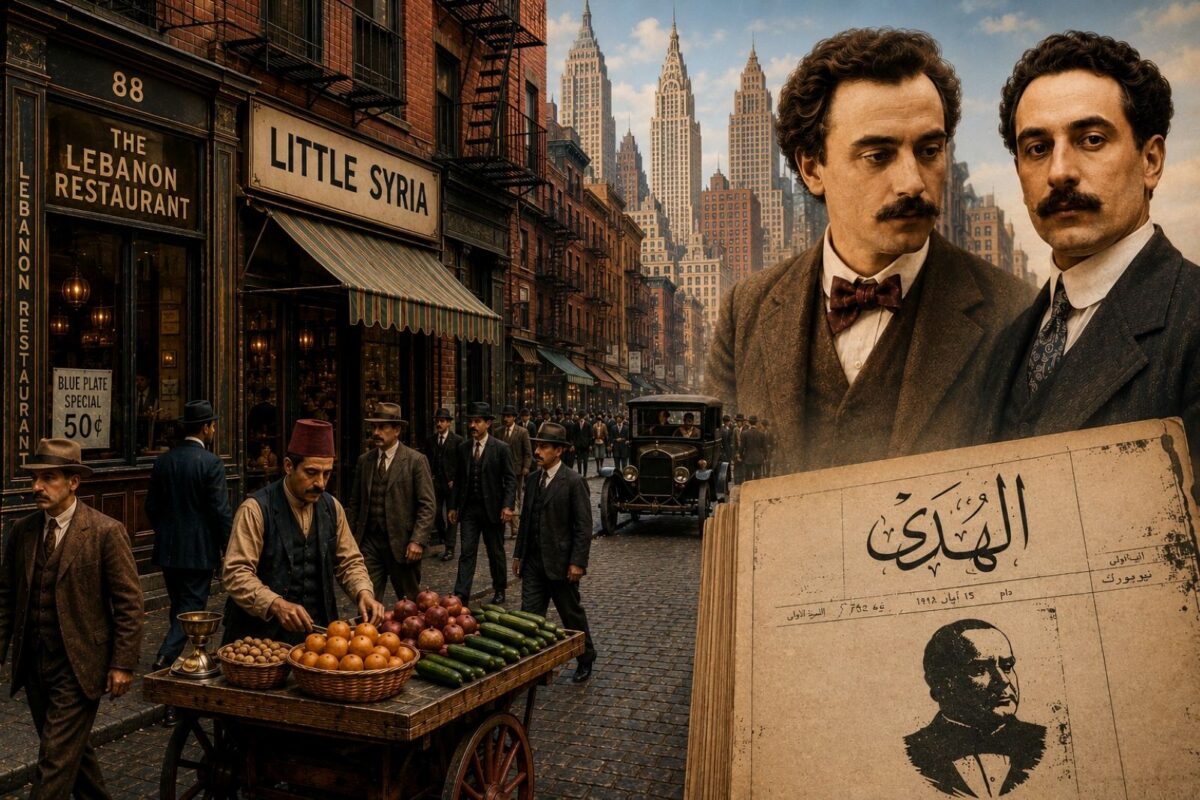
On 30 April 2026, New York City unveiled “Al-Qalam: Poets in the Park” in Lower Manhattan, a public monument commemorating the Pen League and the historic Little Syria neighbourhood in New York. (1)
Founded in New York in 1916 by Nassib Arida and Abd al-Masih Haddad, the Pen League was a collective of Arabic-speaking intellectuals and scholars from the Ottoman Levant who supported one another’s work and championed the revitalization of Arabic literature. The group included figures such as Amin al-Rihani, Nadra Haddad, Gibran Kahlil Gibran, Agabia Maalouf, Abbas Abu Shakram, Afifa Karam, Mikhail Naimy, Ilia Abu Madi, and others. Their collective contribution to modernizing Arabic literature gave rise to the Mahjar literary tradition. The members were mainly emigrants from the Mutasarrifiyya of Mount Lebanon and from Homs, a major city in the Syria Vilayet, both administrative units of the late Ottoman Empire.
The monument generated immediate controversy, with calls to action issued by Lebanon’s ministers of culture and foreign affairs, centered on a question of historical identity that the memorial’s inscriptions addressed with insufficient precision: the designation of these writers as Syrian. (2) The Lebanese diplomatic intervention proved fruitful, and NYC Parks led to the removal of the plaque, which contained what Lebanese considered an inaccurate and ambiguous description of major figures in Lebanese literature, reaffirming their Lebanese identity.
The controversy exposed several fault lines. First, the plaque’s authors were identified ambiguously, and its research and texts were written without taking into consideration the distance between two distinct historical moments: the world the Pen League inhabited and the world in which the monument was erected in 2026. Second, the majority of those commenting on social media demonstrated limited knowledge of the writings of the Pen League’s intellectuals, and of Gibran Khalil Gibran and Amin al-Rihani in particular. Third, when the Pen League was formed in New York, the terms “Syria” and “Lebanon” carried meanings far removed from the state-bound, politically charged designations they hold today.
According to the Moise Khayrallah Center for Lebanese Diaspora Studies, (3) approximately 120,000 emigrants left the Ottoman Eastern Mediterranean for the United States between the 1870s and the 1930s. They originated from across what is conventionally termed Greater Syria, subdivided by the turn of the twentieth century into the Vilayets of Syria, Beirut, and Aleppo, and the autonomous Mount Lebanon Mutasarrifiyya.
Writing on the identity of early Mahjar emigrants, Dr. Akram Khater, Professor of History at North Carolina State University and founding director of the Moise Khayrallah Center for Lebanese Diaspora Studies, observes that:
“Their sense of self was located within villages and towns like Homs, Bayt Meri, Bethlehem, or Rashaya, and distilled through their experiences of family and religion. Ethnicity and nationality were meaningless to the great majority of them. In other words, when they left they were neither Lebanese nor Syrian, Phoenician nor Arab.” (4)
Once in the United States, emigrants encountered a social, legal, and political order that demanded legible ethnic, racial, and national categories. Immigration officials at Ellis Island and shipping companies alike operated with no working knowledge of the Ottoman Levant: “Turkey in Asia” appeared in arrival registers until the late nineteenth century, after which “Syria” became the standard entry, occasionally alongside the earlier designation. As Akram Khater has observed:
“Thus, upon entrance into the US, immigrants acquired a different and larger identity, ‘Syrian,’ than the ones they had left with. The label ‘Syria’ made sense geographically as a designation for where they came from, but it also represented an emerging political project and idea among the educated urban elites of their homelands.”
By the early twentieth century, many intellectuals among the emigrants had begun designating their adopted world as al-Mahjar, the land of migration. Its counterpart, al-Watan, the homeland from which they came, raised a question that the monument has failed to settle, yet one that was itself still being formulated at the time: was that homeland the Ottoman Empire? Greater Syria? Mount Lebanon? Lebanon?
Both the present-day notions of Lebanon and Syria were in a period of gestation when these intellectuals were writing in the Mahjar. “Lebanon” as a geographical designation of antiquity acquired a political dimension gradually from the 1840s onward, consolidated by the establishment of the autonomous Mutasarrifiyya in 1861. “Syria,” equally ancient as a geographical designation, was nonetheless reinvented as an administrative unit within the Ottoman Empire in 1865, shaped by missionary activity and local intellectual currents. By the early twentieth century, even following the creation of the Vilayet of Beirut in 1888, carved from the coastal districts of the former Syria Vilayet, what had long been known as “the Levant” had, in the eyes of both Western observers and local intellectuals, come to be designated simply as Syria.
For Catholic missionaries, Syria was a land of civilisation, with Mount Lebanon as its heartland and mountain refuge. Protestant missionaries, by contrast, conceived of Syria in broader, more secular and ecumenical terms. Local intellectuals gave the idea an articulation as well: Butrus al-Bustani’s Nafir Suriyya (1860), written in the aftermath of the Mount Lebanon civil war, advanced a civic and pluralist vision of Syrian identity as a framework for communal coexistence.
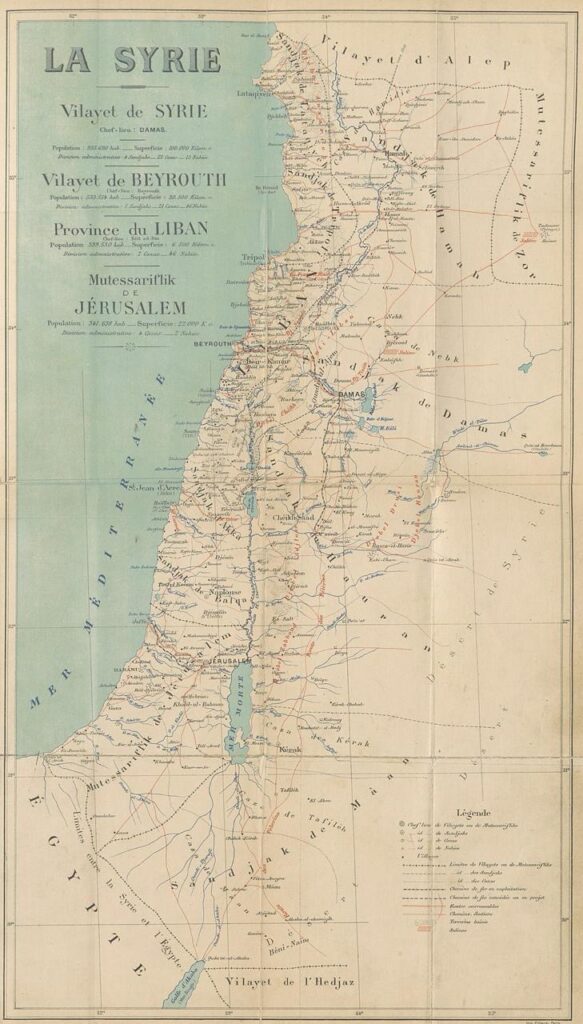
1896 Map from page 529 of Syrie, Liban et Palestine. Géographie administrative, statistique, descriptive et raisonnée., by CUINET, Vital. Original held and digitised by the British Library.
By the turn of the twentieth century, as evident from the Mahjar press and community institutions, “Syrian” had acquired sufficient currency as a collective designation for the diaspora. The principal immigrant settlement in Lower Manhattan came to be known as the Syrian Colony, or Little Syria. The intellectuals of this community drew on the notion of “Syrian” as a primary self-identification, though a number equally claimed “Lebanese,” and some navigated both designations simultaneously. The cases of Rihani and Gibran, two examples among many, illustrate the complexity, and near impossibility, of assigning either figure a singular or stable national identity. Rihani, in his political articles published under the title Al-Rihaniyyat (Beirut, 1923), openly identifies as Syrian first, Lebanese second, and Maronite third, (5) a self-positioning that recurs throughout his writings.
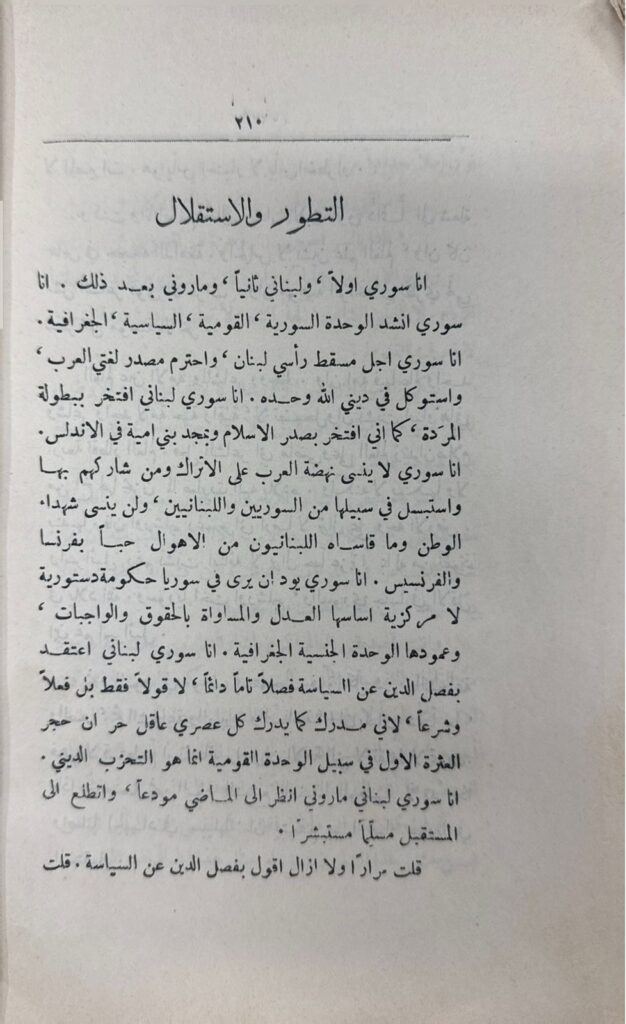
Amin al-Rihani, “Development and Independence,” in Al-Rihaniyyat (Beirut: al-Matba’a al-‘Ilmiyya, Yusuf Sader, 1923). Translation by the author.
“Development and Independence
I am Syrian first, Lebanese second, and Maronite thereafter. I am a Syrian who calls for Syrian unity, national, political, and geographical. I am a Syrian who reveres Lebanon as my birthplace…”
Gibran Khalil Gibran drew on both designations. As early as 1917, in “Dead Are My People,” written in response to the Great Famine and published in al-Hilal, he mourned the victims of starvation in terms that embraced both geographies at once: “But, alas, I am not an ear of wheat in the plains of Syria, nor a ripe fruit in the valleys of Lebanon. This is my misfortune…” (6) In his 1923 Arabic collection of articles and reflections al-Bada’i’ wal-Tara’if, he both articulated his celebrated Lebanese attachment, “You have your Lebanon and I have mine,” and alluded to a Syrian frame of reference in “Independence and the Tarboush.” Three years later, in his address “To Young Americans of Syrian Origin,” published in 1926, he declared: “I am the descendant of a people who built Damascus and Byblos, and Tyre and Sidon and Antioch, and I am here to build with you, and with a will.” (7)
Four figures from the Maronite community of the Mutasarrifiyya of Mount Lebanon, all active in the Mahjar or in close dialogue with it, exemplify the range of positions this reorientation produced. Philip Khuri Hitti, who would become the preeminent scholar of Arab and Islamic history at Princeton, maintained a Syrian intellectual framework within which Lebanon remained a constituent. Naoum Mokarzel, publisher of the leading Al-Hoda newspaper in New York, followed the opposite trajectory: by the time of the First World War he had consolidated a distinctly Lebanese nationalist position, and traveled to the Paris Peace Conference to lobby for an independent Lebanese state. The intellectual trajectories of Boulos Njeim and Shukri Ghanem are equally instructive: both had operated within a broader Syrianist intellectual horizon before reorienting toward a Lebanese national position.
The First World War and the subsequent creation of Greater Lebanon in 1920, followed by the establishment of the Syrian Republic under French mandate, brought these debates into an entirely new political context. Identities that had long remained fluid were gradually drawn into alignment with the hardening borders of new nation-states.
The national identities that took shape in Syria and Lebanon over the course of the twentieth century diverged sharply from the older, more fluid relationship between what “Syria” and “Lebanon” had meant to immigrants in the United States and Latin America. Thirty years of Syrian military presence in Lebanon, accompanied by systematic repression and recurring episodes of violence, and the periodic Lebanese campaigns against Syrians, often openly xenophobic in character, have since redrawn the boundaries of how each identity is understood and received, by its bearers and by others alike.
It is this earlier history, before those ruptures hardened into received truth, that Dr. Linda K. Jacobs, (8) President of the Washington Street Historical Society, (9) board member of the Moise Khayrallah Center for Lebanese Diaspora Studies, and a descendant of four grandparents who were members of the New York Syrian community, inadvertently evoked when she addressed the inauguration of the monument:
“Imagine an immigrant from Lebanon after a five-thousand mile voyage stepping into American soil and being greeted in Arabic, walking up Washington Street and seeing dozens of Syrian businesses and establishments.” (10)
This is a fluidity that contemporary Lebanese and Syrians find difficult to contextualise, given the fraught history between the two countries in recent decades. Her words nonetheless exemplify how elements of this early, formative period, when Lebanese and Syrian identities remained connected, interchangeable to a degree, and at points complementary, fossilised and survived in the diaspora long after they had relatively dissolved in the homeland.
The controversy, even if now allegedly resolved, is itself revealing: a measure of how deeply the question of Mahjar belonging resonates within Lebanese cultural and diplomatic self-understanding. And yet the reflex, however politically intelligible, carries its own anachronistic risk. The categorical clarity of “Lebanese, not Syrian” belongs to a post-mandate world of recognised borders and consolidated national identities. Gibran died in New York in 1931, al-Rihani in Freike in 1940; the final decades of both men’s lives unfolded in a world still in transition, where the borders were new, the national identities contested, and the old fluid categories had not yet fully given way to the fixed ones that came after. That dynamic of historical change is inscribed in their thought, and it is precisely what a monument erected in 2026 is obliged to reckon with, rather than resolve by anachronism.
Charles al-Hayek is a public historian and the founder of Heritage and Roots.
The views in this story reflect those of the author alone and do not necessarily reflect the beliefs of NOW.
Endnotes
(1) https://www.nyc.gov/assets/designcommission/downloads/pdf/8-14-23-pres-DPR-c-AlQalam.pdf
(2) https://washingtonstreethistoricalsociety.org/projects/
(3) https://lebanesestudies.ncsu.edu/
(4) https://lebanesestudies.ncsu.edu/news/2017/09/20/phoenician-or-arab/
(5) https://archive.org/details/Heliopolis1957_gmail_20180718_2209/page/n573/mode/1up, p. 573.
(6) https://archive.alsharekh.org/Articles/134/13095/256580, p. 333. Verse translated by the author.
(7) https://www.si.edu/object/gibrans-message-young-americans-syrian-origin%3Anmah_335039
(8) https://kalimahpress.com/about/linda-k-jacobs/
(9) https://washingtonstreethistoricalsociety.org/
(10) https://www.nycgovparks.org/news/press-releases?id=22306