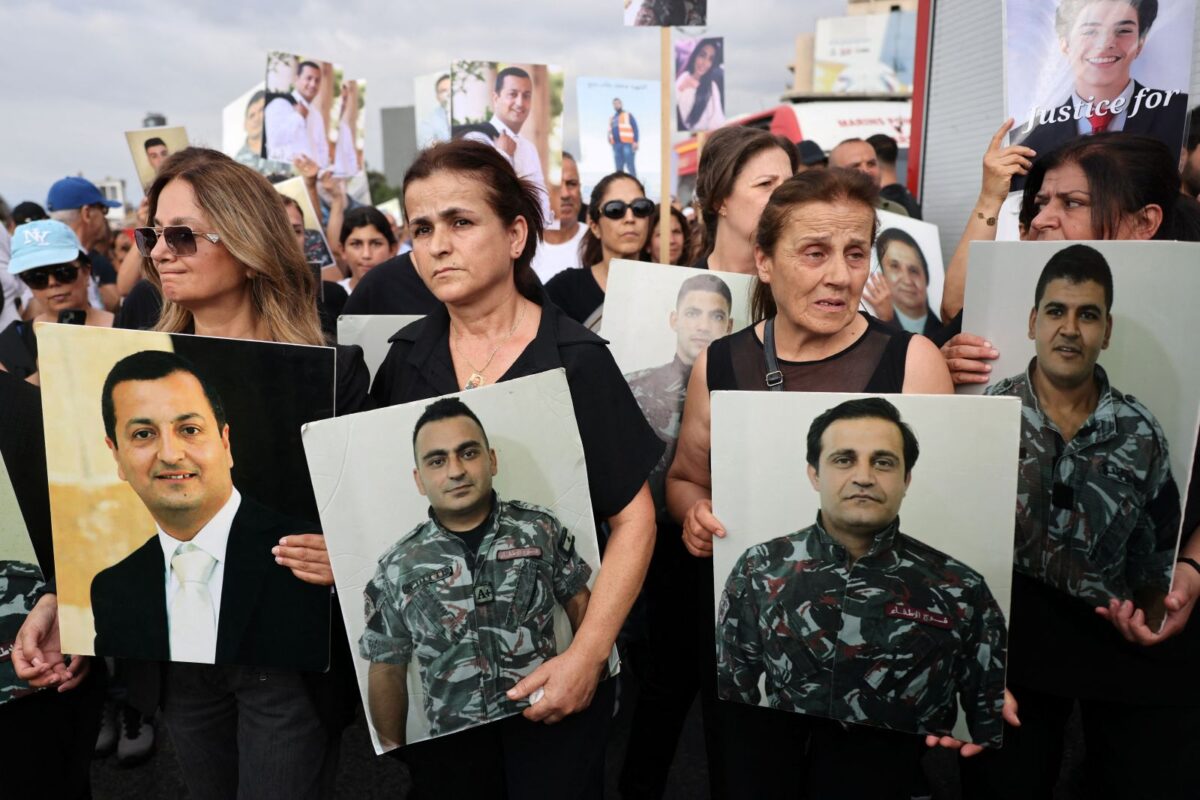
Lebanese demonstrators carry portraits of the victims of the catastrophic port explosion in 2020, during a march to call for accountability for the blast, in Beirut on August 4, 2025. (Photo by ANWAR AMRO / AFP)
I was arriving home from work, I live abroad, when I heard my three sons screaming. Mom, they hit Beirut with a nuclear bomb. I found them frozen in front of the television: grey ash, people walking the streets like they weren’t fully there. I fell to my knees when I understood it was the port. My brother worked there. I could hear myself shouting his name inside my head “Imad”! but I don’t know if any sound left my throat.
He survived. Alexandra, Sahar, Joe, Elias, Ahmed didn’t. Hundreds in Lebanon didn’t, and thousands abroad have been grieving them every single day since. Six years on, the heart is still broken. And it hasn’t healed, because nothing was ever resolved. It was simply left open.
Why did no country help find the truth? Why did the world go quiet? Why did every door close? Did they all, in their silence, let Beirut die a little more? The port’s grain silos are still standing, six years on, not repaired, not demolished. Just there, suspended between collapse and standing. Hanging between life and death. Exactly like Lebanon.
That is the cruelty of August 4: not a wound from one day, but one kept open by the absence of the one thing that lets a country grieve and move forward: accountability.
That is the cruelty of August 4: not a wound from one day, but one kept open by the absence of the one thing that lets a country grieve and move forward: accountability.
The facts were never in dispute. Nearly 2,750 tons of ammonium nitrate had sat unclaimed in a portside warehouse since 2013, after a stop in Beirut never meant to be permanent. For seven years, officials at every level of the state were warned, in writing, that it was there and dangerous. Customs officers flagged it. Security agencies knew. The file moved desk to desk, and nothing was done, until roughly a fifth of that stockpile detonated on August 4, 2020, one of the largest non-nuclear explosions in history, killing more than 220 people, wounding thousands, and gutting half a capital.
What happened to the other four-fifths has never been answered. A theory circulating among journalists and investigators for years, never proven, never fully dismissed, holds that some of it never reached Mozambique, and instead made its way to Hezbollah and the Assad regime in Syria. No one has produced the paper trail to confirm it. No one in power has produced one to rule it out, either. That, too, is what absent accountability looks like: not just unpunished negligence, but questions the state never even tried to close.
What makes it unforgivable, not merely tragic, is what came after. Former President Michel Aoun confirmed he’d been warned weeks before the blast and had told security chiefs to “do what is necessary.” He later admitted that by the time he grasped the danger, it was “too late”! his own word, with no evacuation ordered and no alarm raised for the people living around the port. Nothing was done. That is the Lebanese state in miniature: awareness without action.
The investigation that followed has been a case study in obstruction. Judge Fadi Sawwan, the first to take the case, was removed within months after seeking to question sitting former ministers. His successor, Judge Tarek Bitar, spent years fighting a barrage of lawsuits and more than ten separate recusal claims from a single pair of former ministers alone, plus a prosecutor general implicated in the case, who released suspects and simply blocked Bitar’s own orders outright. Generals, MPs, former ministers, nearly every powerful name he summoned found a way to refuse him, each one shielded by the political bloc that put him in office. The probe was frozen for two years, resuming only in 2025. This March, Bitar finally closed his file and referred it onward, having charged seventy people. It now sits with the prosecutor general for review. Earlier this year, a court fined two of the obstructing former ministers, the first and only time anyone has been made to answer, in any form, for anything. Six years, and that fine remains the highest price paid.
And this should shame anyone still defending the system: it happened despite the shift, not because of it. Lebanon elected a president who promised, in his election speech , to close this case, a prime minister who once headed the International Court of Justice, ministers anti Hezbollah and its ally Amal still hold key cabinet seats notably Justice. Still no answer. Under a president who promised closure and a jurist as prime minister, the file is still stalled, the truth still hidden. If accountability cannot move here, it was never meant to move at all.
And then there are the ones who tried to tell the truth and paid with their lives. Joe Bejjani, a photographer who documented the port hangar and assisted investigators, was shot dead in his car in December 2020, his phone and camera stolen. Two months later, Lokman Slim, a writer who had publicly blamed Hezbollah and the Assad regime for the blast, was found shot dead in the south. His sister has said he had already written down the names of those he believed would kill him. Both killings remain unsolved. Israeli military intelligence has since claimed Hezbollah killed both to hide its role, a claim from a hostile party that deserves scrutiny, not blind acceptance, but one that fits a pattern no one disputes: everyone who got close to this truth either went silent or was silenced.
This is what “absence of accountability” means in Lebanon: a system built to protect those who let it happen and punish those who said so. The port blast sits beside every other Lebanese file opened and never closed: assassinations, disappearances, financial collapse, proof the state answers to no one. Everyone here already knows, in general terms, who did this and why.
This is what “absence of accountability” means in Lebanon: a system built to protect those who let it happen and punish those who said so. The port blast sits beside every other Lebanese file opened and never closed: assassinations, disappearances, financial collapse, proof the state answers to no one. Everyone here already knows, in general terms, who did this and why. What’s missing is a state willing to say it in a courtroom. Justice has not gone missing, it has been taken hostage by the institutions meant to deliver it. Until it is released, August 4 will keep bleeding into every anniversary, and so will every wound Lebanon carries in silence.
My brother came home that night. Alexandra’s family is still waiting for someone to answer for why she didn’t. So is Sahar’s, Joe’s, Elias’s, so is every family in Lebanon owed a name, a verdict, a reason. Six years of anniversaries, and the state has offered a day off instead of justice. Beirut needs one trial. Until it gets one, August 4 is not a memory, it is still happening, every day no one is made to answer for it.
Elissa E Hachem is a journalist and political writer specializing in regional affairs and governance. Former Regional Media Advisor at the U.S. State Department’s Arabic Regional Media Hub, with broad experience in strategic communication across government and private sectors.
The views in this story reflect those of the author alone and do not necessarily reflect the beliefs of NOW.