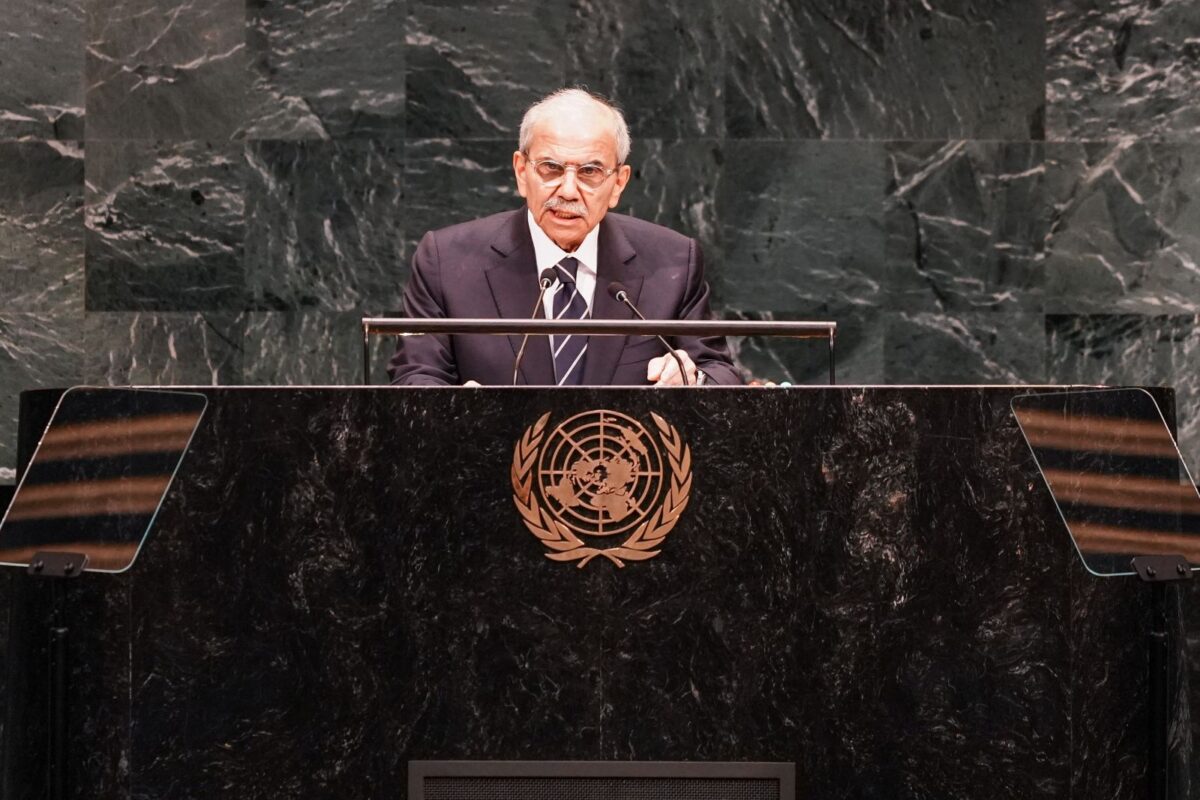
NEW YORK, NEW YORK - SEPTEMBER 25: President of the Council of Ministers of Lebanon, Nawaf Salam speaks during the 81st session of the United Nations (U.N.) (Photo by RYAN MURPHY / GETTY IMAGES NORTH AMERICA / Getty Images via AFP)
On Thursday 24 September, ten blocks from the UN General Assembly, the Abraham Accords countries met for the first time since October 7. The United States, Israel, the UAE, Bahrain and Morocco sat around one table on the 43rd floor of a Manhattan tower. Kazakhstan was there too. Trump announced its entry only in November 2025, roughly ten months before it got a chair. Kazakhstan shares no border and no war with Israel. Lebanon shares both, and it was not in the room.
Trump calls this a “club of STRENGTH.” I would call it a ledger, and Lebanon has been on the wrong side of it for decades.
The World Bank puts the cost of the last war at $14 billion, split between $6.8 billion of destroyed buildings and $7.2 billion of lost output, with $11 billion needed to rebuild. This year it expects the economy to shrink another 6.4 percent, and our finance minister counts up to $20 billion in losses since 2023. The lira has lost more than 95 percent of its value. That is what a country pays when war and peace are decided by someone other than the state.
Now the other side of the ledger.
UAE and Israeli trade reached $3.24 billion in 2024, after a 2022 agreement cut tariffs on 96 percent of traded goods. Morocco managed about $576 million in goods over four years, and Bahrain only $50 million. The difference is a plan. Abu Dhabi had one, Manama had a slogan.
So what would a plan look like for us? Start with electricity and gas, because every Lebanese home lives with the shortage. Gas from the eastern Mediterranean already reaches Egypt and Jordan by pipeline, while our power stations wait for fuel and whole neighborhoods run on generators. Peace would let us drill in our own waters without any missile or obstruction.
Then technology. The UAE has just committed to train a million Lebanese in artificial intelligence, which Emirati Minister of State Lana Nusseibeh framed as a serious bet on Lebanon’s future. Put those graduates next to Israeli and Emirati fintech and startup hubs, with investment flowing in both directions, and Lebanon stops exporting its brightest young people and starts keeping them.
Hospitals and universities follow, with joint medical research and exchange programs for doctors and students. Security comes next: intelligence sharing, border surveillance and equipment for an army that makes do with what it is lent, so we never again need UNIFIL-like forces to guard our border. Add reopened air corridors and our ports as gateways for Gulf and Mediterranean cargo.
Why are we still outside, then?
Two obstacles come from beyond our borders. Hezbollah and the Iranian axis treat any peace as a threat to their reason for existing, and they hold the weapons to enforce that view. Saudi Arabia ties its own normalization to a path toward a Palestinian state, which is its right, but Lebanon does not have to bind itself to that timetable. We paid the Palestinian bill, in blood and in ruin, long before anyone else was asked to. The third obstacle is ours. Those in charge are stuck in old allegiances and old habits, without a vision or a strategy, while the Lebanese people are far ahead of them.
How do we get there? President Aoun speaks of a security agreement first, a prelude to a later peace. Sequencing is fine with a destination and a deadline; without them it is buying time.
The June 26 framework signed in Washington must be implemented, with the army deploying wherever Israel withdraws. The only visible track is military, with talks reportedly set for Tampa next month, and without a political horizon it is only waiting.
The cabinet decisions of August 5 and 7, 2025 and March 2, 2026 on exclusive state control of arms must become action. Then the framework turns into an agreement that ends the state of hostility, and we ask for the seat.
The deadline is real.
On December 31, in under 100 days, the UN peacekeeping mission ends, about 8,500 troops from nearly 50 countries who have been in the south since 1978. Without an agreement and a state monopoly on arms, we face a vacuum.
Every country in that room made the same calculation: a seat costs less than a war. Lebanon has already paid for the war. The only open question is whether it will ever collect the peace.
Elissa E Hachem is a journalist and political writer specializing in regional affairs and governance. Former Regional Media Advisor at the U.S. State Department’s Arabic Regional Media Hub, with broad experience in strategic communication across government and private sectors.
The views in this story reflect those of the author alone and do not necessarily reflect the beliefs of NOW.