The most revealing part of the American-Iranian memorandum of understanding was not only the text. It was the theater around it.
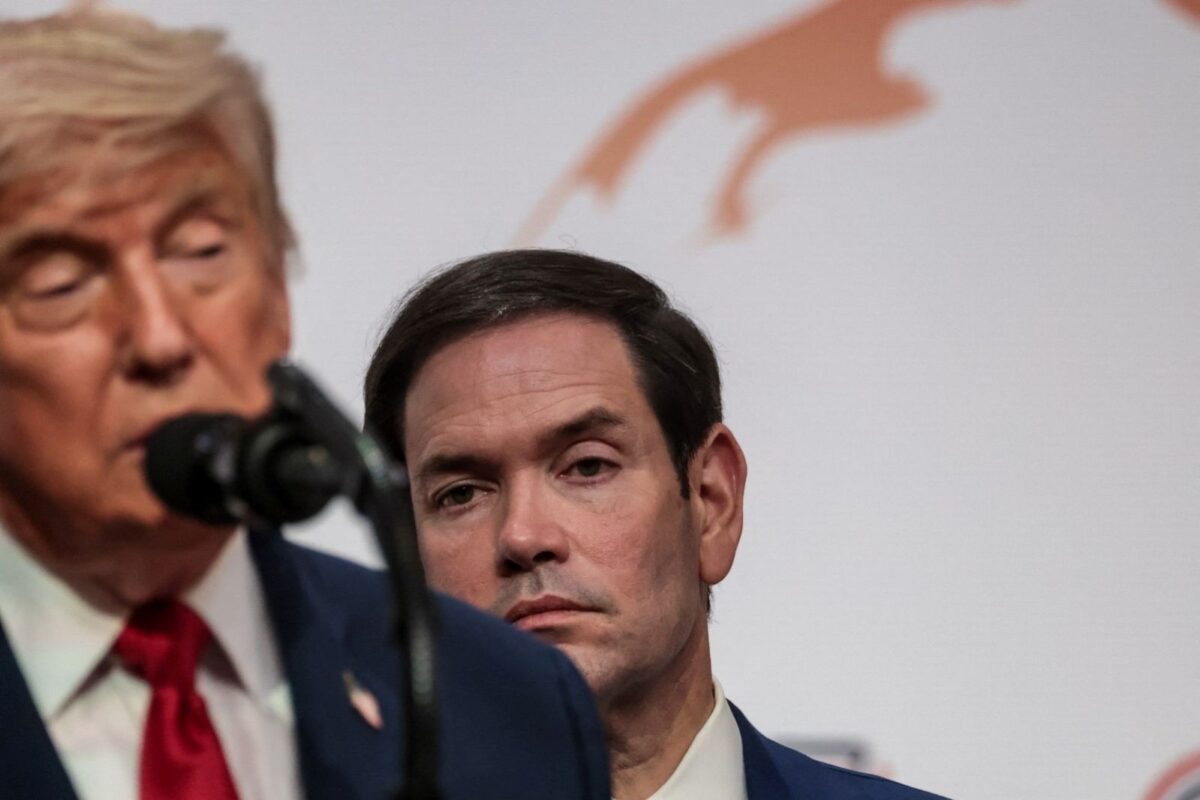
President Donald Trump spoke for almost an hour and a half, drifting between threats, boasts, market reactions, military details, real estate imagery, and the familiar claim that history bends around his ability to make a deal. Yet amid the performance, there was a moment more eloquent than any clause in the document: Marco Rubio’s face.
Rubio looked like a man forced to read a map whose borders had been redrawn by someone else. His expression captured the contradiction at the heart of this agreement. Washington wants to declare victory over Iran, reopen maritime routes, reassure markets, contain escalation, and claim that Tehran has been forced into a historic retreat. But at the same time, the agreement leaves untouched the regional machinery through which Iran has projected power for decades.
For Lebanon, this is where the danger begins.
The MOU places Lebanon inside the language of regional de-escalation, but not inside the logic of national restoration. It refers to the Lebanese arena as one of the fronts where military operations are meant to stop. That sounds significant until one asks the only question that matters: who controls the decision to resume fire?
The MOU places Lebanon inside the language of regional de-escalation, but not inside the logic of national restoration. It refers to the Lebanese arena as one of the fronts where military operations are meant to stop. That sounds significant until one asks the only question that matters: who controls the decision to resume fire?
The answer is not found in Beirut.
This is the fatal defect. The document speaks in the language of sovereign states, but Lebanon’s crisis is precisely that the constitutional order no longer controls the country’s strategic choices. The guns that dragged Lebanon into this war are not an accidental feature of Lebanese politics. They are the operating system of Iranian influence on the Mediterranean. Unless that system is dismantled, paused violence is merely another diplomatic interval between rounds of destruction.
This is the fatal defect. The document speaks in the language of sovereign states, but Lebanon’s crisis is precisely that the constitutional order no longer controls the country’s strategic choices. The guns that dragged Lebanon into this war are not an accidental feature of Lebanese politics. They are the operating system of Iranian influence on the Mediterranean. Unless that system is dismantled, paused violence is merely another diplomatic interval between rounds of destruction.
Trump’s speech made this painfully clear. Lebanon appeared not as a partner to be empowered, but as a troublesome corner of a larger bargain. He spoke sympathetically of Lebanon’s past, its culture, its professionals, and its suffering. He even suggested that Israel could perhaps use a lighter hand when dealing with Hezbollah. But sympathy is not policy. Nostalgia for Lebanon’s lost brilliance does not restore its institutions. And telling Israel to be somewhat less destructive is not the same as giving Lebanon the means to recover command over its own territory.
In Trump’s hierarchy, the main bargain is with Iran. Lebanon is an irritant within that bargain. It is a place where things can go wrong, where Israeli overreach can complicate the optics, and where Hezbollah’s actions can embarrass the diplomatic choreography. But it is not treated as the central test of whether Iran has truly changed its behavior.
That is why Rubio’s discomfort mattered. It reflected the unease of an American policy trying to reconcile incompatible claims: that Iran has been humbled, that Iran is now a potential negotiating partner, that the regional file can be managed later, and that Lebanon can somehow be stabilized without confronting the armed structure that made it unstable in the first place.
The text itself is full of deferred answers. The nuclear file is postponed to mechanisms and future understandings. Sanctions relief is tied to schedules still to be agreed. Maritime guarantees are temporary. Monitoring bodies are promised. A future Security Council resolution is imagined. Everything difficult is pushed into a process. But Lebanon does not have the luxury of process without power. Every delay benefits the actor that already holds the weapons.
This is why the Lebanese should be careful not to confuse a diplomatic pause with a strategic rescue. Iran may accept constraints on certain files if the price is right. It may trade language, sequencing, inspections, and economic access. But Hezbollah is different. Hezbollah is not merely a Lebanese ally of Iran. It is one of the principal assets that allows Iran to bargain from beyond its borders. To expect Tehran to loosen that card without a direct cost is to misunderstand the entire architecture of the Islamic Republic’s regional policy.
The greater danger is that Lebanon will be asked to celebrate its own marginalization, while quite ironically some Shiite supporters of Hezbollah will celebrate the destruction of their homes and villages . Officials in Beirut may welcome the MOU because it buys time. Party leaders may claim that the storm has passed. Diplomats may praise the spirit of de-escalation. But time, in Lebanon, is never neutral. When the state uses time to avoid decisions, armed factions use it to reorganize, rearm, and redefine the next crisis.
Worse still is the suggestion that Syria could play a role in solving the Hezbollah problem. This is not realism. It is amnesia. Lebanon has already paid the price of being placed under Syrian management in the name of stability. To invite Damascus back into the Lebanese equation, directly or indirectly, would not weaken Hezbollah. It would only add another layer of external custody over a country that has spent decades trying to breathe outside the grip of its neighbors.
The MOU may be useful for Washington. It may give Trump a victory narrative. It may give Iran oxygen. It may calm Gulf shipping and reassure investors watching oil prices. It may even reduce immediate pressure on Israel’s northern front. But none of this automatically produces a Lebanese outcome.
Lebanon’s future cannot be hidden inside an American-Iranian annex.
The country needs a policy that begins from Beirut, not from Tehran’s needs, Washington’s electoral theater, Israel’s security doctrine, or Syria’s appetite for relevance. It needs an official position that says plainly that the decision of war cannot belong to a faction, that the border cannot remain a private military zone, and that the south cannot be used as a negotiable card in someone else’s settlement.
Until that happens, every regional arrangement will leave Lebanon suspended between someone’s war and someone else’s deal.
The tragedy is not that Lebanon was ignored. It was mentioned. And that may be worse. It was acknowledged just enough to be managed, but not seriously enough to be saved.
This is why the real meaning of the MOU will not be measured in Washington signing ceremonies or Iranian compliance formulas. It will be measured in whether Lebanon remains a platform for Tehran’s leverage or becomes again a republic with one army, one border policy, and one decision over war.
Rubio’s face understood the problem before the document admitted it. The deal may calm the region for a moment. But in Lebanon, calm without authority is only the silence before the next explosion.
Makram Rabah is the managing editor at Now Lebanon and an Assistant Professor at the American University of Beirut, Department of History. His book Conflict on Mount Lebanon: The Druze, the Maronites and Collective Memory (Edinburgh University Press) covers collective identities and the Lebanese Civil War. He tweets at @makramrabah