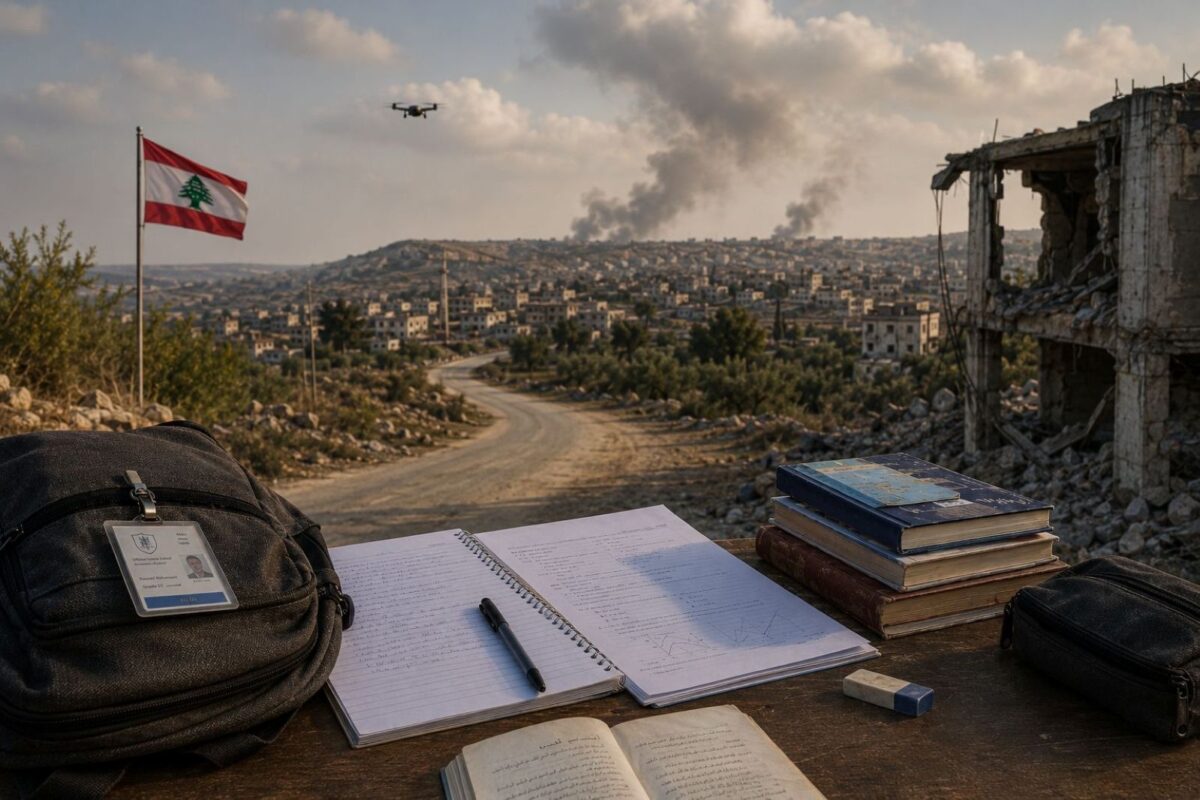
In the afternoon of Monday 1 June 2026, college student Theodosia, her younger brother Tony, and their father, James, were killed when an Israeli drone strike hit their vehicle on the road between Nabatieh and the Khardali Bridge in southern Lebanon. They were returning to their village of Qlayaa after Theodosia had taken her end-of-year exams at the Lebanese University in Beirut. Amidst widespread outrage and grief, the public directed severe blame at Lebanon’s Minister of Education and the ministry for insisting that exams be held in person. In response to the mounting pressure, including protests from student and parent groups, the Lebanese University postponed for one week some exams scheduled at its campuses in the southern suburbs of Beirut and in the southern city of Sidon, both of which are under Hezbollah control.
While blame is an evident response to such a tragedy, intellectual shortcuts and scapegoating are the wrong approach – no matter how turbulent emotions are.
Let’s think.
The road to university does not kill.
The recurring argument is that the Ministry created the conditions that forced families onto dangerous roads by holding university exams in person. Students (and their parents) had to commute, which exposed them to foreseeable danger. After all, everyone knew the country was under missile attack.
I ask, in a targeted country, which roads are considered “dangerous” and which are considered “safe”? Was the road lethal because it led to the university exam? Or was it lethal because it connected the university to the hometown? Are roads missile-free when we commute to the grocery store, pharmacy, or a friend’s house? Did the student and her family hit the road back home despite a security warning that they missed? Would they not have taken the Nabatieh and Khardali Bridge if she had not had to take the exam?
In a country where repeated crises can destroy academic years, the Ministry of Education must preserve students’ access to education, certification, university admission, and graduation. Canceling or postponing exams without foreseeing an end to the hostilities goes beyond an administrative decision because it affects university admissions and exchanges, scholarships, school calendars, and the international recognition of certificates. It also affects thousands of students who may need end-of-year results to transfer to universities or who are simply in safer areas.
In this sense, how could the Ministry have managed risk, especially for students from border areas in southern Lebanon or directly targeted neighborhoods? Although the Ministry announced three consecutive sittings for the 2026 official exams in an attempt to balance continuity with safety amid mounting pressure on Lebanon’s education sector, we wonder if the Ministry should have also
- Moved or relocated examination centers,
- Designed remote alternatives,
- Guaranteed make-up exams without penalty,
- Assessed transportation routes and coordinated secure transportation options with the Ministries of Interior and Transport,
- Established a crisis cell that includes students, teachers, and ministry representatives to devise solutions to these challenges.
The state doesn’t want to state.
While talk is easy, action is hard. In reality, the Ministry is part of a state in shambles, ravaged by decades of corruption. This makes any redress extremely challenging, almost impossible, when the same public servants and those who appointed them remain in place. A minister and their team cannot change such a situation in 15 months without the necessary prerogatives. These prerogatives are not only executive; they also depend on resources. Ministries operate on a very reduced workforce, while the ongoing economic collapse gravely limits planning and its sound, accountable implementation. Added to this is the lack of coordination between agencies: among public administrations, security bodies, and stakeholders in general. Coordination and teamwork are not always a Lebanese reflex, and they often run up against personal egos, institutional rivalries, and political calculations.
This doesn’t negate the fact that the state has a duty of care toward students, citizens, and residents. This is where the reality check becomes painful. Without mincing words, the state does not take itself seriously. It is still largely run by warlords and by officials appointed by them, and they do not engage with the state as constitution and institutions. They don’t believe in it, and the concept of the State doesn’t suit them. For decades, the political class across the board covered Hezbollah’s illegal weapons and activities in exchange for Hezbollah covering their corruption – and then Hezbollah surpassed them in corruption. Most leaders are weak and feeble, afraid to take a firm stance, either because their own practices may be exposed in retaliation, or simply because they fear being assassinated. After all, 20 years of political assassinations targeting those who criticized Hezbollah and its regional allies, or took action against them, are enough to terrify even the strongest among them. At this point, the legal and legitimate “duty of care” exists more as rhetoric than as a practical reality.
And we ask: in the face of active bombing, drone activity, and military escalation, how do public authorities apply precautionary principles? Is it by declaring a state of emergency and limiting commutes? But haven’t people died from missile strikes while staying in their homes? Or is it by actively working to implement a sustainable and imminent ceasefire? Wars end either when one fighting group wins over the other, or when a ceasefire is declared and its conditions are respected by the belligerents. The facts are that Hezbollah cannot win over Israel, and yet, Hezbollah accepted the conditions of a ceasefire in November 2024, violated them, then fired six rockets on Israel in March 2026, before blaming Israel for its retaliation, and has engaged in back-and-forth attacks ever since.
The elephant in the room is that most outraged voices blame the in-person exams for the killing, and suddenly refuse to acknowledge that the family members died by a missile strike. The responsibility for the killings lies here. Exams do not endanger life. Wars do, and wars must stop. This is how lives are saved.
There is, of course, a real and understandable political and moral responsibility for failing to reduce an avoidable risk. The risk is Lebanon being dragged into an unnecessary war, which responsibility falls upon the entire political class. In the current Lebanese reality, this responsibility cannot be effectively identified, enforced, or translated into accountability without a radical reset. The only way out starts with implementing a sovereign peace between Lebanon and Israel, grounded in long-term development. But what are the conditions for such peace?
Stay put. No retreat, no vacuum, no void.
Suddenly, the same voices that had been denouncing Israeli strikes shifted the blame for the missile strike onto the Minister of Education. Is this move emotionally driven or politically calculated? I ask this question as calls for the minister’s resignation multiplied, sounding like an orchestra in composition.
Should the Minister of Education resign for the failure to protect the lives of Lebanese students from missile strikes while commuting to their exams? Many would say yes. After all, in “civilized politics,” a minister would resign for less.
With the Minister of education out, and for the sake of consistency and equality of outcome, the Minister of Labor should also resign for the failure to protect the lives of Lebanese workers from missile strikes while commuting to work.
The Minister of Public Health should also resign for the failure to protect Lebanese hospitals and health workers from missile strikes. He should also resign for the failure to ensure that hospitals admit all the ill and injured, for the failure to fix the highly inconsistent flow of medication, for the failure to solve the issue of counterfeit and corrupt medication that still kills cancer patients and exploits vulnerable ones.
The Minister of Environment should also resign for the failure to protect natural ecosystems and biodiversity from missiles.
The Minister of Agriculture should also resign for the failure to protect rural livelihoods, local food security, and the agricultural sector from missile strikes, which have rendered South Lebanon an “agricultural disaster zone.”
And the list of ministers who should resign goes on.
According to this logic, the entire cabinet must resign. There have been enough deaths by missile strikes to mount popular pressure for the resignation of the Salam government. Let’s support all these voices that have been calling for the resignation of the Salam government. Let’s join this group in Lebanon that has been asking for the resignation of the Salam government. Remind me which group in Lebanon has been threatening to topple the Salam government? Which group in Lebanon is it but Hezbollah?…
Let’s be honest. Calling for the resignation of the Minister of Education is pure hypocrisy. At best, it is petty politics. It is not a “moral decision” to prevent further similar killings or to insinuate accountability. It is merely an attempt to create a government void so that a new minister can be appointed and pressure can be exerted on the prime minister and president to appoint a replacement who would make political choices better aligned with Hezbollah’s plans. It is an ambitious plan, but it is not going to happen.
Yes, in “civilized politics,” a minister would resign for less than this. Correct, agreed. In these “civilized politics,” a group of people whose military activities are declared “illegal” by the government wouldn’t roam freely, hijack the government’s decision to go to war, and use civilians across the country as human shields. They wouldn’t claim allegiance to another country, and threaten to assassinate the president, the prime minister, and many other ministers. Civility? All in! Throughout. Or not. Civility is not a buffet from which we can pick and choose. Civility is certainly not hijacking the deaths of a father and his two children to create a ministerial void and exert pressure in an attempt to secure political gain and control.
Education, no matter what.
Every time a critical event occurs in Lebanon, groups start calling for the cancellation of official middle and high school exams. This seems to be a systemic effort, an absurd campaign that should be countered.
First, official secondary exams cannot simply be canceled because the certificate is a requirement for university enrollment in Lebanon and worldwide.
Second, if every threat automatically cancels or “postpones” national exams, then armed actors and those creating chaos effectively gain control over the education system. This means subverting education (namely students, teachers, programs, books, exposure, learning, knowledge, intellect) into a weapon to pressure the entire country and inevitably alter the culture of its people.
In the case of Lebanon, not only should exams have gone ahead, but our entire education system must also be revised, improved, and consolidated, beginning with our teachers and curricula. We have rested on our educational laurels for far too long while doing very little to reverse our academic regress. We must improve our standards because the level of our students, school teachers, and university faculty has dramatically declined. Many of us who teach at universities can attest to how much we Lebanese have lost the spark, rigor, and competitive edge that once distinguished our education system. Excellence is not measured against mediocrity.
Resistance in the face of death and destruction starts with education, and education is continuity. Historically, our Lebanese education sector has always endured amid active conflict and security risks. Have we forgotten that our universities never closed during the war? The Saint Joseph University of Beirut and the America University in Beirut remained open no matter what. My mom, for example, still went to school, graduated, enrolled in college, and graduated – all throughout the Lebanese “civil” war. Had a missile strike killed her, would we have blamed the school, the university, and the ministry, or would we have blamed the culture of war and the unwillingness to resolve conflict with diplomacy and politics?
Education and exams are a refusal to let violence paralyze civil life. Postponing exams without a foreseeable date creates further chaos, inequality, and uncertainty for students who have already lost years to war, economic crises, strikes, and displacement.
The Minister and the Ministry of Education did not kill anyone, and the only way to end the killings, destruction and suffering is through a sovereign peace between Lebanon and Israel, grounded in long-term development. However, this is conditional – above anything else – on the Lebanese willingness and action toward a decent and capable state that retains the monopoly of legal violence and that doesn’t tolerate illegal arms. Only then will it be internationally respected and deemed a partner for sustainability and security. In any case, scapegoating, intellectual laziness and shortcuts do not build countries, do not build civilizations, do not build excellence.
The views in this story reflect those of the author alone and do not necessarily reflect the beliefs of NOW