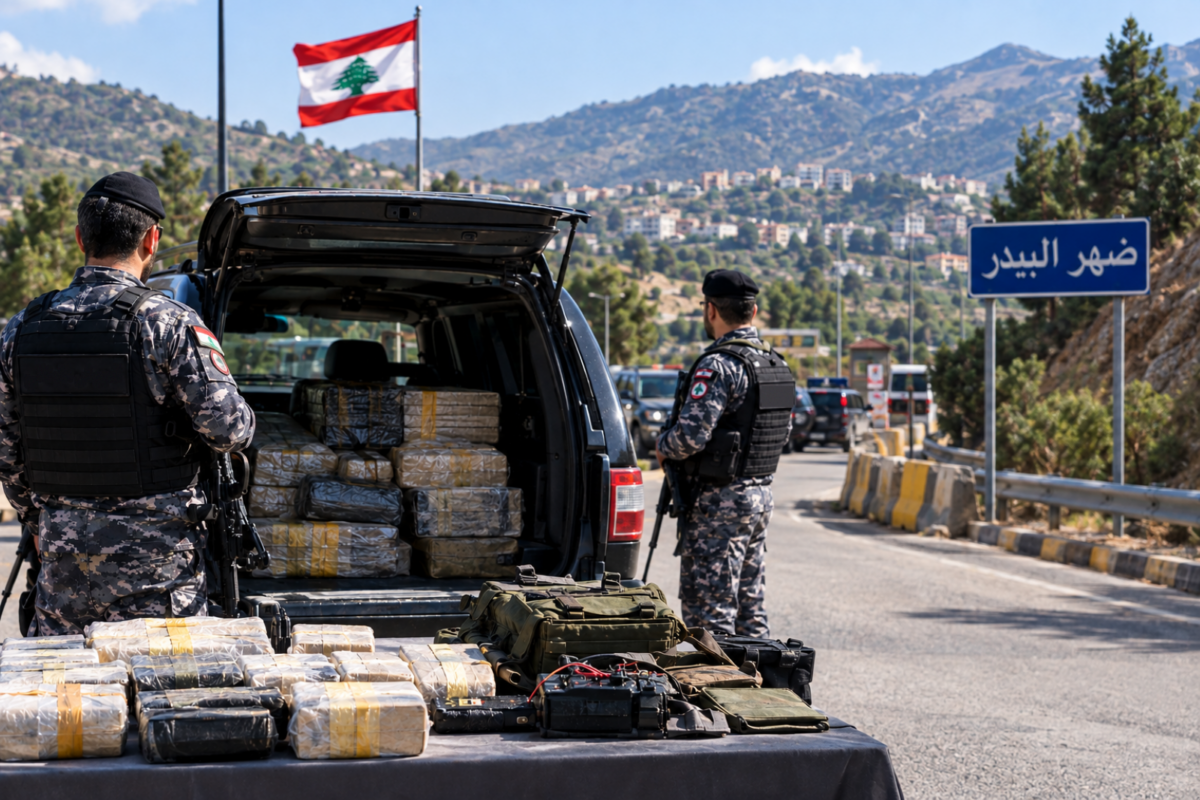
Lebanon’s security forces stopped a vehicle carrying hundreds of kilograms of explosives at Dahr al-Baydar. The officers deserve credit. The political leadership now has to demonstrate that their work can lead to something more durable than a successful interception.
On Monday, Prime Minister Nawaf Salam promised to identify everyone involved, including those behind the shipment, and establish its objectives. He has made a promise that can be tested through the conduct and outcome of a specific investigation. Asharq Al-Awsat, citing a judicial source, reports that investigators are already seeking to identify the alleged supplier and intended recipient, described in the detainees’ accounts as Hezbollah officials. This matters. An investigation beyond the two men transporting the explosives is reportedly underway. It deserves support and scrutiny.
The intended use of the shipment has not been publicly established. Lebanon’s history makes the fear of assassination understandable, but fear cannot substitute for evidence. A serious investigation must establish responsibility precisely enough to withstand a courtroom, including when its findings disappoint those already certain of the answer. The political test begins where the evidence reaches someone who expects protection.
For President Joseph Aoun and PM Salam, the responsibility is concrete. Investigators must be able to pursue leads, obtain records and question suspects without discovering that a party affiliation changes the procedure. Judicial decisions must be implemented. Officers and judges must know that doing their jobs will not leave them professionally exposed or physically unprotected.
An arrest demonstrates the state’s reach. What happens to the people behind the operation reveals its limits.
This requires a careful boundary. The executive must protect the investigation’s independence while leaving conclusions to the courts. Neither leader should dictate whom judges indict or acquit. Their duty is to prevent political influence from determining whom investigators are allowed to examine. An arrest demonstrates the state’s reach. What happens to the people behind the operation reveals its limits.
If the evidence implicates people within Hezbollah, their position in the organization cannot become a reason to negotiate away legal obligations. If it implicates others, the same standard applies. The government cannot promise comprehensive accountability and then permit informal bargaining over who remains available to justice.
There is also a consequence inside the security institutions themselves. Every case teaches officers what their superiors will defend. If a politically sensitive arrest produces abandonment, reassignment or pressure to narrow an inquiry, the next officer receives a lesson in caution. If the investigation proceeds with consistent institutional backing, professionalism becomes less personally costly. This is how political authority affects conduct far below the cabinet table. Leaders establish expectations through the cases they allow to proceed.
The European Union’s decision on October 12 to establish a support mission adds another dimension. Its mandate includes assistance to the army and Internal Security Forces in border security and counter-smuggling. Deployment still requires a separate launch decision. European expertise can strengthen the ability to detect illicit activity. Its usefulness will depend partly on whether Lebanese institutions can act on what they discover. No training programme can guarantee that a Lebanese official will resist a political intervention.
The Constitutional Council’s amnesty ruling, issued the same day, offers a reason to resist automatic pessimism. The Council preserved the law while annulling provisions and imposing binding interpretations, including the exclusion of all corruption offences from amnesty. A political bargain encountered institutional limits. Whether those limits survive implementation remains the next question, but the intervention deserves recognition.
Dahr al-Baydar presents a different institutional task with a related challenge: ensuring that legal authority produces consequences after the public attention fades. That also requires disciplined communication. Authorities should explain verified developments and procedural progress without exposing witnesses or compromising evidence. Prolonged silence allows competing political camps to supply their own verdicts. Selective leaks can turn suspects into instruments of public accusation before their responsibility has been established.
Precision protects the public as well as the accused. Establishing individual and organizational responsibility prevents suspicion from spreading indiscriminately across a community. Hezbollah’s opponents should want a case strong enough to survive judicial examination. Its supporters should demand answers about conduct that could endanger them. Neither interest is served by replacing an investigation with a contest of communal loyalties.
The government must protect the investigation from politics without protecting anyone from its findings.
The government must protect the investigation from politics without protecting anyone from its findings. That is a demanding position in a country accustomed to negotiating exceptions. It requires leaders to accept the possibility that a lawful inquiry will upset relationships they would prefer to preserve.
The officers at Dahr al-Baydar have given the government a case on which to demonstrate its authority. If the investigation reaches powerful people, Aoun and Salam will have to decide how much political capital they are willing to spend defending it. Their answer will help determine what the next officer at the next checkpoint believes he is allowed to do.
Ramzi Abou Ismail is a Political Psychologist, Researcher and Analyst.
The views in this story reflect those of the author alone and do not necessarily reflect the beliefs of NOW.