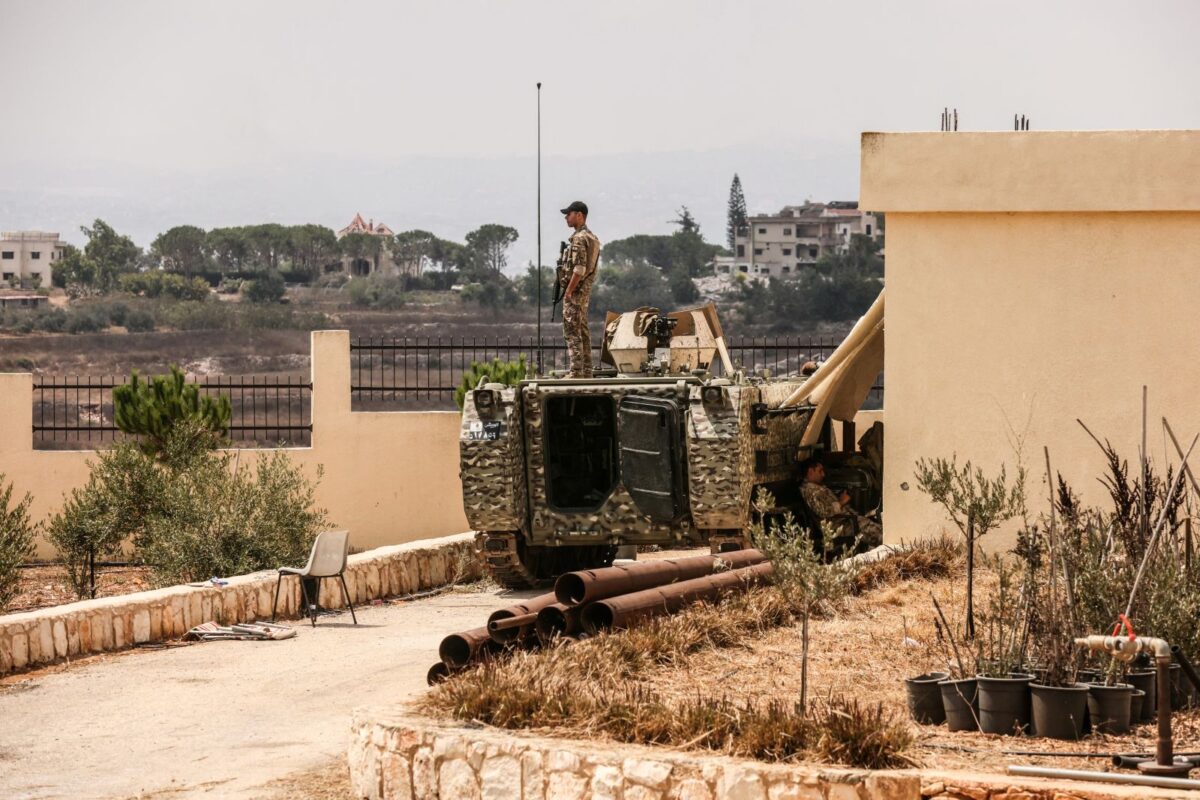
Photo by MAHMOUD ZAYYAT / AFP. A Lebanese army soldier stands on top of his tank in the southern Lebanese village of Zawtar al-Gharbiyah as he observes the Israeli soldiers movement in the nearby village of Zawtar al-Charkiyah on August 8, 2026.
For years, Lebanon’s debate over Hezbollah has been framed around a single question: how can the state recover its monopoly over weapons?
That question remains central. But it is no longer sufficient.
Lebanon is approaching a more consequential problem: what happens after the weapons are removed, contained or rendered politically unusable?
The answer will determine whether Lebanon enters a genuine state-building phase or simply replaces one security dependency with another.
The current U.S.-brokered framework between Lebanon and Israel has already altered the logic of the confrontation. Its security annex links the gradual Israeli military withdrawal from southern Lebanon to a verifiable process of Hezbollah disarmament and the deployment of the Lebanese Armed Forces. The mechanism envisages “pilot zones,” verification, Lebanese military control and reconstruction as sequential components of the process.
This is more than a technical military arrangement. It is an attempt to construct a new security architecture in southern Lebanon.
And that is where the real challenge begins.
From disarmament to state capacity
The Lebanese Army is now being asked to perform a function that extends well beyond conventional border security.
It is expected to dismantle military infrastructure, confiscate weapons, expand its presence in areas historically dominated by Hezbollah and eventually assume exclusive operational control over territory from which Israeli forces are expected to withdraw.
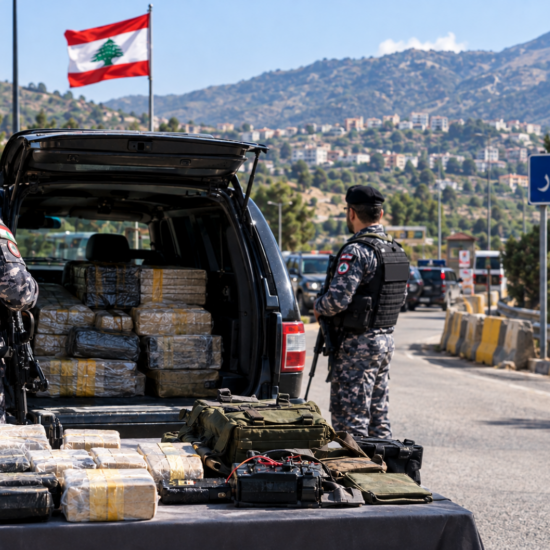
The army has already reported operations in the designated pilot zones, including the seizure of approximately 1,818 weapons and pieces of ammunition. But the process remains limited, and the first phase covers only three villages.
The distinction matters.
A state can possess the legal authority to monopolize force without possessing the institutional capacity to exercise that authority everywhere.
Lebanon’s problem is therefore no longer simply one of sovereignty. It is one of state capacity.
Lebanon’s problem is therefore no longer simply one of sovereignty. It is one of state capacity.
Can the army simultaneously secure the border, prevent the reconstitution of Hezbollah’s military infrastructure, maintain internal stability, protect civilians, cooperate with international actors and avoid becoming the direct instrument of a confrontation between the Lebanese state and a deeply embedded political organization?
That is a substantially harder question than whether the government can issue a disarmament decision.
The army cannot operate in a vacuum
The political environment surrounding the army is equally important.
President Joseph Aoun has repeatedly called for Hezbollah’s disarmament while emphasizing that it should be achieved without confrontation. He has also warned against creating a security vacuum in southern Lebanon and called for international support to enable the army to expand its deployment and authority.
That approach reflects a fundamental Lebanese dilemma.
A rapid attempt to impose state authority through force could generate an internal confrontation with consequences far beyond the military problem itself.
But a prolonged process without measurable enforcement could leave the state formally responsible for security while the practical balance of power remains contested.
But a prolonged process without measurable enforcement could leave the state formally responsible for security while the practical balance of power remains contested.
The result would be the worst of both worlds: a state expected to guarantee security without possessing uncontested control over the means of providing it.
This is why the future of the Lebanese Army matters as much as the future of Hezbollah’s arsenal.
Israel’s withdrawal is part of the equation
There is another variable that Beirut cannot control alone: Israel.
The framework agreement envisages a relationship between Lebanese disarmament and Israeli redeployment. In other words, the two processes are designed to move together.
But the military reality on the ground has complicated that equation.
Israel has established and expanded a buffer zone in southern Lebanon, while its forces have recently taken operational control of the strategically important Ali al-Taher ridge and destroyed what Israeli officials described as an extensive Hezbollah underground complex there.
This creates a dangerous feedback loop.
The longer Hezbollah retains military capabilities, the stronger Israel’s argument for maintaining a forward military presence.
The longer Hezbollah retains military capabilities, the stronger Israel’s argument for maintaining a forward military presence.
The longer Israel remains on Lebanese territory, the harder it becomes politically for Beirut to implement a disarmament process that Hezbollah can portray as occurring under occupation.
And the longer both processes remain stalled, the weaker the Lebanese state’s ability to present itself as the central security actor.
Breaking that cycle requires more than declarations from Beirut.
It requires a functioning mechanism in which Lebanese deployment, Hezbollah dismantlement, international verification and Israeli withdrawal reinforce one another rather than become mutually conditional obstacles.
The coming UNIFIL question
The timetable makes the challenge even more urgent.
UNIFIL is scheduled to leave Lebanon by the end of 2026, creating concerns about a security and monitoring vacuum in the south. European and Arab military leaders met in Paris this week to examine alternatives, including an international or European-led mechanism focused on supporting, training and mentoring the Lebanese Armed Forces.
More than ten EU countries have already expressed willingness to contribute to a proposed mission supporting the Lebanese military, with discussions focused on training and capability-building rather than simply reproducing UNIFIL.
This distinction could prove decisive.
Lebanon does not merely need another international force positioned between its army and Israel.
It needs a transition mechanism that helps the Lebanese state become capable of performing the functions that international actors have performed around it for decades.
The objective should therefore not be permanent internationalization of southern Lebanon.
It should be Lebanonization of security under international support.
The danger of replacing one dependency with another
There is, however, a strategic contradiction that Beirut and its international partners will have to confront.
If the Lebanese state becomes dependent on foreign military assistance, intelligence, funding and guarantees to exercise its authority, it may recover the monopoly over weapons while remaining dependent on external actors for the ability to use that monopoly.
That would represent a change in the structure of dependency, not necessarily its disappearance.
The challenge is therefore to build an army that is not merely stronger, but institutionally capable of making security decisions as a national institution.
The challenge is therefore to build an army that is not merely stronger, but institutionally capable of making security decisions as a national institution.
That means sustainable financing, intelligence capabilities, border surveillance, logistics, air and maritime capabilities, command-and-control systems and the ability to deploy rapidly across Lebanese territory.
It also means political protection for the institution itself.
An army cannot become the backbone of a sovereign security architecture if every major security decision is treated as an extension of domestic political competition.
The real post-Hezbollah question
The debate over Hezbollah’s future will continue to dominate Lebanese politics.
But the more consequential question may eventually become something else:
What kind of state emerges after Hezbollah’s military role is dismantled?
A Lebanon in which the army merely replaces Hezbollah’s checkpoints and weapons depots would not be enough.
A Lebanon in which Israeli forces remain indefinitely because the Lebanese state cannot guarantee security would not represent a stable strategic settlement either.
And a Lebanon whose security depends permanently on international forces would remain structurally vulnerable.
The strategic objective must therefore be broader: to create a Lebanese state capable of controlling its territory, protecting its population, managing its borders and engaging its neighbors from a position of institutional authority.
That is why the next phase cannot be reduced to disarmament.
Disarmament is the transition. State capacity is the destination.
Disarmament is the transition. State capacity is the destination.
The success or failure of Lebanon’s next chapter will ultimately be measured not by how many weapons disappear from Hezbollah’s arsenal, but by whether the Lebanese state becomes capable of ensuring that no parallel military architecture can emerge in its place.
The day after Hezbollah, in other words, will not be defined by what happens to the organization alone.
It will be defined by what Lebanon builds in the space left behind.
Ibrahim Rihan is a Lebanese journalist and writer focusing on Arab and international affairs. He is particularly interested in U.S., Saudi, and Egyptian policies in the Middle East.
The views in this story reflect those of the author alone and do not necessarily reflect the beliefs of NOW.