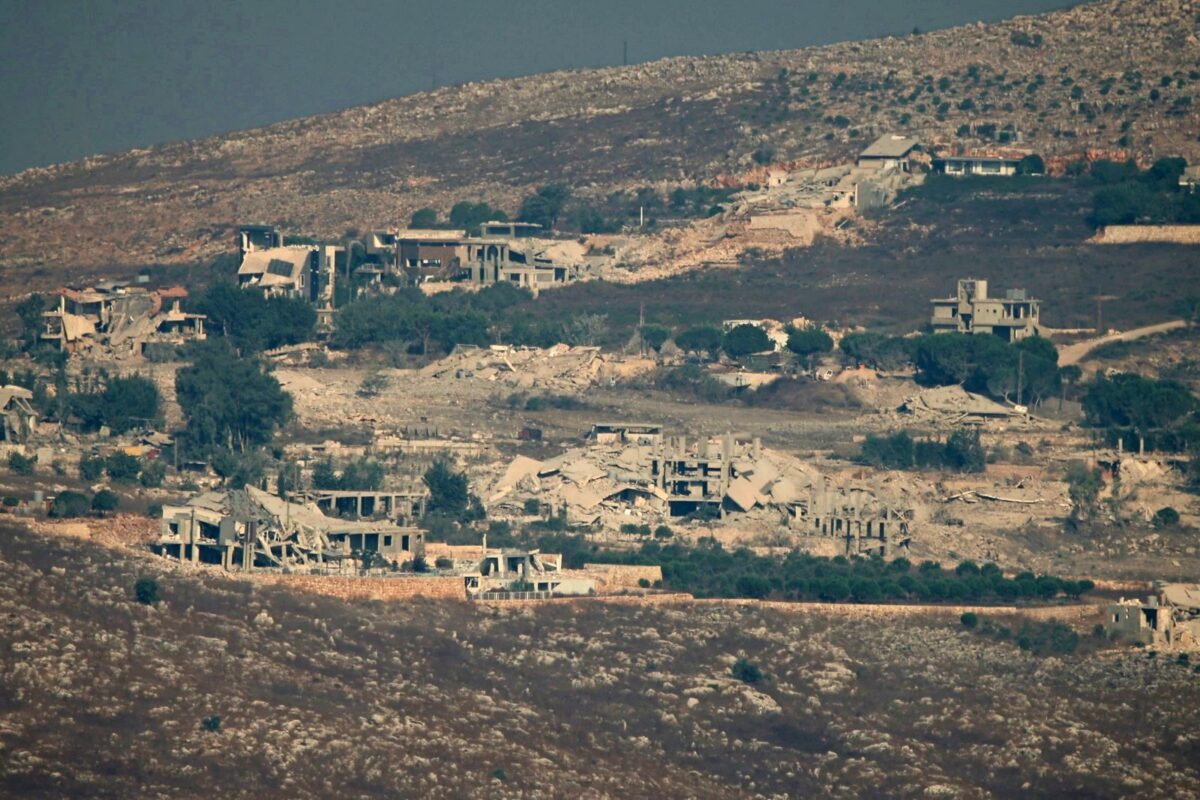
Kfar Tibnit, Lebanon. Photo by- / AFP. A picture shows destroyed houses in the southern Lebanese village of Kfar Tibnit on September 11, 2026, following an Israeli demolition on the Ali al-Taher ridge that triggered a 4.1 magnitude tremor.
Two years after the collapse of Bashar al-Assad’s regime, the strategic map of the Levant looks fundamentally different. The regional order that once connected Tehran to Beirut through Damascus has been disrupted, while Hezbollah’s military confrontation with Israel has exposed vulnerabilities that were previously concealed by the aura of deterrence.
Yet the transformation is less complete than its early observers predicted.
Hezbollah has lost much of its strategic freedom. Its leadership has suffered devastating blows, its traditional logistical environment has become more contested, and its ability to present itself as Lebanon’s uncontested national shield has weakened. But the organization has not disappeared. Its social base remains, its political influence endures, and the question of its weapons continues to shape Lebanon’s internal balance of power.
Hezbollah has lost much of its strategic freedom. Its leadership has suffered devastating blows, its traditional logistical environment has become more contested, and its ability to present itself as Lebanon’s uncontested national shield has weakened. But the organization has not disappeared. Its social base remains, its political influence endures, and the question of its weapons continues to shape Lebanon’s internal balance of power.
This distinction matters. The weakening of an armed non-state actor is not the same as the restoration of the state. Lebanon’s sovereignty is not secured simply because the regional axis that once empowered Hezbollah has been pushed back. It must still be built through institutions capable of governing, protecting, and integrating a deeply divided society.
The question facing Beirut is therefore no longer whether Hezbollah can preserve the regional order it once represented. It is whether Lebanon can convert the erosion of that order into a sustainable sovereign settlement.
The Limits of Deterrence
For decades, Hezbollah’s strategic legitimacy rested on a central proposition: that its military arsenal was indispensable to protecting Lebanon from Israel.
The party’s deterrence model combined missile capabilities, operational experience, political influence, and the implicit threat that any attempt to dismantle its armed structure could trigger a wider domestic confrontation. Its weapons were not merely a military asset. They were the foundation of a political arrangement in which the Lebanese state exercised sovereignty unevenly, particularly in matters of war and peace.
The September 2024 pager explosions and the subsequent Israeli campaign against Hezbollah’s leadership exposed the vulnerabilities of that model. The scale of the intelligence penetration, the loss of senior commanders, and the assassination of Hassan Nasrallah demonstrated that the organization’s military and security architecture was far more exposed than its public image suggested.
But the strategic lesson should not be overstated.
A damaged deterrence system is not necessarily a defeated one. Hezbollah may no longer possess the same freedom to determine the timing, scope, and consequences of confrontation.
A damaged deterrence system is not necessarily a defeated one. Hezbollah may no longer possess the same freedom to determine the timing, scope, and consequences of confrontation. Yet the ability to impose costs on Israel, retain a military infrastructure, and mobilize a loyal social constituency remains strategically relevant.
The more accurate conclusion is that Hezbollah’s deterrence has been degraded, not erased.
This distinction also applies to the concept of Wahdatal-Sahat, or the unity of the fronts. The regional escalation revealed the limits of an integrated resistance strategy when its principal actors faced different national calculations. Iran’s priorities were shaped by the survival of its own regime and the preservation of its strategic assets. Hezbollah, meanwhile, carried the direct military and political costs of confrontation in Lebanon.
This does not prove that Iran abandoned Hezbollah. It does demonstrate that regional alliances are governed by asymmetrical interests. Tehran may view Hezbollah as a vital strategic asset, but that does not mean the Lebanese organization can assume that Iran will absorb every cost of escalation on its behalf.
For Lebanon, the implication is clear: national security cannot remain dependent on a regional deterrence architecture whose priorities are ultimately determined elsewhere.
Damascus and the Geography of Strategic Depth
The fall of Assad was not simply a Syrian political event. It altered the logistical and geopolitical environment in which Hezbollah operated.
For decades, Syria served as Iran’s principal overland connection to Lebanon. It provided strategic depth, transit routes, storage facilities, and a political environment that enabled the movement of weapons and personnel. Damascus was not merely a geographic corridor. It was a central component of the regional architecture that sustained Hezbollah’s military position.
The collapse of the Assad regime disrupted that architecture.
The new authorities in Damascus face their own imperatives: consolidating power, controlling territory, managing relations with regional actors, and preventing Syria from becoming an arena for competing foreign militaries. These priorities do not necessarily align with the preservation of Iran’s traditional supply routes to Lebanon.
As a result, Hezbollah’s strategic environment has become more contested.
But the end of Assad’s rule should not be confused with the complete disappearance of the Iranian corridor. Geography remains. Networks adapt. Smuggling routes can change, and regional actors may seek alternative channels for transferring material and financial support.
But the end of Assad’s rule should not be confused with the complete disappearance of the Iranian corridor. Geography remains. Networks adapt. Smuggling routes can change, and regional actors may seek alternative channels for transferring material and financial support.
The more consequential development is not that the corridor has vanished, but that its political protection has become less certain.
That uncertainty raises the cost of rebuilding Hezbollah’s military capabilities and reduces the strategic predictability that once characterized the Iran–Syria–Lebanon connection. It also gives Damascus a greater stake in preventing its territory from becoming a launchpad for renewed regional confrontation.
For Beirut, this creates an opportunity. A more independent Syrian state could eventually become a partner in border management, arms control, and regional economic integration.
But that outcome is not automatic. It depends on Syria’s internal consolidation, the behavior of regional powers, and the ability of Lebanon and Syria to establish functioning state-to-state relations.
Lebanon’s Sovereign Moment
The weakening of Hezbollah’s regional position has created a strategic opening for Lebanon. It has not, however, created a ready-made state.
The Lebanese political class has long operated within a balance shaped by Hezbollah’s military power, sectarian calculations, and the fear that any attempt to alter the status quo could trigger internal violence.
That balance has been weakened. Yet the political system that sustained it remains.
Lebanon’s sovereignty therefore depends on three interconnected tasks.
First, the state must establish a credible monopoly over the use of force.
This does not mean that the Lebanese Armed Forces can simply impose disarmament through coercion. Such an approach could produce precisely the instability that the state is supposed to prevent.
The objective must be a negotiated, state-led process that places all weapons and military decisions under legitimate national authority, in accordance with the Lebanese Constitution and the implementation of United Nations Security Council Resolution 1701.
That process requires political legitimacy, institutional capacity, and credible security guarantees. It also requires an understanding that the integration of Lebanon’s Shiite community into the state cannot be separated from the question of Hezbollah’s military structure.
Second, Lebanon must rebuild the political institutions that can sustain sovereignty.
A stronger state cannot be built simply by weakening Hezbollah. Lebanon’s political class has its own history of corruption, patronage, sectarian deadlock, and institutional paralysis.
If these structures remain intact, the decline of Hezbollah’s military influence may produce a redistribution of power rather than genuine state-building.
The challenge is to transform the current strategic opening into institutional reform: an empowered executive, an independent judiciary, effective public administration, and a security establishment capable of operating without parallel chains of command.
Third, sovereignty must acquire an economic foundation.
Lebanon cannot expect international partners to finance reconstruction indefinitely while the country remains unable to control its security decisions.
Lebanon cannot expect international partners to finance reconstruction indefinitely while the country remains unable to control its security decisions.
But the relationship between sovereignty and economic assistance must not be reduced to a simple transaction. The Lebanese state must also demonstrate that it can deliver services, protect property, create employment, and provide a viable future for communities that have historically depended on non-state institutions.
Without that capacity, disarmament risks being perceived not as national integration, but as communal abandonment.
The Shiite Question Is a State Question
Any serious strategy for Hezbollah’s disarmament must recognize the difference between the organization and the community in which it operates.
The Shiite community is not a foreign instrument, nor can it be treated as a security problem to be managed. It is a central component of Lebanon’s political and social fabric.
Hezbollah’s influence has been sustained not only by ideology and military power, but also by decades of institutional patronage, social services, and the perception that the party provides protection in a state that has often failed to do so.
This is why a purely military approach is unlikely to produce a durable settlement.
The Lebanese state must offer an alternative political compact: equal citizenship, security under national institutions, meaningful political representation, and economic opportunities that do not depend on allegiance to a party-controlled system.
The objective should not be the marginalization of Hezbollah’s constituency. It should be the transfer of political and security authority from a party-led structure to the Lebanese Republic.
That is a far more difficult task than simply declaring the resistance defeated.
The Strategic Reality Ahead
The Levant is entering a period of strategic reconfiguration.
Iran’s regional projection of power has faced serious setbacks. Syria’s political transformation has disrupted the old regional architecture. Hezbollah’s military position has been weakened, and the Lebanese state has an opportunity to reclaim authority that it previously struggled to exercise.
But regional power vacuums do not automatically produce stable states.
Israel’s continued security concerns, the unresolved question of its military presence in southern Lebanon, Syria’s uncertain transition, Iran’s interest in preserving influence, and Hezbollah’s domestic resilience all complicate the path ahead.
Lebanon cannot build sovereignty in isolation from these forces. Nor can it afford to remain dependent on them.
The strategic choice is not between Hezbollah’s old model and an idealized state that can be constructed overnight. It is between a managed transition toward national sovereignty and a prolonged period of instability in which no actor possesses sufficient power to impose a settlement.
The first requires political courage. The second requires only inertia.
Two years after the fall of Assad, the old regional order has been weakened but not fully replaced. The resistance’s aura of invincibility has been damaged, but the institutions of the Lebanese state remain fragile.
The guns have not all fallen silent. The regional networks have not all disappeared. And the state has not yet filled the space left by the erosion of Hezbollah’s strategic dominance.
Lebanon’s sovereign moment is therefore not a victory already secured. It is a contest over what comes next.
The country can become a functioning state with control over its territory, foreign policy, and security decisions. Or it can remain trapped between the remnants of a declining regional order and the failures of its own political system.
The real strategic question is no longer whether the old order can return in its previous form.
It is whether Lebanon has the capacity—and the political will—to build something more durable in its place.
Ibrahim Rihan is a Lebanese journalist and writer focusing on Arab and international affairs. He is particularly interested in U.S., Saudi, and Egyptian policies in the Middle East.
The views in this story reflect those of the author alone and do not necessarily reflect the beliefs of NOW.