Contemporary Lebanese Maronites have largely lost awareness of their historical connection to Aleppo. Three decades of Syrian Baathist occupation in Lebanon, years of war in Syria, and the absence of any large-scale public history initiative within Maronite institutions have collectively severed that link. Yet the Maronites of Aleppo survived the recent war and the fall of the regime, restored a jewel of Maronite heritage in their magnificent Cathedral of Saint Elias, and preserved a history that carries lessons worthy of serious attention.
The earliest documented evidence of a Maronite presence in Aleppo dates to 727, recorded in the Chronicle of Denys of Tel Mahre (1). The community’s existence in the city is attested again in the eleventh century through the figure of Thomas of Kfartab, the Maronite bishop of Kūrat Ḥalab, the region of Aleppo, who is believed to have authored al-Maqālāt al-ʿAshr (The Ten Treatises), one of the oldest surviving Maronite written documents alongside Kitāb al-Hudā. Like other Aleppine communities, the Maronites suffered gravely under the Mongol invasion of the Levant and the siege and sack of Ayyubid Aleppo by Hülegü Khan in 1260. The community likely ceased to exist as an organized entity following the devastating sack of Mamluk Aleppo by Tamerlane in 1400.
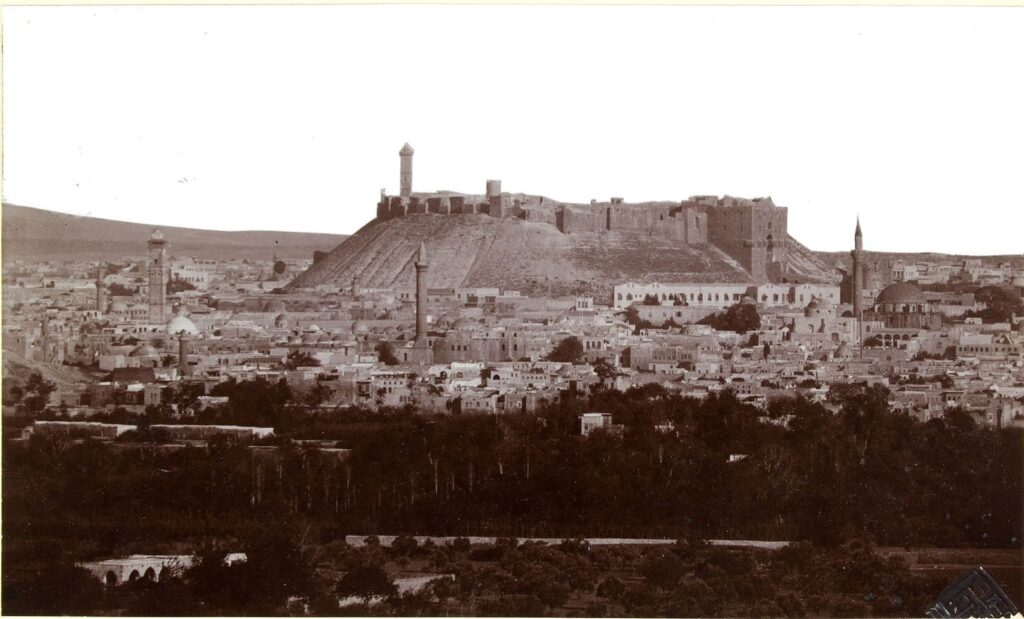
Late 19th century panorama of Aleppo, https://asia.si.edu/whats-on/blog/posts/aleppo-an-ancient-city-of-enduring-appeal/
Immigrants from Mount Lebanon eventually reconstituted the Aleppo Maronite community during the late Mamluk period. By 1490, they had established a modest church, that of Saint Elias, in the newly created Christian neighborhood of al-Judayda, literally “the new one.” Following the Ottoman entry into Aleppo in 1516, Maronite families who had previously migrated to Lebanon, as well as those departing at that time, began to return to their original homeland alongside other families. The community continued to grow throughout the Ottoman period, consolidating its urban presence and ecclesiastical structures over successive generations. Aleppo thereby came to occupy a key role in shaping the history of the Maronite Church as one of its rare and vital urban centers.
By the seventeenth and eighteenth centuries, Aleppo had emerged as the third-largest city in the Ottoman Empire, after Istanbul and Cairo, a major hub of culture, trade, and diversity. European consuls made it one of their principal centers of activity in the East, and the culture that would later be identified as distinctively Levantine was taking root there. Within this context, the Maronite community flourished, sustained both by the city’s commercial prosperity and by the presence of a resident bishop from 1638 onward. Yet the first bishop to reside permanently in Aleppo was the learned Bishop Germanus Farḥāt, who served from 1725 to 1732.
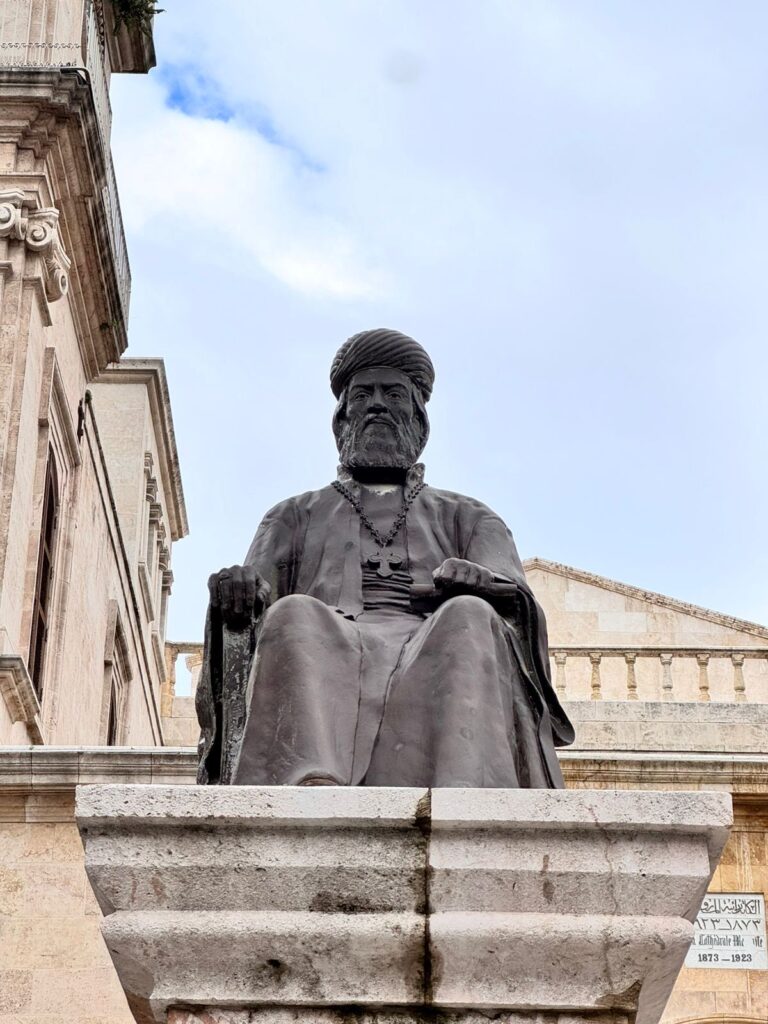
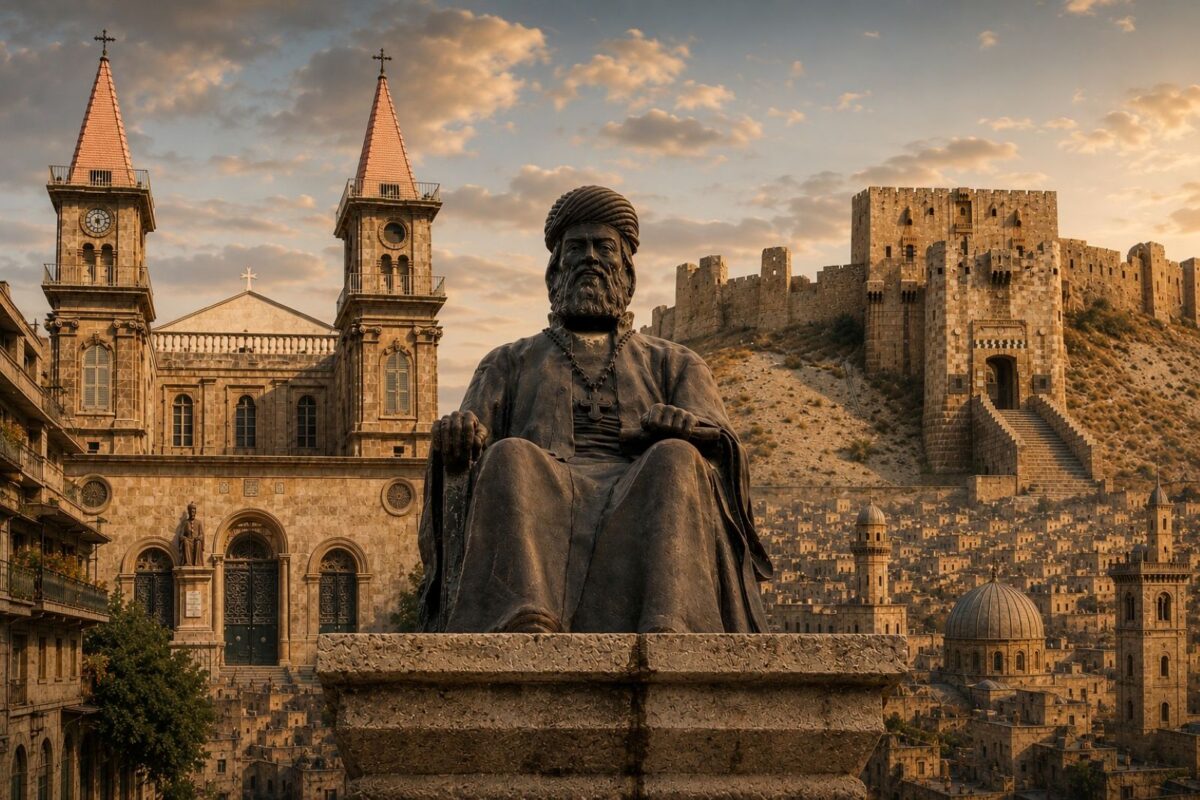
Statue of Maronite Bishop of Aleppo, Germanus Farḥāt (1725–1732), inaugurated in 1932, Farḥāt square, Aleppo. (Picture taken by Charles al-Hayek)
Aleppo is also linked to the formative years of one of the most consequential figures in Maronite and Lebanese history. Isṭifan al-Duwayhi, the future patriarch, was dispatched twice on mission to serve the community in Aleppo: first between 1658 and 1662, and again between 1662 and 1668. In 1663, he established al-Kuttāb al-Mārūnī, the Maronite School of Aleppo, where Syriac, Arabic, and Italian were taught.
One of the defining developments in the Maronite Church’s modern history had its direct origins in this same Aleppine milieu. Four young Maronite men from the city who studied at the Maronite School there, Gabriel Ḥawwā, ʿAbdallāh Qarāʿalī, Yūsuf al-Batn, and Germanus Farḥāt, resolved to renew monastic life within the Maronite Church and to transform the monastic order into an instrument of education and social mobility. They were received by Patriarch Isṭifan al-Duwayhi in Mount Lebanon in 1695, marking the official beginning of monastic reform in Maronite history. The new congregation subsequently divided into two branches in 1770: the Lebanese Maronite Order, known as the Baladites, and the Aleppian Maronite Order, formally renamed the Mariamite Maronite Order in 1969. In parallel, in 1700, Bishop Gabriel of Blouza founded the Antonine Maronite Order at the monastery of Mār Chaʿyā in Broumana, in the Matn district. These Aleppine-founded orders, alongside the Western missionaries then active in Lebanon, became the backbone of education in Mount Lebanon, generating the social and intellectual dynamics that allowed the Maronites to grow in influence, articulate a coherent national vision, and ultimately see that vision realized in 1920 with the proclamation of Greater Lebanon.
The Aleppine Maronite community also produced Germanus Farḥāt (1670–1732), the Maronite Archbishop of Aleppo and a figure of major significance in the history of Arabic literature. Living a full century before the beginning of the Arab literary revival, the Nahḍa, Farḥāt devoted considerable effort to laying its intellectual foundations. A prolific scholar, writer, and poet, he produced a substantial body of work encompassing Arabic syntax, lexicology, morphology, stylistics, and rhetoric. Farḥāt also established the Maronite library of Aleppo, famed for its manuscript collection. Over the following centuries, the library grew into one of the most important private manuscript collections in Syria, comprising more than 1,640 volumes, an irreplaceable repository of Maronite, Lebanese, and Syrian history of exceptional scholarly significance.
An equally remarkable figure from the Aleppine Maronite tradition was the mystic Hindiyya al-ʿUjaymī, born into a wealthy Maronite family in Aleppo in 1720. She went on to establish a religious order for women in Antoura in Mount Lebanon, representing a rare expression of Oriental mysticism within a church operating under substantial Western influence in the eighteenth century (2). Together, these figures embodied the distinctive intellectual character of the Aleppine Maronite tradition: urban, cosmopolitan, and positioned at the crossroads of Eastern and Western currents.
The period also produced an Aleppine Maronite who left an enduring mark on world literature. In 1709, Antoine Galland, the French scholar who had rendered The Thousand and One Nights from Arabic into French, met in Paris a young man named Hannā Diyāb (3). After nearly a decade of sustained work, Galland’s source material was exhausted, and his encounter with Diyāb, a native of Aleppo famed for its coffeehouse culture, literary cosmopolitanism, and professional storytellers, proved transformative. Among the stories Diyāb contributed were “Ali Baba and the Forty Thieves” and “Aladdin and the Magic Lamp,” today the best loved in Galland’s collection and comprising nearly one third of his Contes Arabes, though Diyāb received no attribution in the published work. When Galland’s journal was discovered and published in 1881, it restored that debt to the record. His entry of 5 May 1709 reads: “In the morning the Maronite Hanna from Aleppo finished telling me the story of the lamp.”
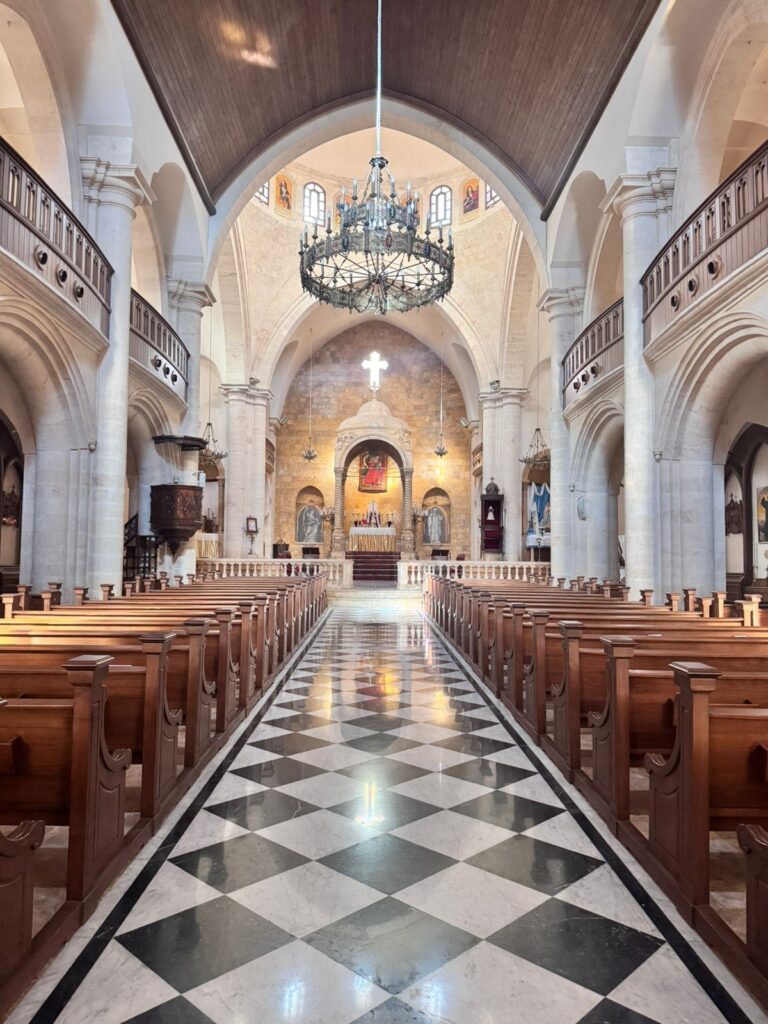
Restored interior of the Maronite Cathedral of Aleppo, 2026. (Picture taken by Charles al-Hayek).
The importance of the Maronite community in Aleppo is materially expressed in the scale and prominence of its cathedral within the city’s urban fabric and skyline. Located at the center of Farḥāt Square, named in honor of the Maronite bishop of the city, the Cathedral of Prophet Elias stands as one of the jewels of Syrian and Maronite architectural heritage. The original church on the site dates to the late fifteenth century. A new structure was erected on the same foundations in 1873 and subsequently renovated in 1914, when concrete was employed for the first time in Aleppo in the construction of its dome. The cathedral’s architectural style combines Aleppine craftsmanship with Western influence, a synthesis that reflects the city’s historic role as one of the great meeting points of East and West, and as one of the ancient cultural and commercial capitals of the Levant.
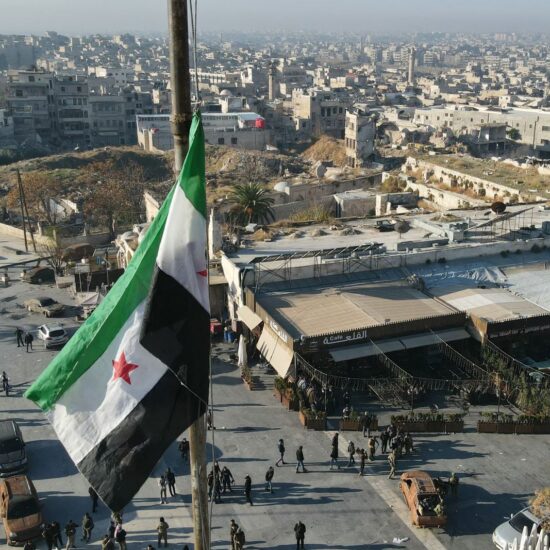
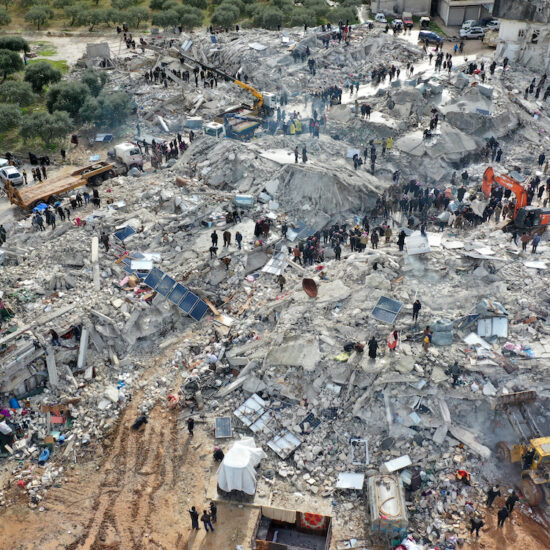
The war years between 2012 and 2016 subjected the historic core of one of humanity’s oldest continuously inhabited cities to systematic aerial bombardment, siege, and urban combat that reduced entire quarters to rubble. The partial destruction of the Maronite cathedral was a harsh blow to the collective memory of the Christian community: the roof collapsed under mortar fire in August 2012, and the interior, like the broader Christian quarter of al-Judaydah, was devastated by bombing in 2015.
The scale of destruction in the quarters of old Aleppo confronts the visitor with something beyond grief: a rupture in the continuity of cultural memory.
And yet the story of the Maronites of Aleppo extends beyond destruction. Œuvre d’Orient has supported the restoration of the cathedral, while the community has renovated the bishopric and is working actively to preserve its manuscript collection. Despite modest numbers, the Maronites of Aleppo have returned to their cathedral, reorganized their cultural and social life, maintained scouts, social workers, and choral groups, and demonstrated in concrete terms what it means to refuse erasure. They have also produced a documentary on the history of the community and the restoration of the cathedral, a tangible act of ensuring that their communal space of memory remains alive and legible to future generations (4).
The Maronites of Aleppo represent a forgotten connection, one that their counterparts in Lebanon would do well to recover. This is a community with deep roots, embedded in the urban fabric of a great city, connected to global history within its Mediterranean context, and actively participating in the modernization of Lebanon, Syria, and the Arab world. Recovering this connection is above all a matter of historical orientation. Heritage, properly understood, functions as a living energy that propels communities into the future, distinct from its reduction to a nostalgic or ideological bond to the past. In the context of the profound challenges Syria and Lebanon face, the example of the Aleppine Maronite community, its determination, its institutional continuity, and its commitment to safeguarding shared spaces of memory and heritage, demands attention and emulation.
Charles al-Hayek is a public historian and the founder of Heritage and Roots.
The views in this story reflect those of the author alone and do not necessarily reflect the beliefs of NOW.
Endnotes:
(1) Bkerki, “أبرشية حلب المارونية,” https://bkerki.org/eparchy/%D8%A3%D8%A8%D8%B1%D8%B4%D9%8A%D8%A9-%D8%AD%D9%84%D8%A8-%D8%A7%D9%84%D9%85%D8%A7%D8%B1%D9%88%D9%86%D9%8A%D8%A9/
(2) Bernard Heyberger, Hindiyya, Mystic and Criminal, 1720–1798: A Political and Religious Crisis in Lebanon, trans. Renée Champion (Cambridge: James Clarke & Co., 2013). Also cited in the PDF via Cambridge Core.
(3) The Book of Travels, Library of Arabic Literature, https://www.libraryofarabicliterature.org/books/9781479820016/the-book-of-travels/
(4) Documentary link cited in the PDF: https://youtu.be/wCaIVS8lHLE?si=4xjDREO8ky55zMDC