Let’s try a small exercise. Take a map of Lebanon and try to place a Phoenician site on it. One. Just one. Chances are the pen hovers, then stalls. This article opens a series naming those sites one by one, the temples, sites, and inscriptions that make up Lebanon’s and the Levant’s Phoenician record. The Phoenician past has become fashionable again on social media, and anchors competing claims about what it means to be phoenician or Lebanese. That fashion, though, rests on remarkably thin ground, and it stops well short of the school syllabus and any serious public discourse, an image of ships and an alphabet, rarely a place, and almost never a lesson. Umm el-Amed is one such place, a Phoenician temple complex that has slipped from public memory. Neglected for decades and now under direct threat from the conflict in South Lebanon, it sits barely twenty kilometers from Tyre.
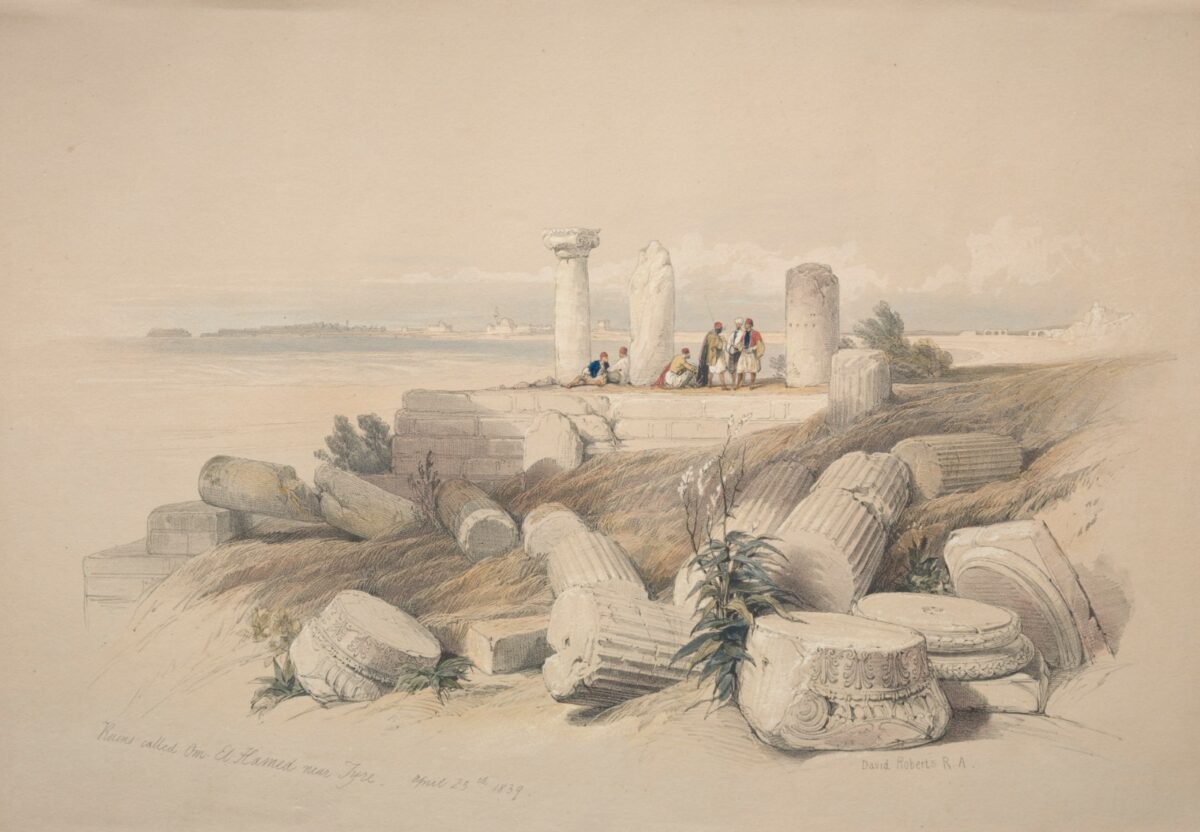
Overlooking the sea near Naqoura, the site takes its local name from the scattered column remains that once marked it: Umm el-Amed, “Mother of the Columns.” It entered the historical record in 1799, when the French antiquary Louis-François Cassas produced an engraving of the ruins, and resurfaced in 1861 in Ernest Renan’s Mission de Phénicie. Proper excavation, however, came only decades later: between 1943 and 1945, Maurice Dunand and his architect Raymond Duru led three campaigns on the site.
Their work uncovered two sanctuaries at the heart of the settlement. One, on a western acropolis facing the sea, was dedicated to Milk’ashtart; the other, known to archaeologists as the “East Temple” for its location, may have honored Astarte. Around these two temples, which together covered a third of the site’s total area, stood dozens of domestic installations and three necropolises, the layout of a small town built as much for cult as for daily life. Coins and pottery recovered there date the settlement’s peak to the Hellenistic period, and more precisely the third century BC, though traces of an earlier, pre-Hellenistic phase also came to light.
Let’s try a small exercise. Take a map of Lebanon and try to place a Phoenician site on it. One. Just one. Chances are the pen hovers, then stalls. This article opens a series naming those sites one by one, the temples, sites, and inscriptions that make up Lebanon’s and the Levant’s Phoenician record. The Phoenician past has become fashionable again on social media, and anchors competing claims about what it means to be phoenician or Lebanese. That fashion, though, rests on remarkably thin ground, and it stops well short of the school syllabus and any serious public discourse, an image of ships and an alphabet, rarely a place, and almost never a lesson. Umm el-Amed is one such place, a Phoenician temple complex that has slipped from public memory.
The finds indicate that the temples served local and regional populations, as was the case at many other Phoenician sanctuaries. The site is in the territory of the Phoenician Kingdom of Tyre, not far from Tyre itself to the north, and Akko, a secondary but important Phoenician city that later became a strategic base for the Achaemenid empire’s operations against Egypt. The temple stood close to the “Ladder of Tyre,” the main coastal highway linking the two cities, and beyond this coastal traffic, the inhabitants of the region lived primarily from agriculture, particularly olive cultivation.
The two temples were conceived as a “cella” (sacred building) within an enclosed “temenos” (sacred precinct). Their architecture, local in character, reflects some Egyptian influence, visible in the winged solar disk and Egyptian-style statues found on-site. Built during the Achaemenid period outside the urban centers of Tyre and Akko, the complex may have functioned, in the view of some scholars, as a neutral, semi-urban space capable of appealing to urbanites, wealthy landowners, and farmers alike.
The site’s full significance lives in its epigraphy. Phoenician inscriptions are rare survivals, and Umm el-Amed has produced one of the most substantial corpora known from rural Phoenicia, the temples’ architecture sets the stage, but it’s the stones’ texts that speak.
Of the seventeen inscriptions discovered at the site, all dating to the third, second centuries BC, sixteen are written in Phoenician characters and only one in Greek, strong evidence for the persistence of the Phoenician language in the Phoenician countryside well after the Greco-Macedonian conquests in 333 BC.
These stone inscriptions reveal, first, the ancient name of the settlement: Hammon, mentioned six times. They also identify its principal deities: Milk’ashtart, the tutelary god of the city, to whom the western sanctuary was dedicated, and Ashtart/Astarte, his consort and the great goddess of the Phoenicians, whose cult the East Temple may have housed. The inscriptions name several other deities venerated at the site, among them Baalshamin, Baal, Eshmun, and the Egyptian gods Osiris, Isis, Horus, Anubis, and Bastet, though Melqart, the great god of Tyre, is notably absent, a gap scholars continue to debate given the site location within the territory of the kingdom of Tyre.
The same inscriptions shed light on the prestigious offices held by those who commissioned them: Ba’alyaton was “chief of the [olive-oil] presses”; Ba’alshamar and his father Abdosir were “chief[s] of the gatekeepers”; and another Ba’alyaton, son of Abdhor, describes himself as a “priest of Milk’ashtart.” These were public benefactors, who financed works undertaken for the common good, the renovation of sanctuaries, and lavish offerings presented to their gods.
Beyond text, the site’s excavations have contributed directly to our understanding of Phoenician religion, cult practice, and art, and one object exhibited at the National Museum of Beirut illustrates this especially well.
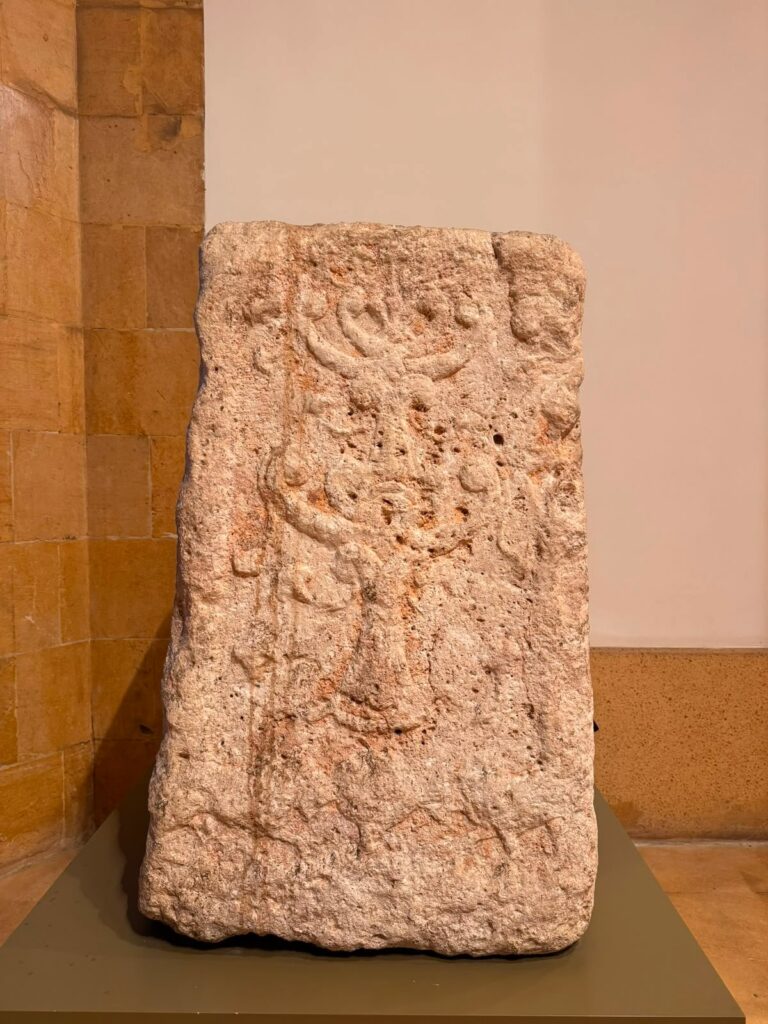
The ‘Sacred Tree”, the incense burner from Umm el-Amed, National Museum of Beirut. Picture by the author.
Discovered by Dunand and Duru in the courtyard of the sanctuary of Milk’ashtart, this quadrangular limestone structure rises 123 cm in a slightly pyramidal form. It is carved in relief on three faces, with the fourth holding a rectangular cavity where offerings were likely burned. The main face shows two kneeling bulls flanking a “sacred tree” in superimposed volutes. The side faces depict bareheaded, barefoot figures advancing toward it in adoration, one carrying a “handled censer” guarded by a sphinx wearing the double crown of the pharaohs, the other showing two more attendants, one of whom may have held high rank given his costume. In a single monument, the object captures a cultic scene in action, offering a rare, direct glimpse of worship at Hammon.
Nowhere at Umm el-Amed do the Phoenicians become as visible as in its stelae. Twenty-three of them, dated between the fourth and second centuries BC, show men and women standing in a gesture of adoration (raised right hand), frozen in stone at the exact moment of prayer. The figures fall into three groups: women; men in a short robe; and men in a long robe and headdress, holding a cult object, usually a hand-sized bowl with a handle shaped as a nude girl, the so-called “swimming girl,” an object originally from Egypt. Inscriptions attached to the long-robed figures name their titles: priest, chief, chief of the gates, and one of these long-robed dignitaries stands out.
Umm el-Amed argues otherwise, and it exposes the real gap still to be closed: the neglect, and the absence of any real policy for discovering and protecting the Phoenician past. It is unacceptable that Lebanese students cannot place a site of this magnitude on the map of their own heritage.
The Ba’alshamar stele offers a rare, direct meeting with an individual: his likeness, his lineage as named in the inscription, and his place in the sanctuary all still legible on the stone. Discovered at Umm el-Amed and exhibited today at the National Museum of Beirut, it rewards a visit in person, dated to the third–second century BC. Beneath a curved winged disk in Egyptian style, a barefoot man stands on a trapezoidal pedestal with an Egyptian-style cornice, facing left in a long tunic, his right hand raised in adoration and his left holding a molded casket, likely for incense. A cap sits over a headband on his head, and a stole, a probable mark of rank, falls from his shoulder to a braid at its end.
The man’s name is itself telling: Ba’alshamar, a theophoric name meaning “Baal has guarded/protected”. He held the office of “chief of the doorkeepers” (rb š’rm), a title mentioned elsewhere in Phoenician inscriptions and associated with a high rank in the priestly hierarchy, one that, in this case, appears to have passed through the family, since his son Abdosir bore the same title. Carved into the base, the Phoenician inscription commemorates him:
“To Ba’alshamar, son of Abdosir, erected for his father, the chief of the porters.”
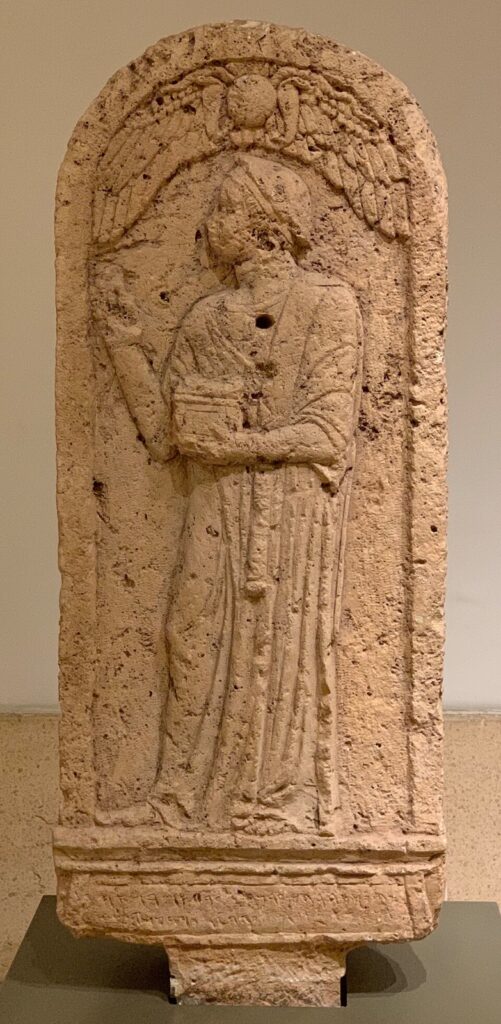
Baalshamar stele from Umm el-Amed. National Museum of Beirut.
Among the site’s discoveries, one object is a working instrument for measuring time, carved some 2,000 years ago. The Umm el-Amed sundial is shaped as a half-sphere or concave quarter-sphere and marked with eleven lines that divide the span between sunrise and sunset into twelve equal hours. Its discovery in two separate fragments, 80 meters apart, mirrors the story of the site’s own excavation. The first piece surfaced in 1860–61, during Ernest Renan’s Mission de Phénicie, and is held at the Louvre. The second piece waited more than eighty years longer, emerging only in Maurice Dunand’s 1943–45 campaigns, and is now held at the National Museum of Beirut. Together, the fragments carry a Phoenician dedication:
“To Lord Milkashtart, god of Hammon, from your servant Abdosir, son of [ ].”
Two fragments, recovered nearly a century apart by two different missions, reunited only in reconstruction, the sundial’s split history mirrors the history of Umm el-Amed itself: known, lost sight of, and pieced back together.
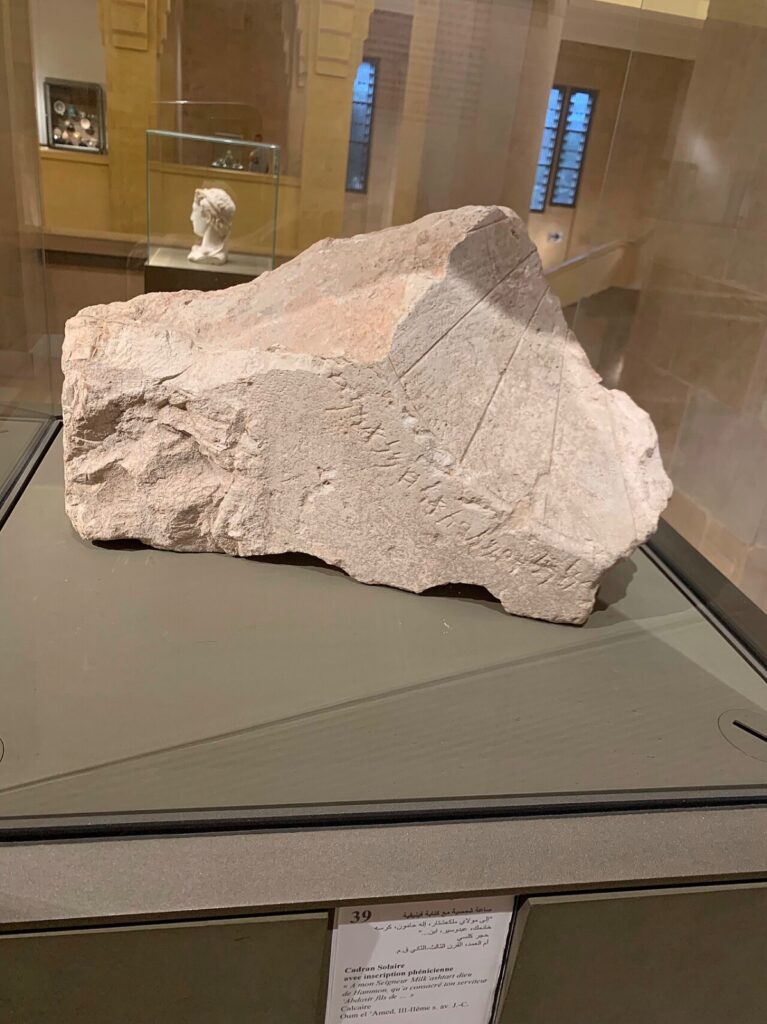
Fragment of the Sundial of “Abdosir”, Umm el-Amed, National Museum of Beirut.
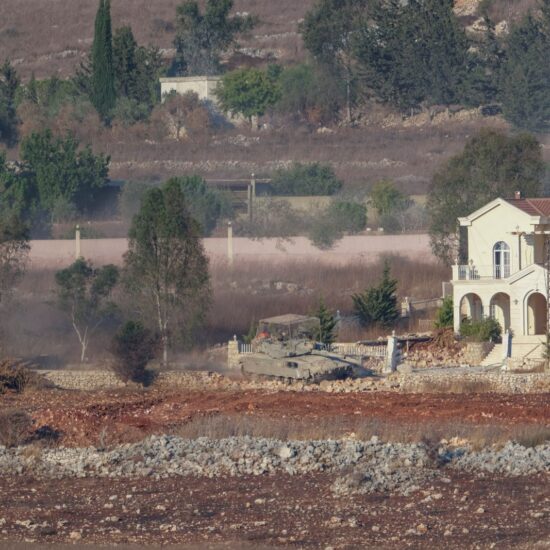
The 2024 war between Israel and Hezbollah left the site, already worn by years of neglect and pillaging, newly vulnerable, and the fighting that has continued into 2026 has kept it that way. Amid that first war, Umm el-Amed was placed under UNESCO’s enhanced protection for cultural property in Lebanon, following Lebanese lobbying efforts.
That international protection came as a response to local demand. The question is whether it is enough. The site still remains absent from history textbooks and school curricula, unknown to the very population it could inspire to rediscover these ancient roots. Lebanon’s present-day territory holds three of the ancient Iron Age Phoenician kingdoms: Byblos, Sidon, and Tyre, with the fourth, Arwad, sitting just across the border in present-day Syria. A country holding this share of the Phoenician heartland might be expected to have a policy for identifying, protecting, and teaching its Phoenician sites. Umm el-Amed argues otherwise, and it exposes the real gap still to be closed: the neglect, and the absence of any real policy for discovering and protecting the Phoenician past. It is unacceptable that Lebanese students cannot place a site of this magnitude on the map of their own heritage.
The Phoenician past merits scholarship, a curriculum, and a public that can walk into the National Museum, stand before the Ba’alshamar stele, and gain a real historical understanding of the land it stood on. That strategy, to protect, excavate, and teach this past, is missing. Umm el-Amed is still waiting, and the clock is running, and every season without protection is a season closer to losing it for good.
Charles al-Hayek is a public historian and the founder of Heritage and Roots.
The views in this story reflect those of the author alone and do not necessarily reflect the beliefs of NOW.