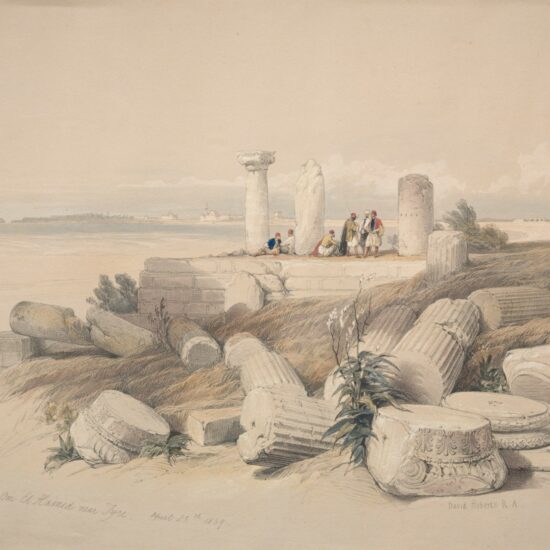
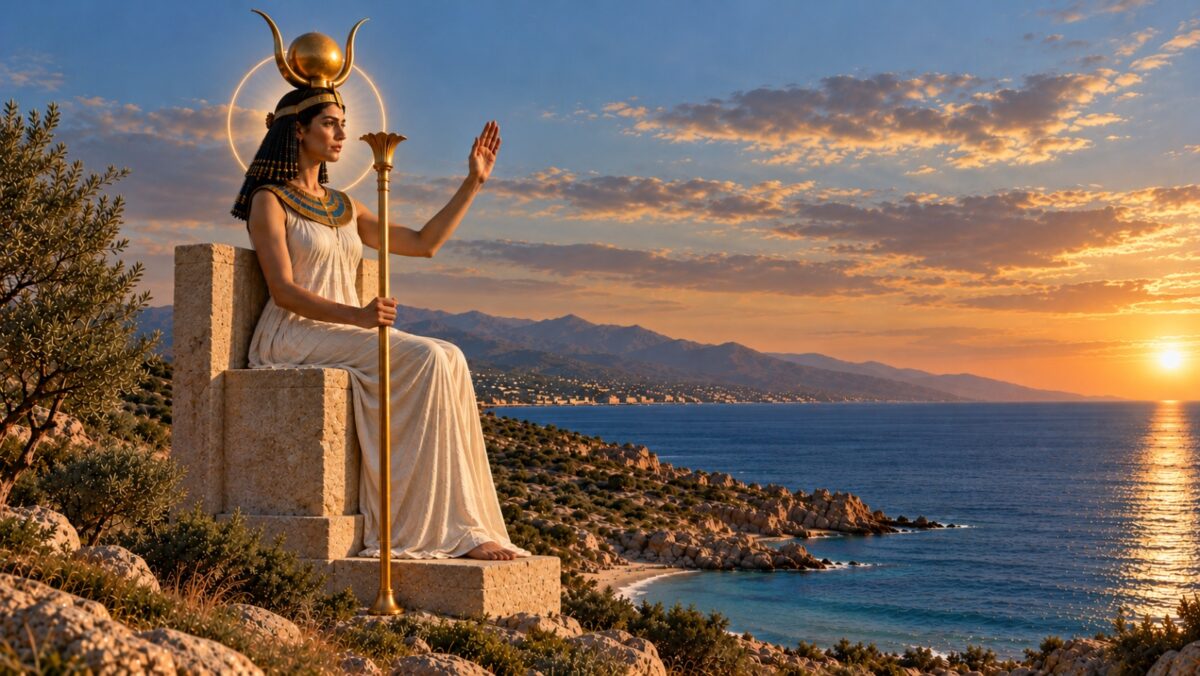
For nearly three thousand years, Baalat Gubal, the Lady of Byblos, presided over one of the oldest cities in the world, receiving offerings from Egyptian pharaohs, Byblian kings, and ordinary worshippers. Today a single rusted panel beside the ruins of her temple marks her presence, and school textbooks grant Phoenician religion a few lines at most. Weak pedagogy and identity wars have drained Phoenician history of life in Lebanese classrooms, though few subjects awaken curiosity as readily as the religions of the ancients, which open a direct path into the minds of those who came before us. Who was the Lady of Byblos, and why has she vanished from her own city’s archaeological itinerary and from our textbooks?
To answer, we must first recover her: who she was, what powers she held, and what archaeology reveals about the cult that surrounded her. The Phoenician name bʿlt gbl means “Lady of Gubal,” the ancient name of present-day Jbeil-Byblos, and served as the name or title of the city’s principal goddess. She appears in Phoenician inscriptions from the beginning of the first millennium BC, yet Egyptian sources had recorded her long before as Nbt kpn, “Lady of Byblos”. In fact, Byblos maintained close commercial and cultural ties with Egypt as early as the Old Kingdom, driven above all by the cedar trade, and Egyptian cultural influence remained strong in the city until the end of antiquity. New Kingdom texts continue to attest the close bond between Hathor and the goddess of Byblos. The Gebel Barkal stela of Thutmose III records:
“Now My Majesty travelled to the ends of Asia. I let many ships be constructed of cedar, on the hills of the God’s Land, in the presence of the mistress of Byblos…”
Baalat Gubal also figures prominently in the Amarna letters, the diplomatic correspondence of the fourteenth century BC. Rib-Hadda, king of Byblos, sent over sixty letters to pharaoh Akhenaten, recording the deteriorating situation around his city and across the Levant while Egypt was absorbed by Akhenaten’s religious reforms. In these letters, written in Akkadian, the goddess stands as witness and guarantor of the king’s words. Rib-Hadda invokes her with near regularity when wishing the pharaoh strength, presenting her as a source of royal power:
“Rib-Hadda says to his lord, king of all countries, Great King: May the Lady of Gubla grant power to my lord. I fall at the feet of my lord, my Sun, 7 times and 7 times…”
Rib-Hadda also names individuals attached to the goddess’s cult. In one of his letters, he reports that Ummahnu, the “maidservant of the Lady of Byblos,” probably a priestess of the goddess, and her husband Milkuru intercede with the Lady of Byblos on the pharaoh’s behalf. Scholars believe that these prayers for the pharaoh’s wellbeing show that Baalat Gubal and her priests had a voice in the city’s international relations.
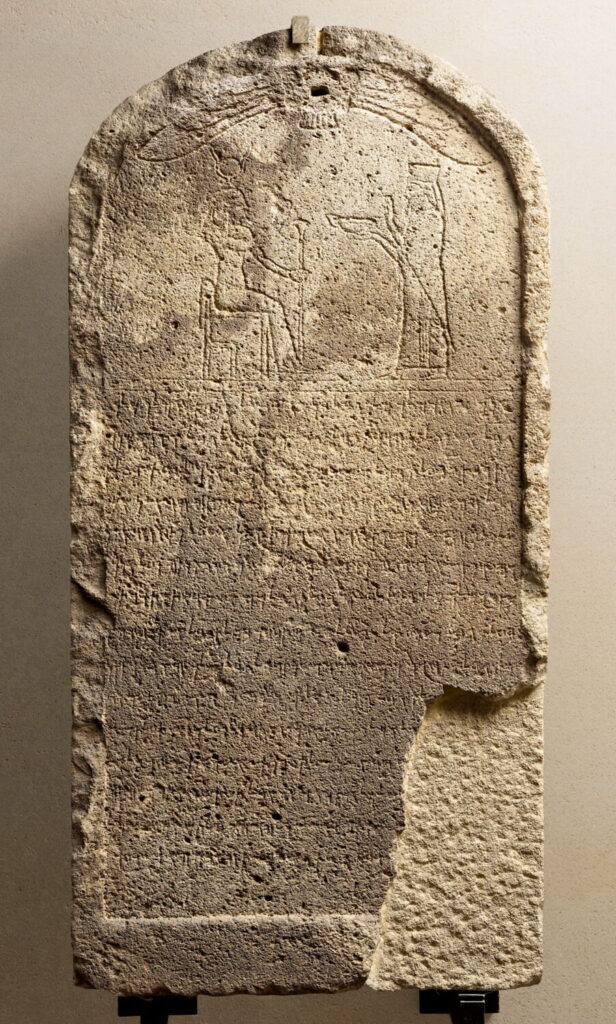
Stele of King Yehawmilk depicting and mentioning Baalat Gubal, c. 450 BC, Byblos, Department of Near Eastern Antiquities, Louvre, Paris.
Several kings of Byblos in the first millennium BC, proclaimed themselves under the protection of Baalat Gubal. The most eloquent royal testimony comes from Yehawmilk, who reigned in the fifth century BC. His stele, now in the Louvre, ranks among the most important sources for understanding her cult. In its upper register, the king stands in worship before the enthroned Baalat, who raises her hand in blessing, wears the Hathoric crown, and holds a sceptre in her left hand, while a great winged solar disc crowns the whole scene. These images display the strong Egyptian imprint on the goddess’s forms and iconography, an influence that persisted into much later times. The missing fragment of the inscription is held in the National Museum of Beirut, and the text records the works Yehawmilk carried out on her temple and calls upon her blessing in terms of striking intimacy:
“…I, Yehawmilk, King of Byblos, made (this work) for my Lady Baalat Gubal. When I call to my Lady Baalat Gubal, She hears my voice, and does good things to me. May Baalat Gubal bless Yehawmilk, King of Byblos, and may She grant him long life, and prolong his days and years over Byblos, for he is a righteous king…”
The king then asks for a double favor, in the eyes of the gods and in the eyes of his people, placing the goddess at the service of his political legitimacy:
“…May [the Lady Ba]alat of Byblos grant [him] favor in the eyes of the gods and in the eyes of the people of this land, and may She grant favor to the people of this land, [and favor in the eyes of] the whole kingdom…”
Today a single rusted panel beside the ruins of her temple marks her presence, and school textbooks grant Phoenician religion a few lines at most. Weak pedagogy and identity wars have drained Phoenician history of life in Lebanese classrooms…
Closely tied to her role as proteress of the city, the inscriptions of Byblos reveal the goddess’s bond with the king and with royalty in all its dimensions. Her temple, embellished by Yehawmilk, was among the oldest in the city. It stood on the acropolis beside the sanctuary of a male god who may have been her consort, and its first phase dates to the early third millennium BC. Measuring approximately 60 by 40 meters, it occupied the highest point of the city’s sacred sector near the sacred well, with a series of accessory rooms and a single southern exit. The sanctuary was rebuilt and enlarged over several phases. Built mainly of stone masonry, its monumental scale reflected Levantine traditions while incorporating Egyptian elements. The sanctuary remained in use for nearly three thousand years, into the Roman period. A coin struck at Byblos under the emperor Macrinus (r. 217–218 AD) shows a temple with its sacred enclosure and a large conical sacred stone, generally identified as the temple of Baalat Gubal and the only surviving depiction of it. However, one question remains unresolved: was Baalat Gubal an epithet concealing the goddess’s true name within the Phoenician pantheon, or was it her name in its own right?
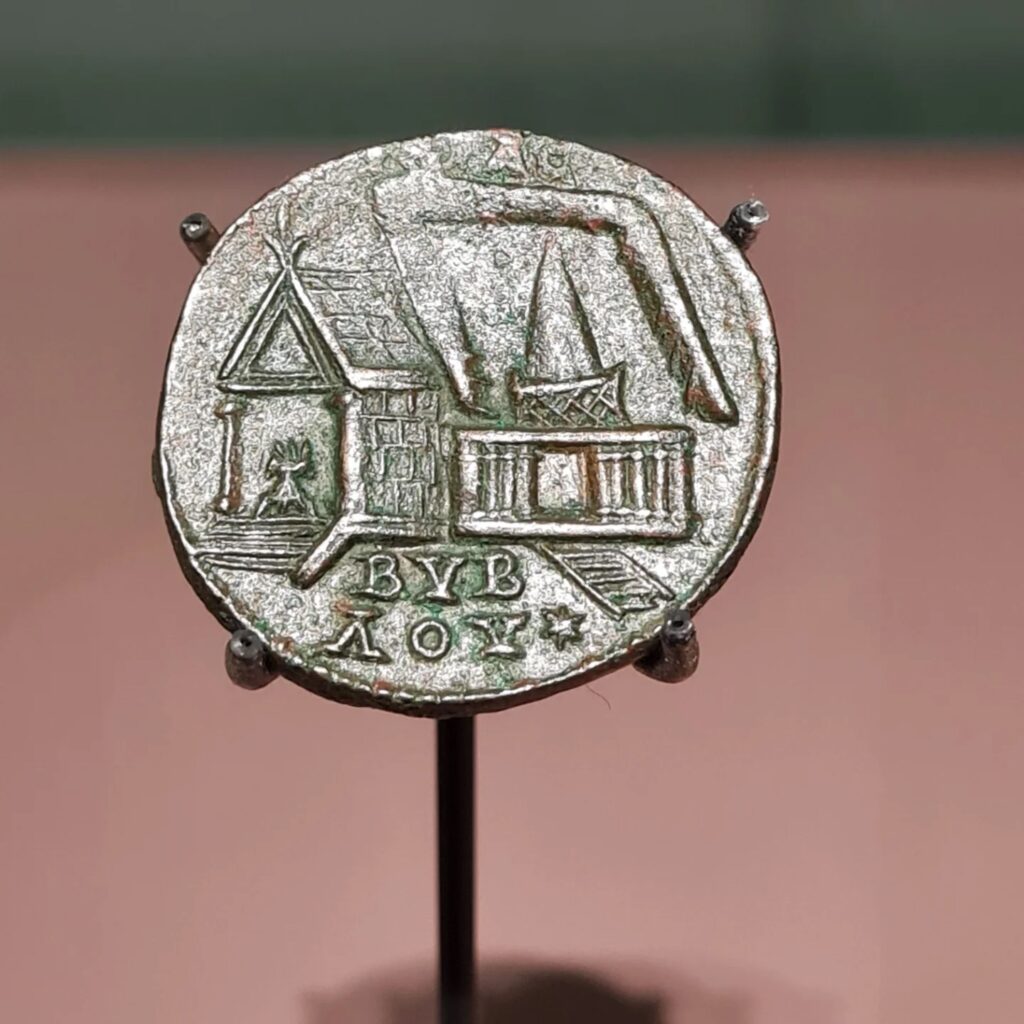
Roman coin from Byblos underemperor Macrinus (r. 217–218 AD) shows a temple with its sacred enclosure and a large conical sacred stone, generally identified as the temple of Baalat Gubal, BNF, Paris.
The cult of the goddess outlived the Phoenician monarchy of Byblos, which disappeared in the aftermath of Alexander the Great’s conquest and the spread of Hellenism in the 4th c. BC. Her identification with Astarte, the most widely venerated goddess of the Phoenician world, was already under way before the Hellenistic period. A terracotta model of a throne from the fourth century BC bears two dedicatory inscriptions on its back: one in Phoenician with the customary formula lbʿlt gbl, “to the Lady of Byblos”, and one in Greek addressed to Astarte, “the greatest goddess”. Scholars still dispute whether the two texts are contemporary, yet the object clearly attests the merging of the two goddesses. Under Hellenistic and Roman rule, her cult was reinterpreted through Greek religious culture. Under Roman rule, the continuity of her cult is attested first by Philo of Byblos. His Phoenician History, written in Greek in the late first or early second century AD, survives in excerpts quoted by Eusebius of Caesarea. Philo presented the work as a translation of the ancient Phoenician author Sanchuniathon, and modern scholars read it as a composite that recasts Phoenician traditions through Greco-Roman culture.
In Philo’s narrative, Baalat Gubal appears as Dione. The god Ouranos sends her and her two sisters, Astarte and Rhea, to trick and defeat their brother Kronos, who instead marries all three and fathers their children, whose number and names are lost. Elsewhere in the work Kronos is identified with El. No other source pairs Baalat Gubal with El, and the union would also have surprised Greek readers, for whom Dione was generally a consort of Zeus. The account culminates in an episode of direct local significance: when Kronos distributes cities among the gods, he grants Byblos to her, here also called Baaltis. The myth thus serves as a charter for the goddess’s lordship over her city, still meaningful in Roman times.
Restoring Baalat Gubal to the picture gives our ancestors a face, a name, a ritual, and a map of their beliefs. Public discussion of Lebanon’s ancient past too often oscillates between denial and myth-making; her story offers it solid ground, as one of the many diverse elements that compose the history of Lebanon.
Another Roman-era source, Lucian’s De Dea Syria, written in the second century AD, describes the great sanctuary of the “Byblian Aphrodite” at Byblos. Lucian also reports on Adonis, the goddess’s divine lover, and on the rites mourning his death, which included ritual breast-beating, the shaving of heads, and a form of temporary prostitution imposed on women who refused to be shaved:
“…I saw too at Byblos a large sanctuary of Byblian Aphrodite: this is the scene of the secret rites of Adonis: I mastered these. They assert that the legend about Adonis and the wild boar is true, and that the facts occurred in their country, and in memory of this calamity they beat their breasts and wail every year, and perform their secret ritual amid signs of mourning through the whole countryside…after this they allege that he is alive again… They proceed to shave their heads, too, like the Egyptians… The women who refuse to be shaved have to submit to the following penalty, to stand for the space of an entire day in readiness to expose their persons for hire…”
Lucian offers a briefer glimpse of the goddess’s cult beyond the city, in the mountains of Lebanon. A day’s journey from Byblos stood an ancient sanctuary of Aphrodite, generally identified with Afqa, where a Roman era temple faced the sacred grotto at the source of the Adonis river:
“…I went up also from Byblos into the Libanus, a single day’s journey, as I had heard that there was an ancient sanctuary of Aphrodite there founded by Cinyras. I saw the sanctuary, and it was indeed old…”
It is at Afqa that we may be able to trace the end of the cult of the Lady of Byblos. If the goddess worshipped there in Roman times was a form of Baalat Gubal, the fate of her mountain sanctuary tells us how her cult came to an end. If she was a distinct deity, Afqa still offers precious evidence of how ancient Phoenician religion disappeared. The early Christian writers viewed the persistence of paganism in Lebanon with deep concern, and two of them describe the fate of this sanctuary.
Eusebius of Caesarea (c. 260–339 AD), bishop and biographer of the emperor Constantine, wrote his Life of Constantine shortly after the emperor’s death in 337. His account carries particular weight because he was a contemporary of the events and close to the imperial court, which makes him our earliest witness to the destruction of the temple, around 330. His hostility toward pagan worship is equally evident, and his description of the rites says more about Christian polemic than about the cult itself:
“…Aphaca, on part of the summit of Mount Lebanon, and dedicated to the foul demon known by the name of Aphrodite…Here men undeserving of the name forgot the dignity of their sex, and propitiated the demon by their effeminate conduct; here too unlawful commerce of women and adulterous intercourse…”
He goes on to relate that Constantine had the temple destroyed by military force:
“…[He] gave orders that the building with its offerings should be utterly destroyed. Accordingly, in obedience to the imperial command, these engines of an impure superstition were immediately abolished, and the hand of military force was made instrumental in purging the place…”
Sozomen (c. 400–450 AD), a lawyer in Constantinople who wrote his Ecclesiastical History in the 440s, returned to the episode more than a century later. His account is significant for a different reason: it preserves a local belief about the sanctuary, the descent of a star-like fire into the Adonis river, which shows how the goddess, here called Urania, was still remembered long after her temple fell. He also stresses the psychological aim of the destruction, which was to make the population despise what it had once revered:
“…and that of Venus at Aphaca, near Mount Lebanon and the River Adonis, were then undermined and entirely destroyed…The efforts of the emperor succeeded to the utmost of his anticipations; for on beholding the objects of their former reverence and fear boldly cast down and stuffed with straw and hay, the people were led to despise what they had previously venerated, and to blame the erroneous opinion of their ancestors…”
The cult of the Lady of Byblos came to an end through a convergence of factors over the fourth and fifth centuries: the withdrawal of imperial patronage from the temples, the probable disappearance of her priesthood, the spread of Christianity, and the forcible closure of sanctuaries by imperial decree, from Constantine’s measures to the Theodosian edicts of the 390s.
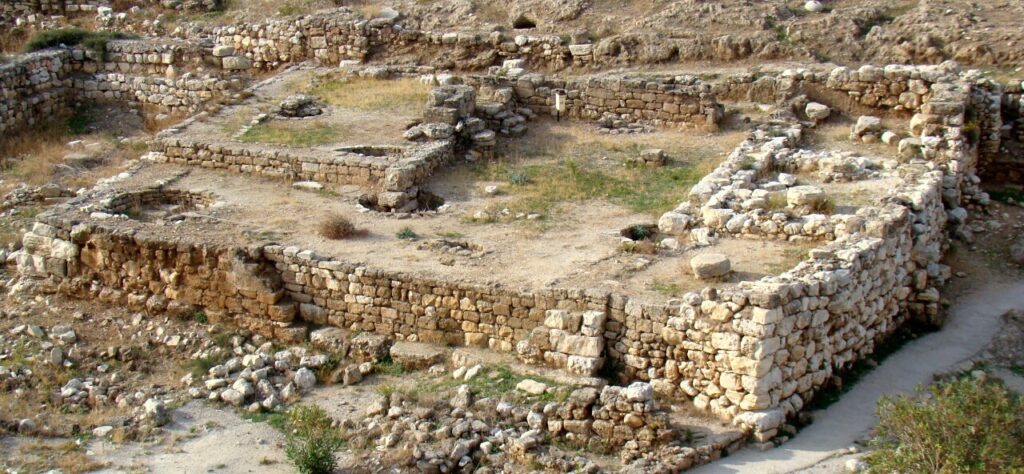
Archeological remains of the temple of Baalat Gubal in Byblos.
Tracing the cult of Baalat Gubal deepens our understanding of the religious landscape of ancient Lebanon. It also raises uncomfortable questions. Why do these texts circulate almost exclusively in scholarly publications? How can curiosity be kindled when school curricula leave so little room for the religious life of Phoenician civilization? Why do our textbooks pass over her story in silence, and why does the city she once ruled grant her a single panel? And how can we invite Lebanese, adults and children alike, to take an interest in their past when the stories that bring it to life remain out of reach?
The cult of Baalat Gubal teaches us more than the history of one goddess. It reveals the antiquity of urban life on our coast, the depth of its religious traditions, and the reach of its commercial ties. It illustrates the dynamics of influence, continuity, change, and rupture that shaped this land over three millennia. Restoring Baalat Gubal to the picture gives our ancestors a face, a name, a ritual, and a map of their beliefs. Public discussion of Lebanon’s ancient past too often oscillates between denial and myth-making; her story offers it solid ground, as one of the many diverse elements that compose the history of Lebanon. She deserves, at the very least, to have her image restored beside her temple, and a little more space than a rusted panel, so that visitors may once again look upon the goddess who presided over Byblos.
Charles al-Hayek is a public historian and the founder of Heritage and Roots.
The views in this story reflect those of the author alone and do not necessarily reflect the beliefs of NOW.