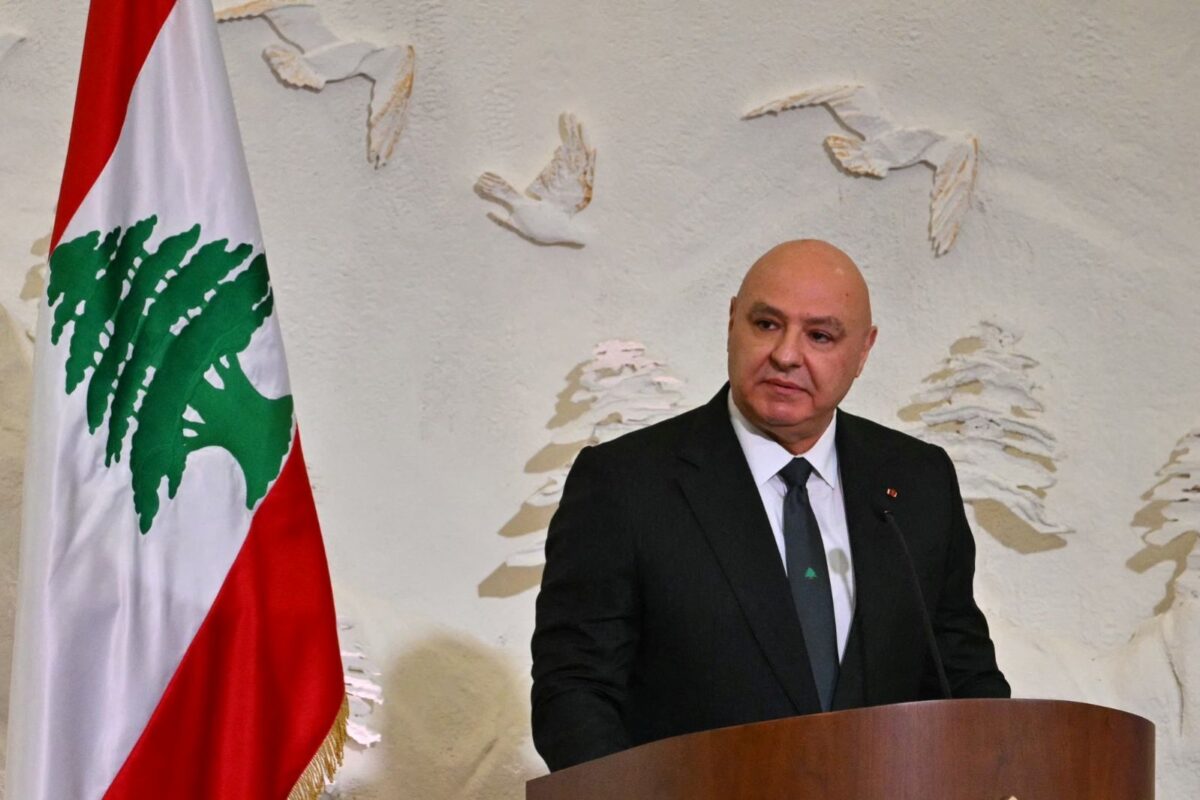
Lebanon's President Joseph Aoun delivers a speech during a meeting of Pope Leo XIV with authorities, civil society and diplomatic corps at the presidential palace in Baabda, east of the capital Beirut, on November 30, 2025. (Photo by Andreas SOLARO / AFP)
When Joseph Aoun declared that “negotiations are not treason,” he did more than defend a policy choice, he challenged a political culture that has long equated diplomacy with surrender and war with dignity. His statement is not merely rhetorical; it is a necessary intervention in a country that has paid, repeatedly and disastrously, for confusing “Resistance” with recklessness.
The president’s position is grounded in a simple but often ignored principle: states negotiate. Militias posture. For decades, Lebanon has been trapped in a dangerous inversion of this logic, where non-state actors monopolize war-making decisions while the state is left to manage the consequences. Aoun’s remarks seek to restore a basic hierarchy, one in which the Lebanese state, not armed factions, determines when and how Lebanon engages in conflict or peace.
The backlash was immediate. Hezbollah, through its secretary-general Naim Qassem, rejected any form of direct negotiations, describing them as a “grave sin.” This reaction is both predictable and revealing. It underscores a deeper reality: negotiations threaten not just a military posture, but an entire political economy built on perpetual confrontation.
Aoun’s most pointed question cuts to the heart of this contradiction: was there ever a national consensus when the decision for war was made? The answer, of course, is no. Lebanon was dragged into successive conflicts, most recently under the banner of “supporting Gaza” and, more broadly, advancing Iranian regional interests, without institutional approval, without parliamentary debate, and without public consent. Yet when the state attempts to pursue negotiations, it is suddenly asked to meet a standard of consensus that was never applied to war.
This asymmetry is not accidental; it is structural. War, for some actors, is a tool of leverage. Peace, by contrast, is a process that redistributes power, back to institutions, to borders, to sovereignty. That is precisely why negotiations are framed as betrayal: because they threaten to end the ambiguity that sustains parallel authority.
The president’s insistence on a ceasefire as a precondition for talks is also significant. It reflects an attempt to anchor negotiations in reciprocity and international guarantees, particularly through U.S. mediation. The reference to commitments that Israel would halt offensive operations is not a sign of naivety, it is a recognition that diplomacy, unlike war, produces verifiable frameworks. These frameworks may be imperfect, even violated, but they create a basis for accountability that endless fighting never does.
More importantly, Aoun reframes the debate around the south. His question, how long will the people of the south continue to pay the price for other people’s wars? is perhaps the most politically explosive part of his statement. It challenges the moral narrative that has long justified turning southern Lebanon into a battlefield for regional agendas. By distinguishing between wars fought for Lebanon and those fought for others, Aoun draws a line that many have avoided for years.
This is not a call for capitulation. It is a call for clarity. Lebanon has signed a ceasefire agreement with Israel before. The 1949 armistice was not an act of surrender; it was a recognition of reality and a framework that preserved relative stability for decades. To invoke that precedent today is not to lower expectations, but to restore a sense of proportion. Ending a state of war does not mean abandoning sovereignty, it may be the only way to reclaim it.
Critics argue that negotiations under fire amount to coercion. They are not entirely wrong. But the alternative they implicitly defend, a permanent state of low-intensity war punctuated by devastating escalations, is far worse. Lebanon does not have the luxury of ideological purity. It has an obligation to survive.
The deeper issue, then, is not whether to negotiate, but who decides. As long as the authority to wage war remains outside the state, any negotiation will be contested, undermined, or dismissed as irrelevant, exactly as Hezbollah has already done by declaring that the talks “do not concern us.” This is not just a rejection of negotiations; it is a rejection of the state itself as the ultimate arbiter of national policy.
Aoun’s statement, therefore, should be read as more than a defense of talks with Israel. It is an attempt, perhaps the most explicit in years, to redefine patriotism. Not as the loudest slogan, nor the most militant stance, but as the willingness to take responsibility for the country’s future.
Negotiations are not treason. The real betrayal is the normalization of endless war, and the quiet acceptance that Lebanon exists to serve battles that are not its own.