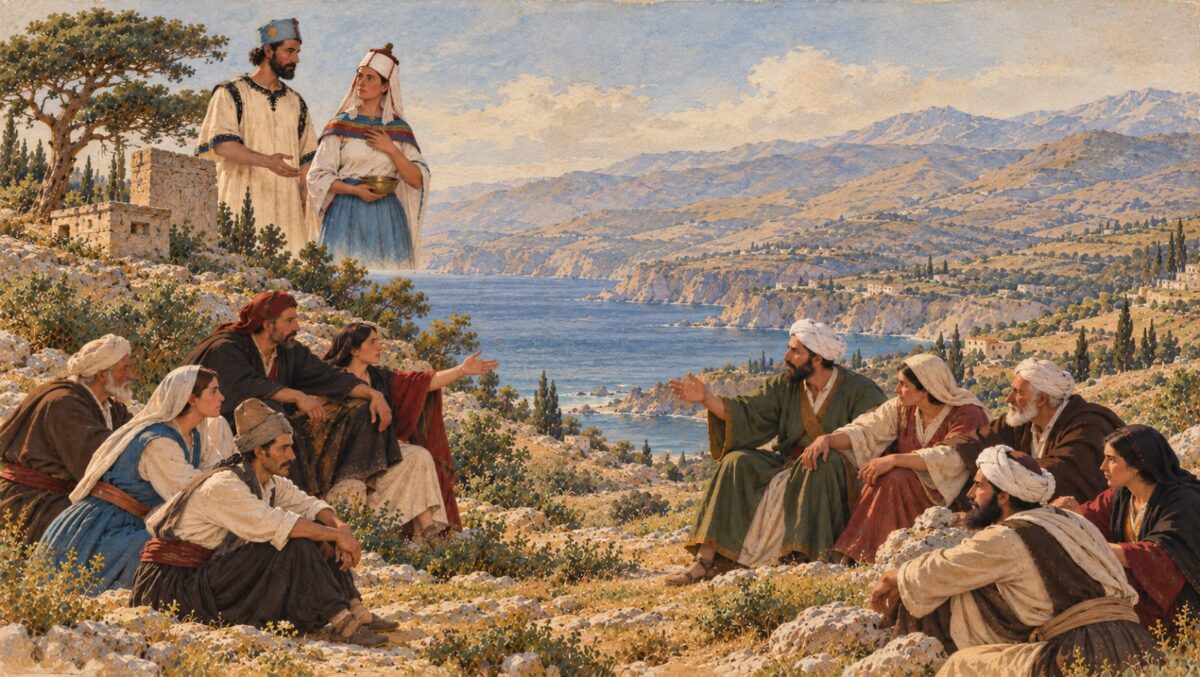
Imagine a Phoenician couple from the first century AD, living under Roman rule, who wake one morning in today’s Lebanon. They set out to find the gods they know. They look for the temples where incense once rose and offerings were laid. On the coast they hear church bells and the call to prayer from the same street. In the mountains they pass monasteries, mosques and khalwas. In Baalbek they find great Roman columns standing in silence, with no priest to receive them. Everywhere they ask the same question: where are our gods?
Slowly they begin to understand. The people around them speak of saints, prophets and imams. The populations of Lebanon today descend, in one way or another, from the population this couple represents. Over the centuries, this population adopted new religions, built new communities and took on new names.
This imagined walk raises a question: how did the descendants of this couple come to pray in churches, mosques and khalwas? Lebanon’s religious landscape is the result of a long process of change, continuity and re-formation. Yet today these descendants rarely ask how that process unfolded. They argue instead over which of them came first.
Content about “who is older than whom” among Lebanon’s religious communities circulates widely. It presents a race between communities to prove which one appeared, or arrived in Lebanon, first. This race revolves around ownership of the past and of geography, and its aim is to turn claimed seniority into political and territorial gains.
How accurate are the claims in circulation? To answer, we must first ask the key question: how do historians study the formation of a religious community? They rely on written sources, primary and secondary, which may confirm the public narrative, contradict it, or remain silent. Archaeology adds its own evidence, such as a temple converted into a church, or a church into a mosque. Oral history completes the picture with each community’s collective memory and founding myths. This method calls for three cautions. The appearance of a religious idea and the formation of a community in Lebanon are two distinct moments. The religious identity of regions shifted over time. Communities themselves move through continuity, rupture and re-formation.
Continuity of population is a fundamental reality in Lebanon’s history. Most of the current population, across most religious groups, can be traced back to the Bronze Age. The idea that communities “came from outside” holds for only a few of them. The majority descend from local people whose beliefs changed over time. The beliefs of today’s communities emerged from a process that began at the end of antiquity, when Christianity and Islam took shape; Judaism is the exception. The population stayed, and its religions changed. This change came through preachers who spread new faiths, and it was bound to political power in three ways: through the religion of rulers, the rejection of a religious center, and the embrace of religious ideas as a form of opposition. Any answer to “who came first?” therefore depends on the criterion we choose. Before choosing one, we need to follow the record period by period, beginning with the gods our imagined couple were looking for.
Content about “who is older than whom” among Lebanon’s religious communities circulates widely. It presents a race between communities to prove which one appeared, or arrived in Lebanon, first. This race revolves around ownership of the past and of geography, and its aim is to turn claimed seniority into political and territorial gains. How accurate are the claims in circulation?
The current debate asks who came first among the monotheistic communities. Long before the monotheistic faiths, however, the population of this land worshiped Baal, Eshmun, Astarte and other gods. These cults also changed over the course of antiquity. In the Hellenistic period, Greek influence reshaped local religion, and Roman influence followed, visible in the Jupiter of Baalbek.
Within this already transformed religious world, Christianity began to spread at the hands of the apostles and their disciples. Conversion was tied to the political authority of the Emperors. In 313, the Edict of Milan granted Christians freedom of worship across the Roman Empire, ending the persecutions. The Theodosian decrees of 380 to 392 went further: they made Christianity the official religion of the Roman Empire and banned pagan cults, although these survived into the fifth century in parts of the mountains and in Baalbek. Alongside these developments, a Jewish presence continued in the major coastal cities.
The new religion left its mark on the landscape. Archaeology attests to churches built in the fourth and fifth centuries at Zahrani, Khaldeh, Tyre, Beit Mery and Baalbek, and to ancient temples converted into churches at Sfireh, Qornet Hardine, Ghineh, Faqra and Hosn Niha. In the fifth century, monastic life began in the Qadisha Valley, which became, alongside the Egyptian desert and Syria, one of the earliest monastic regions of the Christian world.
This Christian world was also divided. It was the era of the dispute over the nature of Christ, and the religious identities of Christian groups in this period are difficult to define with precision. The sources allow us to follow the formation of the Melkites, “the emperor’s people”, who followed imperial doctrine and would later be called the Greek Orthodox (Rum). They also trace the Jacobites, who would later be called the Syriac Orthodox. Finally, they show the beginnings of the community that would later be called the Maronites between the 6th and 7th centuries, a monastic movement in the Roman provinces of Euphratensis and Syria Secunda that had an early presence in Mount Lebanon.
In the first half of the seventh century, the former Eastern Roman provinces of the Levant passed under Muslim rule, and a new religion began to spread gradually. Recent studies show that Muslim communities began to form in the cities around soldiers, administrators, religious scholars and local converts. Archaeology also attests this change: Umayyad-period burials have been found in Beirut, a mosque was built in Baalbek, and at Anjar the Umayyads founded a new city with a caliphal palace and a mosque. Yet written sources for this period are scarce, and little archaeological work has focused on early Muslim rule in Lebanon. This makes the context difficult to reconstruct and leaves room for popular narratives to fill the gaps that scholarship has yet to address.
This was a period of transition, in which the new faith took root alongside older communities. The sources clearly attest a Christian majority, yet as non-Muslims, Christians lived under the dhimma system, a protected but subordinate legal status, and paid the jizya. Three Christian communities can be identified: the Melkites, the Maronites in northern Lebanon, and the Jacobites. In this period, the Maronites emerged as an independent church out of the Melkite majority. According to Maronite tradition, the election of its first patriarch dates to the Umayyad period, in 686.
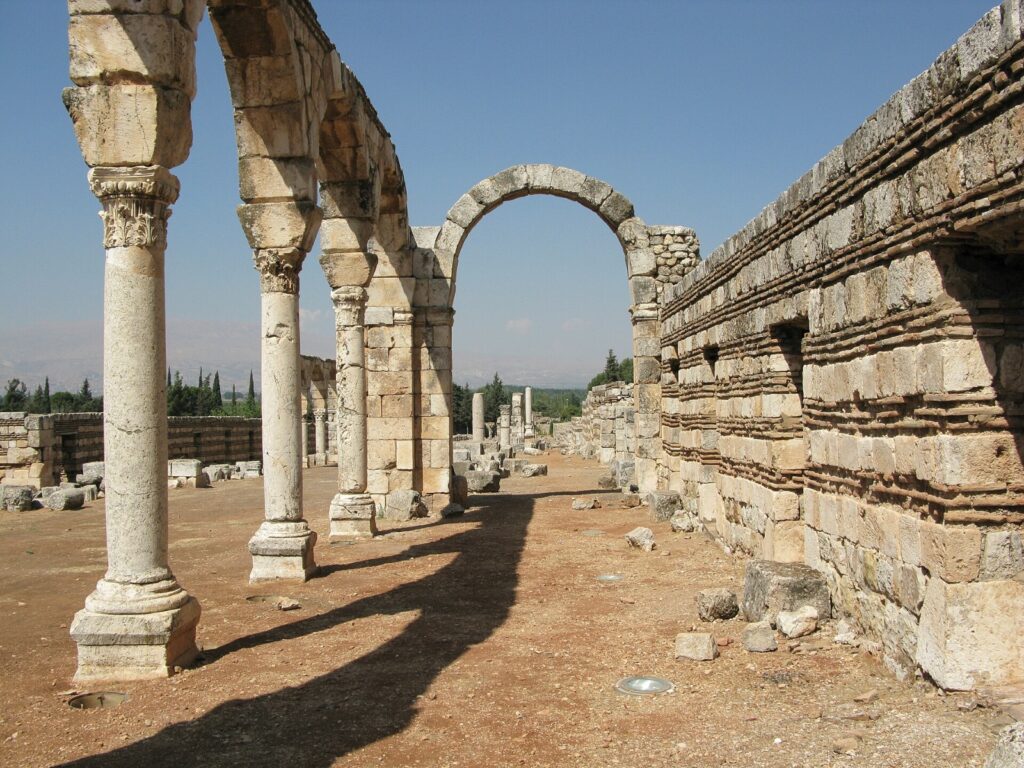
One of the main streets of the Umayyad city of Anjar, constructed in 715, abandoned in 740.
The beginning of Abbasid rule had violent consequences for the rural areas of the Levant. A revolt is attested in 759 in the region of al-Munaytra, in central Mount Lebanon. The area was Christian, yet the historical sources do not specify which community lived there, Maronites, Melkites or Jacobites, although Maronite tradition places its own community in this area. The episode matters for another reason. The Abbasid authorities met the revolt with harsh reprisals against the local Christian population, and Imam al-Awza’i, one of the earliest leading Muslim figures in Lebanese history, intervened on their behalf from Beirut. One of the great scholars of his age, he founded a school of law that prevailed in Bilad al-Sham and al-Andalus.
From the tenth century onward, Shi’ism spread as a form of opposition to Abbasid rule. This current gave the period its character as the “Shiite century”, with Shiite branches spreading widely across the Levant and the Fatimid caliphate playing a central role. Here the sources combine firm evidence with open questions. The formation of the Twelver Shiite community in Jabal Amil and the Bekaa is attested in this period when locals converted. Fatimid rule also saw the beginnings of the Druze call, proclaimed in 1017, which found its followers in the population of the Chouf, Metn and Wadi al-Taym. The open question concerns the presence of Ismailis and Alawites: how and where to assess it, especially since both communities have documented figures, from Tyre for example, in the ninth and tenth centuries. An important Jewish community lived in Tyre, home to a yeshiva by 1071, as documented in the Cairo Geniza.
The Crusades (1099–1291) added new layers to this already complex landscape. A Latin Christian presence settled in the cities and the mountains, made up of Crusader soldiers, settlers and a ruling class alongside the older Melkite population. The sources also show that Muslim communities persisted in the areas under Crusader rule. For the Maronites, this period brought their official union with Rome in 1182, a major turning point with a lasting impact on Lebanese history. An Armenian presence developed through trade and through intermarriage between Crusaders and the noble families of the Armenian Kingdom of Cilicia. The Druze community consolidated its presence in the Chouf, the Metn and Wadi al-Taym.
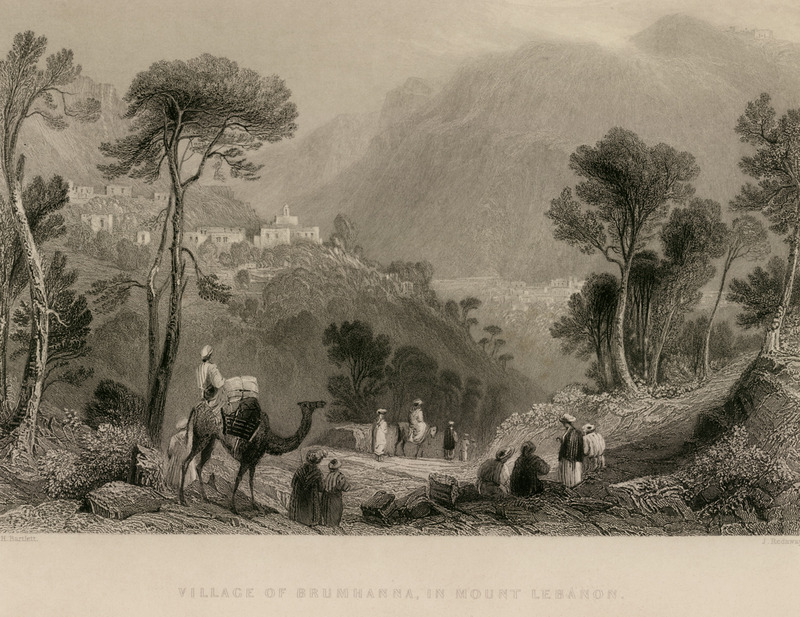
Broummana, a Mount Lebanon village where Druze, Maronites, Greek Orthodox and Greek Catholics lived side by side, c. 1838. From John Carne, Syria, The Holy Land, Asia Minor, &c. Illustrated.
The Bekaa, then under an Ayyubid emirate based in Baalbek, offers a telling example of coexistence. In Ayyubid Baalbek, Sunnis, Twelver Shiite, Melkites and Samaritans lived side by side. A biography from this period shows how fluid belonging could be.
The Mamluks (1260–1516) reshaped the inherited map in several ways. The Latin Christian presence was eliminated. Sunni Islam crystallised, and the four Sunni schools of law spread through the madrasas. Military campaigns targeted heterodox rural communities, and the year 1283 is associated with the Maronites in this context. After the fall of Tripoli to the Mamluks in 1289, Dinniyeh, probably Alawite or Ismaili until then, became Sunni. The three Mamluk campaigns against Kesrouan (1292, 1300 and 1305) ended the Alawite and Ismaili presence there. They reduced the Twelver Shiite presence in the area, which survived, contrary to popular belief.
Christian communities moved in several directions at once. The Maronite presence held while ties with the West weakened. In the fifteenth century, the Jacobite presence expanded in Maronite areas, through immigrants from Mesopotamia and local converts who joined the older local Jacobite community. Nuh al-Buqufani al-Lubnani illustrates this expansion. Born in Bqoufa, near Ehden, he was a Maronite who became a Jacobite and was later elected patriarch of the Jacobite Church (1493–1509). Ethiopian monks also lived in some monasteries of the Qadisha Valley, alongside Maronites, Melkites, Jacobites and some Sufi mystics. Tensions eventually turned into war between Maronites and Jacobites, and the Jacobites were expelled from Mount Lebanon after the battle of Tula in 1488. The Melkite Church persisted. The Druze faith was reorganised by al-Sayyid Abdallah al-Tanukhi (1417–1479), and the Twelver Shiite schools of Jabal Amil were already renowned across the Muslim world.
Lebanon’s religious and cultural diversity is a historical process. It was built over centuries of change, continuity and encounter, and it continues to change today. Understanding that process is a way to share the past and to stop fighting over who owns it.
With the advent of Ottoman rule in 1516, the religious map of Lebanon’s communities underwent significant change over a long period. To better understand this change, the Ottoman centuries can be divided into three phases. The first phase preserved the Mamluk map, and Ottoman administrative documents allow a region-by-region portrait. The coastal cities were home to Sunnis, Melkites and Jews. In the Bekaa lived Sunnis, Shiites and Melkites, and in Wadi al-Taym, Druze and Melkites. In Mount Lebanon, the Druze–Maronite alliance, especially under the Ma’nid emirs and Emir Fakhr al-Din, brought Maronites into the Druze lands. They settled there side by side with Druze, Melkite communities and Jews, notably in Deir al-Qamar, the seat of the emirate. Further north, Kesrouan held Sunnis, Shiite and Maronites. Byblos and Batroun counted Maronites, a Shiite and Melkite minority. Dinniyeh was Sunni, while Akkar combined Turkmen and local Sunnis with Maronites and Melkites. From 1657, a new factor entered this mosaic with the arrival of European Catholic missions.
The second phase brought deeper changes. The battle of Ain Dara in 1711 shifted the balance of the old Druze emirate in the mountain. The new emirs, the Sunni Shihabs of the Qaysi political faction, who had inherited the Druze Ma’nid emirate in 1697, faced opposition from the Yemeni faction. After their defeat at Ain Dara, members of the Druze Yemeni faction migrated toward Hawran and established the Jabal al-Duruz community in Syria. The villages they left behind were settled by Maronites and by a new community, the Greek Catholics. Born of the activity of Catholic missionaries in Aleppo and Sidon, this community emerged in 1724 as a branch of the older Melkite, or Orthodox, Church. The adjective “Greek” comes from French sources and refers to the community’s liturgical use of the Greek language, a point often misread as a claim to Greek ethnic identity. The Armenian Catholic Church formed in 1742, and the Syriac Catholic Church in 1782. Under the protection of the Shihabi emirs, the Maronites continued their expansion in the Chouf and the Jezzine area. The name “Melkite”, previously associated with the Rum Orthodox, now came to designate the Catholic branch, who settled in the Chouf in large numbers from Aleppo, Damascus and Hawran.
Where the second phase changed the churches, the third changed the law. The Hatt-i Sharif of 1839 and the Hatt-i Humayun of 1856 transformed the legal status of the communities. They proclaimed the equality of all subjects of the Ottoman empire regardless of religion, and the jizya gave way to a tax for exemption from military service, although practice often lagged behind the law. In the same period, American and British Protestant missionaries reached Beirut in the 1820s, then the Metn and the Chouf. Local converts, though few in number, played a key role in the intellectual life that emerged in the second half of the nineteenth century.
Beirut, meanwhile, became a point of arrival. Its growing importance as a modern Ottoman port town attracted newcomers alongside its older Sunni and Greek Orthodox core. The civil wars of the mountain in 1841, 1845 and 1860, and the Damascus events of 1860, brought refugees who swelled the city’s Christian community. An Armenian community, Orthodox and Catholic, began to form there. The Jews of Deir al-Qamar moved to the city, and Jewish families arrived from Damascus and Aleppo. A small Baha’i community also formed in Beirut. These movements toward the city announced the larger migrations of the twentieth century. In the same period, emigration took members of all these communities to Egypt, the Americas, Australia and Africa, giving birth to the Lebanese diaspora.
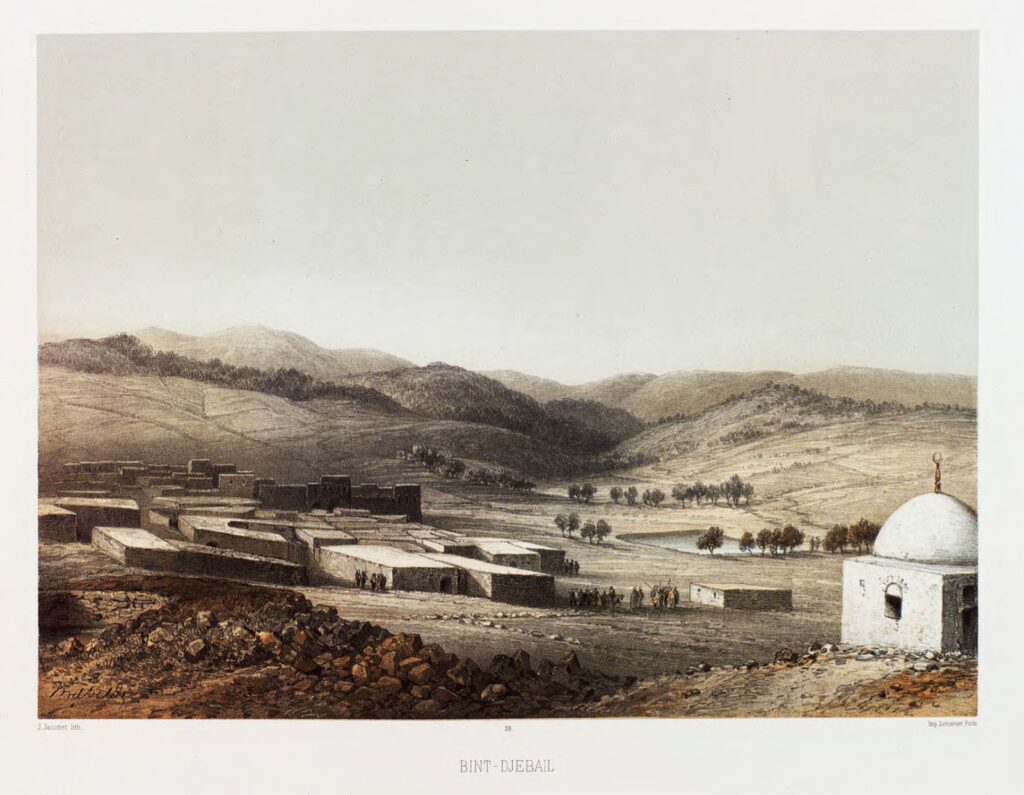
Bint Jbeil in 1857, with its iconic white Maqam, by Charles William Meredith van de Velde.
The end of the First World War also brought the end of Ottoman rule in 1918. The French Mandate (1920–1943) that replaced it received communities shaped by the catastrophes of the region. The Armenian community took shape in the 1920s, in the aftermath of the genocide, and further groups arrived from Musa Dagh in 1939. Syriacs, Orthodox and Catholic, along with Chaldeans and Assyrians, arrived after the Sayfo massacres of the First World War and the massacres in Iraq in the 1930s. During the Second World War, Jews arrived as well from Eastern Europe.
The Mandate also fixed the communities in law and in numbers. The census of 1932 counted the population by sect, and in 1936 a decree of the High Commissioner defined the legally recognised religious communities and their rights. The political system would later build on this framework, with six communities, Maronite, Greek Orthodox, Greek Catholic, Sunni, Shi’i and Druze, serving as its main pillars, while smaller communities were grouped together under the label “minorities”.
The independent Lebanese Republic, established in 1943, opened new chapters. The political framework gave numbers and dates a new weight. The National Pact of 1943 distributed the highest offices among the largest communities, and parliamentary seats were allocated by sect according to the ratios of the 1932 census, the last official count. Change continued and the number of recognised communities eventually reached eighteen.
In the wake of the pan-Arab nationalisation movements of the 1950s, Jews and Christians arrived from Egypt, Iraq and Syria. By the end of the Lebanese war (1975–1990), the demographic balance itself had shifted. The Christian demographic presence declined with emigration, while the Sunni and Shiite communities expanded, and Druze numbers declined. At the same time, Asian migrant labour brought a new religious plurality, including Hindu and Buddhist communities.
Today, in 2026, wars, political and economic crises, and emigration continue to challenge all communities. It is in this context that the question “who came first?” acquires its political charge. Within the Lebanese political system, demographic weight and historical seniority became political arguments. A community’s claim to have come first could be translated into a claim to land, to representation and to a share of the state.
The question “who came first?” therefore needs a criterion before it can have an answer. Measured by the continuity of religious ideas, the Jewish community stands first, even though Judaism itself changed profoundly over the centuries. Measured by continuity of ideas and presence together, the Greek Orthodox do. Measured by population, the answer belongs to all the descendants of the people who have lived on this land, whatever faith they came to hold. Our imagined couple would find their gods gone, yet they would recognise their descendants in every community.
Lebanon’s religious and cultural diversity is a historical process. It was built over centuries of change, continuity and encounter, and it continues to change today. Understanding that process is a way to share the past and to stop fighting over who owns it.
Charles al-Hayek is a public historian and the founder of Heritage and Roots.
The views in this story reflect those of the author alone and do not necessarily reflect the beliefs of NOW.