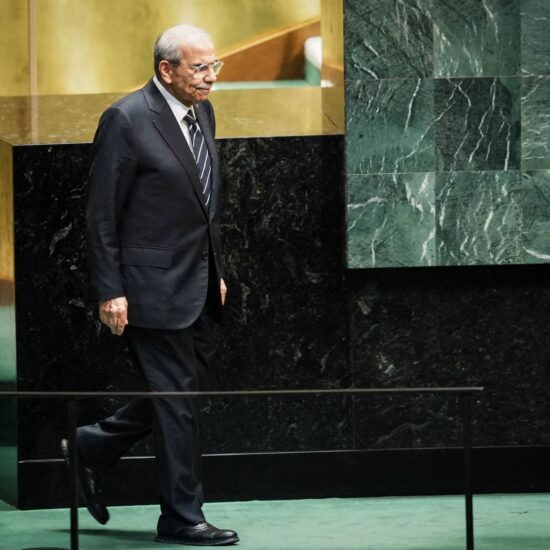
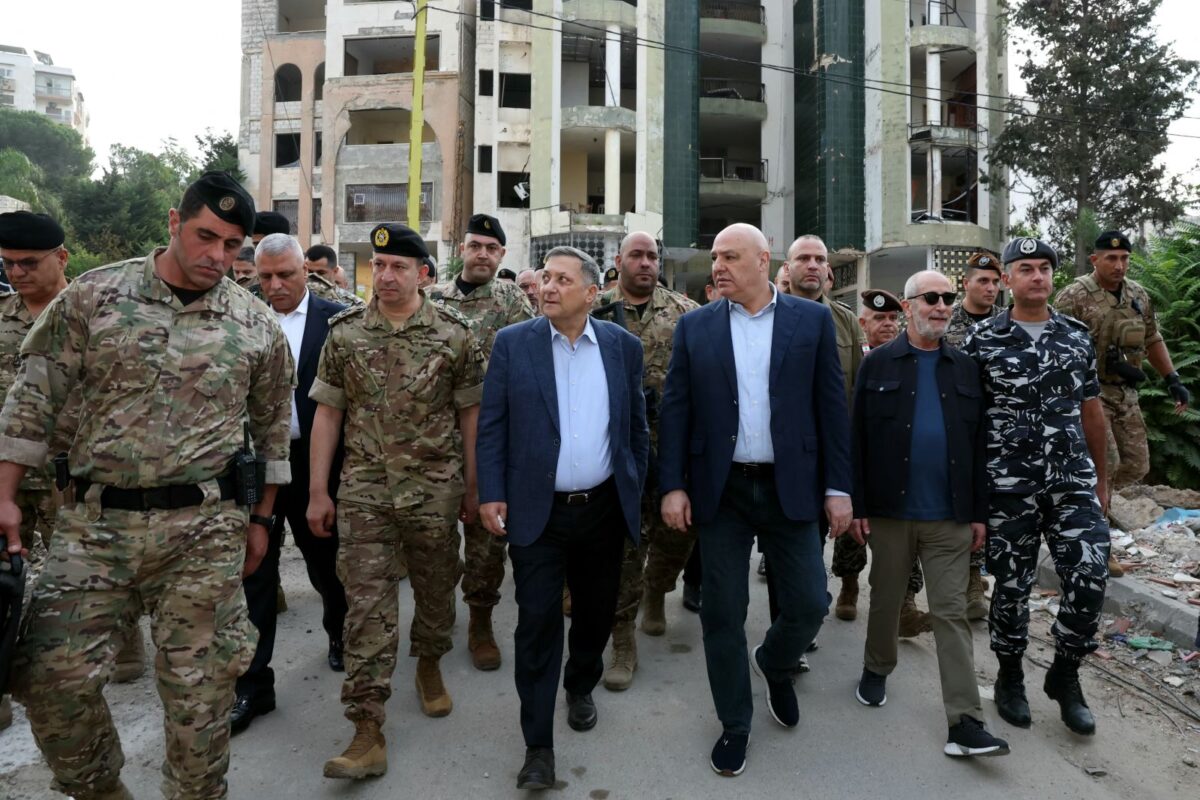
Photo by - / LEBANESE PRESIDENCY / AFP. A photograph released by the Lebanese Presidency press office on September 12, 2026, shows Lebanese President Joseph Aoun (C-R) walking alongside security officials during a visit to Nabatieh. Aoun visited the country's south on September 12, in a surprise trip to the city close to a strategic Hezbollah position recently captured and blown up by Israel.
When President Joseph Aoun visited Nabatieh and Zawtar Gharbieh on September 12, he brought the presidency into direct contact with people living under Israeli attacks. Accompanied by Army Commander Rodolph Haykal, he met residents whose immediate concern was protection. Two days later, Lebanon marked the forty-fourth anniversary of Bachir Gemayel’s assassination. It was a very different occasion on which belonging, loss and political loyalty remain difficult to separate.
The two moments belong to different histories. Civilians facing bombardment and a president-elect who led a wartime militia do not carry the same history or responsibility. Yet placing these moments beside each other exposes a persistent Lebanese difficulty: recognizing suffering across political boundaries without treating that recognition as surrender.
For some Lebanese, acknowledging the devastation of the South comes with an immediate qualification about Hezbollah. For others, condemning Bachir’s assassination seems to require first resolving every argument about his politics, alliances and wartime record. In both cases, grief is made to pass a political test before it is considered worthy of recognition.
This habit does more than impoverish our debates. It teaches people that their suffering will be recognized primarily by those who already share their loyalties. When recognition follows partisan boundaries, belonging becomes dependent on the community that agrees to remember you.
A citizen should not have to abandon a political identity before the country recognizes their pain.
A citizen should not have to abandon a political identity before the country recognizes their pain.
That principle leaves ample room for judgment. Hezbollah’s decisions, weapons and relationship with Iran must remain open to scrutiny. Opposition to its military autonomy is compatible with an unconditional insistence on protecting southern civilians. Responsibility for Israeli attacks remains with those who order and carry them out. Criticism of Hezbollah cannot become an excuse for indifference toward the people living around it.
The same discipline applies to Bachir. His political project, wartime leadership and alliance with Israel remain subjects of historical argument. Condemning his assassination requires no oath of allegiance to that project. Respecting the grief attached to his death grants no immunity to his record. Equally, criticizing that record cannot make his murder an acceptable instrument of politics.
These distinctions are straightforward in principle and difficult in practice because public recognition carries meaning beyond the words themselves. People may hear sympathy for another group as an accusation against their own. They may fear that acknowledging another loss will diminish the importance of what their families endured.
In that understanding, compassion becomes a scarce resource. Each acknowledgment appears to redistribute innocence, legitimacy and the right to belong. A gesture toward one community is read as a withdrawal from another.
Political leaders can exploit this fear. If recognition outside the group is presented as betrayal, the party becomes the custodian of memory and the community’s indispensable defender. Its authority rests partly on convincing people that nobody else will acknowledge their wounds. Citizens may then remain attached to organizations they distrust because they fear abandonment beyond them.
This is where the presidency has a responsibility that exceeds ceremonial language. Aoun’s presence in the South can communicate that residents belong to the republic regardless of their relationship with Hezbollah. Recognizing Bachir’s assassination can communicate that a contested political legacy does not place a killing outside national concern.
Neither gesture settles historical disputes. Both can establish a standard for how institutions approach those disputes. The presidency should be able to recognize a community’s loss while retaining the independence to challenge its leaders.
Recognition, however, must have consequences. People in the South need protection, assistance, proper documentation of attacks and sustained efforts toward accountability. Families affected by political assassinations need credible judicial processes. Otherwise, official sympathy becomes another ritual through which institutions acknowledge suffering without assuming responsibility toward those who endure it.
The state earns trust when people discover that their rights survive their disagreement with those who govern them.
The state earns trust when people discover that their rights survive their disagreement with those who govern them.
Last September, I called for national reconciliation beyond Bachir. That work requires more than bringing leaders together or producing a vocabulary everyone can repeat. It requires creating room for citizens to acknowledge one another without being asked to renounce their histories at the door.
A shared country can accommodate conflicting judgments about its past. What it cannot sustain indefinitely is a public culture in which protection, mourning and justice depend on the political identity of the person concerned.
Aoun’s visit and Bachir’s anniversary offer an opportunity to practice something more demanding than agreement: recognizing a loss while preserving the freedom to dispute the politics surrounding it.
The Lebanese do not need identical memories to live together. They need confidence that a neighbour’s disagreement will not become indifference when their home is destroyed, their family is bereaved or their leader is murdered. The presidency can help establish that confidence by treating recognition as a public responsibility and following it with action. A country becomes more believable when its citizens no longer have to ask which party must speak before their pain will be heard.
Ramzi Abou Ismail is a Political Psychologist, Researcher and Analyst.
The views in this story reflect those of the author alone and do not necessarily reflect the beliefs of NOW.