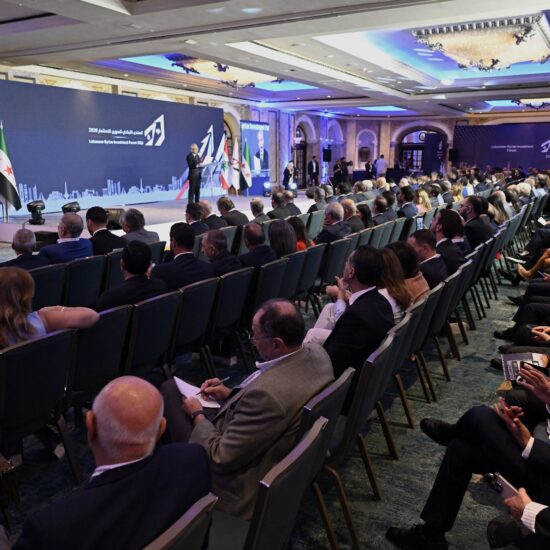

Lebanon’s Culture Minister, Ghassan Salamé, opened an exhibition about the ancient city of Byblos on Monday in Paris. Amid the escalating war between Hezbollah and Israel, his trip has sparked a debate among Lebanese archaeologists — raising the question of whether it was inappropriate to travel abroad at times of war.
For nearly four weeks, Lebanon has been in the midst of war between Hezbollah and the Israeli army, with attacks threatening not only military targets but also both civilians and the country’s cultural heritage. Israel’s strikes have attacked areas near archaeological sites, raising concerns about the preservation of Lebanon’s historical treasures.
The debate around the exhibition: insensitive or diplomatic success?
French President Emmanuel Macron and Salamé inaugurated the exhibition, “Byblos, Lebanon’s Millennial City,” at the Institut du Monde Arabe, on Monday. Many attendees noted the challenges Lebanon is currently facing in protecting its cultural heritage as war is raging in its territory.
The exhibition was originally scheduled to open two years ago but was postponed due to the 2024 war between Hezbollah and Israel. During the opening, Salamé acknowledged that “the initial attempt was interrupted by the war of 2024” and noted that “the current situation remains just as tragic.”
With war still keeping Lebanon under strain, some find the timing insensitive and criticize Salamé for leaving the country amid the crisis. Archaeologist and museum educator Nelly P. Abboud said that Salamé should have stayed in Lebanon to safeguard archaeological sites at risk of damage. With Lebanon increasingly under attack — and archaeological sites in Tyre and Baalbek at risk — the minister’s visit to Paris sends the wrong signal, she argued.
“The timing is problematic,” Abboud told NOW.
“While the minister was giving his speech and smiling to the cameras, Israel was bombing Al Qasmiyeh, part of a larger survey area with Al Kharayeb and Adloun.” In this area, archaeologists have found more than 191 historic sites and features, she added.
“Public opinion often expects a visible presence and engagement on the ground,” Abboud argued. According to her, Salamé and the Director-General of Antiquities Sarkis Khoury did not sufficiently condemn the attacks on Lebanon.
Another archaeologist, who wants to stay anonymous due to the sensitivity of the issue, criticized the outcome of the meeting. According to this person, Salamé should have spoken extensively about the war. “He sits on a platform in Paris, where he has the world listening and he does not even use it to say anything meaningful,” the archaeologist told NOW.
The Culture Minister Salamé said he wanted to use his trip to Paris to foster diplomatic support and assistance for Lebanon. He also has a scheduled extraordinary Heritage Committee meeting, aimed at protecting the archaeological sites of Lebanon which are at risk due to the ongoing war.
Other archaeologists say the trip brings much-needed attention to Lebanon’s threatened cultural heritage. “This exhibition is a tool to talk about the threat to cultural heritage in Lebanon. It comes at the perfect time,” Joanna Farchackh Bajjaly told NOW. She is an archaeologist and founder of the NGO Biladi, which works to promote and protect heritage.
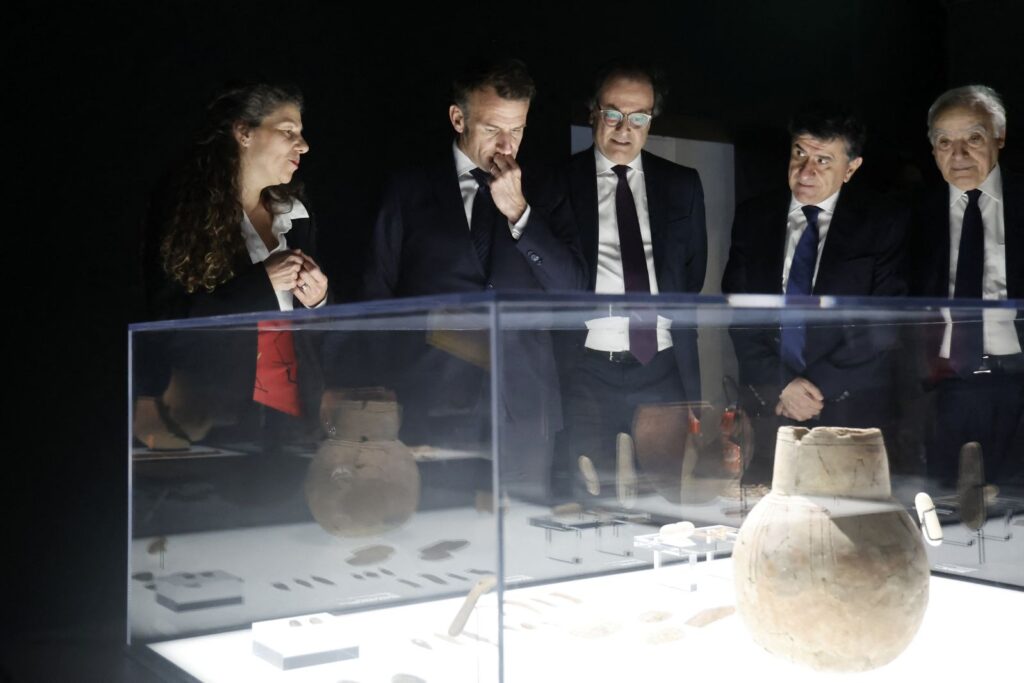
AFP Photo by CHRISTOPHE PETIT TESSON / POOL / AFP French President Emmanuel Macron (2ndL) stands next to Ambassador of Lebanon to France Rabih Chaer (C) and Director of the Byblos archaeological site and scientific curator of the exhibition Tania Zaven (L) as he visits the exhibition “Byblos, Lebanon’s Millennial City,” at the Arab World Institute (IMA) in Paris, on March 23, 2026. France’s President inaugurated on March 23, 2026, an exhibition dedicated to Byblos, the ancient city north of Beirut, organized by the Arab World Institute (IMA), at a time when Lebanon is plunged into a new war that has disrupted the arrival of the works being shown in Paris. The exhibition features some 400 pieces.
“This is an act of cultural resistance towards what is going on: we don’t accept the threats to our heritage,” Bajjaly said. Regardless of the difficulty of the situation — and against all odds — Lebanon continues to showcase its archaeological richness, she added.
The exhibition does not happen in a vacuum, it is a reflection of the ongoing war. “They could not even send all the objects to the exhibition because of the war,” Bajjaly said.
The problem of protection
Protecting archaeological sites is a difficult topic — especially in times of war, when parties to the conflict disregard the rules of international and humanitarian law. While smaller, portable objects have been brought to safe storage to prevent their destruction, major heritage sites cannot be moved.
Lebanon currently uses the UNESCO Blue Shield emblem — which signals war-waging parties that the location should not be damaged amid military action. At the moment, in Lebanon 34 archaeological sites fall under this protection. Last week, Salamé announced that these emblems would be placed in front of the eligible sites. While in Paris, he also demanded more sites to be added to the enhanced protection list. “What is threatened can still be saved,” the Culture Minister said during the exhibition’s opening.
But in Lebanon, this protection measure is causing a debate. While some find it pointless due to implementation and enforcement problems, others say it is the best possible protection given the current circumstances.
The enhanced protection list “is useless and has no jurisdiction,” Abboud said. Under the 1954 Hague Convention, war-waging parties are required to safeguard cultural property. But “compliance is simply nonexistent,“ Abboud added.
Lebanon tends to focus on “post-damage assessment rather than effective on-the-ground protection during active conflict,” Abboud said. “Lebanon does not have a fully operational, nationwide emergency response system specifically tailored to armed conflict and large-scale site protection,” she added. According to her, there have been many trainings for such a scenario, but those now fail to be implemented.
Others see it as a bit more optimistic. UNESCO’s protection status cannot stop destruction, but it offers a certain degree of protection to archaeology, Bajjaly argued. “These are the only tools we have — so why not use them?” she asked.
An example is the al-Bass archaeological site, which has the UNESCO World Heritage status. It is located in Tyre, a city just 20 kilometers from the border. In early March, Israeli strikes killed eight people at a nearby family home and damaged museum windows. This week, a UNESCO Blue Shield emblem was mounted in front of the al-Bass archaeological site.
The protection is not physical, but legal and symbolic. “It is like putting a red cross on an ambulance,” Bajjaly said. While it signals that all war-waging parties are expected to protect the site, the power comes after destruction. The country that suffered the losses can later build a case before the ICC — which, however, takes times and resources, she added.
“They should not bomb. Full stop.”
The problem is much broader than archaeology itself. “This war is challenging every single international law that exists,” Bajjaly explained. If these rules are disregarded, there is little else the international community can resort to.
The politicization of archaeology and of land
Israel has expanded its ground incursion into the country, signaling a readiness to advance as far as the Litani River. Some Lebanese archaeologists fear that Israel could use its military operations to excavate historical and cultural heritage sites in Lebanon. While such excavations seem unlikely at the current stage of the war, the risk increases if there is an occupation of the South for a longer period.
“Over the course of many years, Israel has been intentionally destroying sites and performing illegal excavations in the past and recently,” Abboud said. “They have done that before, and they will do it again.”
There are many such examples. During the 2024 conflict, Israeli nationalist archaeologist Zeev Erlich was killed by Hezbollah in southern Lebanon. He had reportedly intended to examine certain historical sites in the country. Erlich was a well-known settler living in the occupied West Bank, where he conducted archaeological research.
“Archaeology becomes a tool to appropriate the land,” Bajjaly said. “The politicization of archaeology in Israel is on levels unseen elsewhere.” While major historical sites benefit from formal protection, many archaeological sites — such as mosques, libraries, and old houses — are part of local heritage and lack direct international protection.
“For major archaeological sites, the damage has been mostly collateral — so far,” Bajjaly said. “For local heritage, it’s targeted,” she added. This has significant consequences for the communities living there.
These places foster a sense of belonging and strengthen people’s connection to the land they live on. In southern Lebanon, however, these sites are increasingly being destroyed. “By destroying cultural heritage, you erase the memory of people from their land,” Bajjaly added. “It uproots them.”
The destruction of sites that people have long grown accustomed to tampers with the connection they feel to the area. “It causes a loss of identity — it breaks the link between generations and their land,” Bajjaly said. This, she added, is the first step toward repurposing the land. “They are trying to erase the historical part of the land to create a new narrative,” she explained.
A colonial heritage
During the exhibition’s opening, French President Emmanuel Macron condemned the war, saying, “Lebanon must deal with its problems on its own, and nothing should justify any violation of its territorial integrity or sovereignty”. To some, his remarks appear hypocritical.
According to Abboud, Macron’s presence and speeches indicate that “the whole project is political or was politicized at the profit of President Macron”. Abboud argues that a more meaningful gesture would have been to host the exhibition in Byblos itself, where Lebanese people could enjoy the richness of their own cultural heritage.
“This is the third time in the past three years that the exhibition has been held in Europe,” she noted. “To this date, it has never been organized in Lebanon.” To her, this begs the question whether Lebanese people do not deserve to witness their own cultural heritage.
But the problem is also one of resources — excavations, exhibitions and advertisement costs a lot of money. These are assets that are scarce in Lebanon at times of war. Nevertheless, both Abboud and Bajjaly say it would be an important signal if the exhibition was also held in Lebanon.