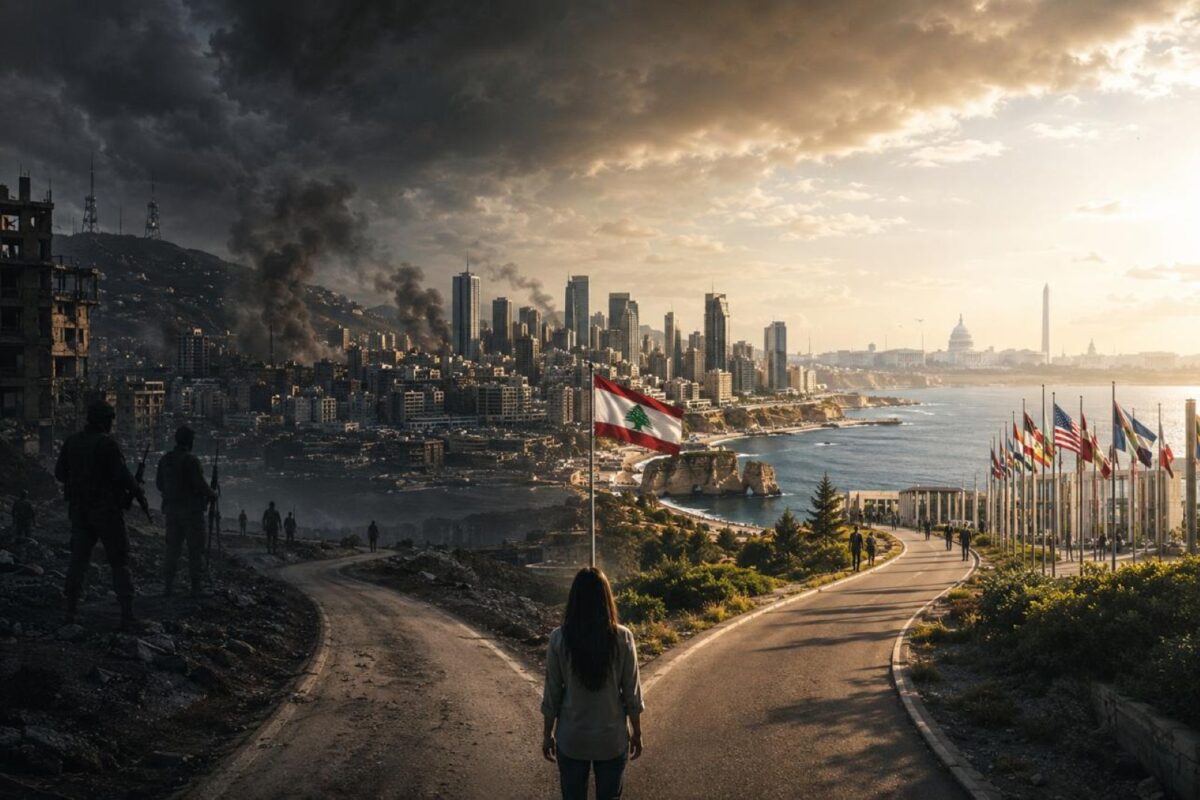
For years, Lebanon lived under a dangerous illusion: that the country could somehow survive while Hezbollah dragged it deeper into regional wars, foreign agendas, and permanent instability. That illusion is now collapsing in real time.
Amid escalating U.S.-Iran negotiations, intensified Israeli strikes on Hezbollah strongholds in the South and the Bekaa, and a rapidly shifting regional order under President Donald Trump, one reality is becoming impossible to ignore:
Washington is not abandoning Lebanon. Hezbollah is the one threatening to destroy it from within.
The latest remarks by Hezbollah Secretary-General Naim Qassem exposed this reality with unusual clarity. In his first public reaction to the emerging U.S.-Iran understandings, Qassem openly expressed hope that Lebanon would be “included” in the negotiations. Once again, Hezbollah attempted to position Lebanon not as a sovereign state, but as a bargaining chip on Tehran’s negotiating table.
At the same time, Qassem escalated his threats against Prime Minister Nawaf Salam’s government, declaring that “the people have the right to take to the streets and overthrow the government” if it does not align with Hezbollah’s confrontation agenda. He rejected direct negotiations with Israel, attacked the Lebanese state for making “concessions,” and promised continued resistance regardless of the cost to Lebanon itself.
This was not political rhetoric. It was a direct threat against the Lebanese state.
Washington responded swiftly.
In a remarkably direct statement, U.S. Secretary of State Marco Rubio condemned Hezbollah’s “reckless call to overthrow Lebanon’s democratically elected government,” accusing the group of deliberately destabilizing the country while obstructing recovery, reconstruction, and international support.
More importantly, Rubio’s response reflected a deeper strategic shift in Washington’s posture toward Lebanon.
For years, Lebanese officials operated under the assumption that Lebanon’s fate would inevitably be tied to broader U.S.-Iran negotiations. Hezbollah built much of its leverage around that very premise: that no meaningful change in Lebanon could occur without Tehran’s approval.
Today, Washington appears determined to sever that linkage entirely.
The American position is becoming increasingly clear: Lebanon’s future will not be negotiated in Tehran. The disarmament of Hezbollah, the implementation of state sovereignty, border security arrangements, and the prevention of another devastating war with Israel are now being treated as independent priorities, handled directly through Lebanese-American-Israeli channels.
This explains the significance of the upcoming meetings in Washington.
Military talks between Lebanese and Israeli officials are scheduled at the Pentagon on May 29, followed by a new round of diplomatic discussions at the State Department on June 2 and 3. These meetings are not symbolic gestures. They are part of a broader American effort to stabilize the Lebanese-Israeli front, prevent regional escalation, and gradually move Lebanon toward a sustainable security framework.
The message from Washington is unmistakable: Lebanon’s peace track is moving forward , with or without Hezbollah’s approval.
And that is precisely why Hezbollah is escalating internally.
The organization understands that the regional environment is changing rapidly. Across the Middle East, momentum is shifting toward de-escalation, normalization, economic integration, and state-centered governance. The old model of armed ideological militias controlling national decision-making is becoming increasingly unsustainable.
Reports published by Axios revealed that President Trump recently urged several Middle Eastern leaders to normalize relations with Israel should a new agreement with Iran materialize. According to those reports, officials from Saudi Arabia, the UAE, Qatar, Pakistan, Turkey, Egypt, Jordan, and Bahrain participated in the discussions. The silence on the line reportedly became so awkward that Trump jokingly asked: “Are you still there?”
Behind the humor was a serious geopolitical reality.
The region is moving , cautiously but unmistakably , toward a new order. Governments are recalculating interests. Economies are demanding stability. Populations exhausted by endless conflict are prioritizing survival over ideology.
Lebanon cannot afford to remain frozen outside this transformation.
Yet Hezbollah insists on exactly that.
By attempting to tie Lebanon’s future to Iran’s negotiations with Washington, Hezbollah is effectively denying Lebanon its sovereignty. It is insisting that the Lebanese people remain hostage to external calculations disconnected from their own national interests.
Lebanon must never again become a file on someone else’s negotiating table.
Only the Lebanese state has the legitimacy to negotiate on behalf of the Lebanese people. Only the state has the right to decide questions of war and peace. And only the state can rebuild international confidence, attract reconstruction support, and restore Lebanon’s shattered institutions.
This is why Hezbollah’s threats against the Salam government matter so profoundly. They are not simply attacks against one cabinet. They are attacks against the very idea of the Lebanese state reclaiming authority from armed non-state actors.
But the equation has changed.
Unlike previous years, Hezbollah now faces mounting military pressure, growing diplomatic isolation, economic exhaustion inside its own support base, and a regional environment that is steadily turning against perpetual confrontation. Israeli strikes against Hezbollah infrastructure in the South and Bekaa are intensifying. International patience is diminishing. Even many within Lebanon’s Shiite community increasingly fear another catastrophic war whose consequences would be unbearable.
Meanwhile, the Lebanese state , fragile as it remains , is finally receiving clear international backing.
Washington is not trying to bring down the Lebanese government. Quite the opposite: it is investing politically in preserving it, strengthening it, and insulating it from Hezbollah’s coercion.
The real confrontation today is no longer simply between Lebanon and Israel. It is between two competing visions for Lebanon itself.
One vision sees Lebanon as a sovereign state integrated into a more stable regional order, protected by institutions, diplomacy, reconstruction, and international partnerships.
The other sees Lebanon as a permanent battlefield tied indefinitely to Iran’s regional confrontation strategy.
These two visions cannot coexist forever.
Hezbollah understands this. That is why its rhetoric has become increasingly existential and confrontational. The organization senses that the regional tide is shifting beneath its feet.
Its days as the uncontested hegemon of Lebanon are numbered.
In the end, only the state survives.
And this may be Lebanon’s last real opportunity in a generation.
A serious opening now exists to reposition the country away from endless war and toward political normalization, institutional recovery, and long-term stability. But opportunities in the Middle East rarely wait forever.
If the region moves toward broader peace arrangements, Lebanon cannot afford to be the last country trapped in the logic of militias and proxy wars while everyone else moves forward.
Washington appears determined to keep Lebanon on a separate track from Iran negotiations because it increasingly recognizes a simple reality: saving Lebanon requires empowering the Lebanese state, not bargaining with those who weakened it.
The path ahead will not be easy. Hezbollah will resist fiercely because its survival depends on preserving the old order.
But Lebanon now faces a historic choice.
To remain a hostage.
Or finally become a state.
Elissa E Hachem is a journalist and political writer specializing in regional affairs and governance. Former Regional Media Advisor at the U.S. State Department’s Arabic Regional Media Hub, with broad experience in strategic communication across government and private sectors.
The views in this story reflect those of the author alone and do not necessarily reflect the beliefs of NOW.