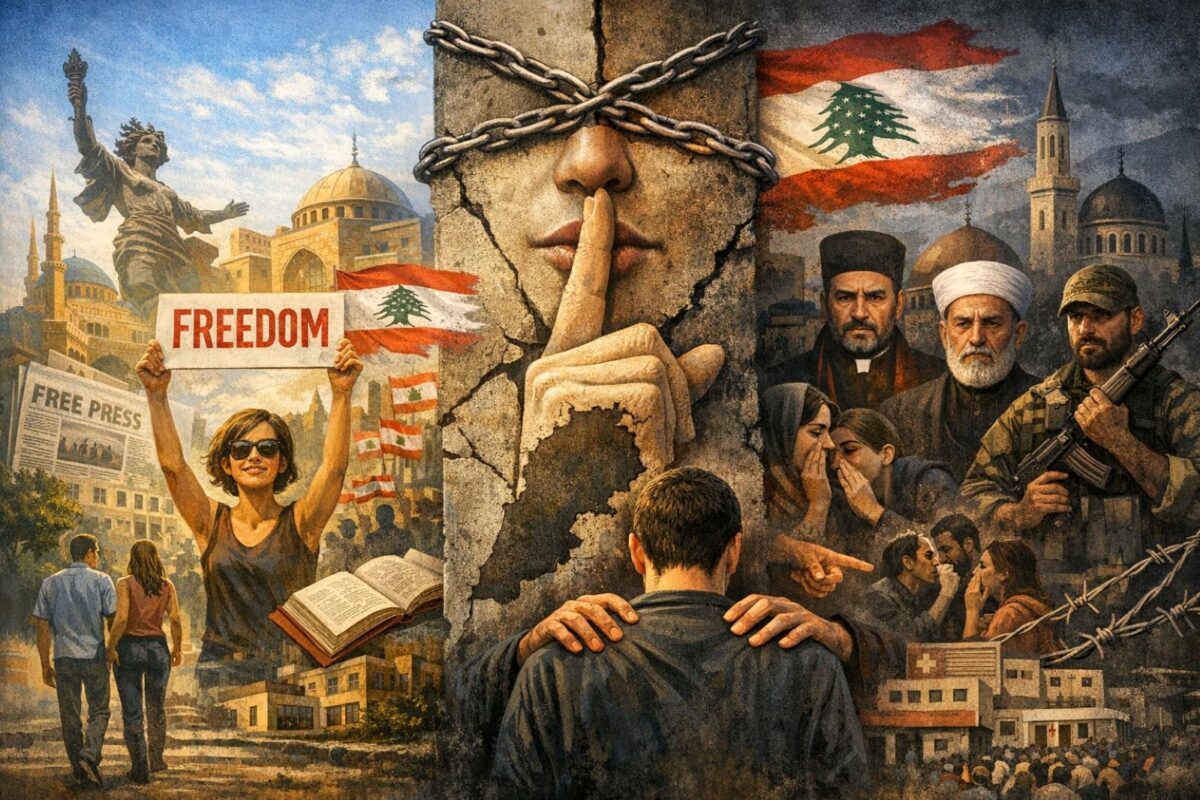
Lebanon presents a structural paradox: it is simultaneously one of the most personally liberal societies in the Arab world and is simultaneously coercively communal. Understanding this requires holding both sides of the contradiction seriously, without collapsing one into the other, and without allowing the visibility of one to obscure the reality of the other.
On one side, Lebanon has historically guaranteed meaningful personal freedoms: freedom of thought, expression, and political organization. Its press, its universities, its cultural life have long attracted those fleeing more authoritarian regional contexts. Political parties of every ideological stripe, from communist to anarchist to liberal nationalist, have organized openly on Lebanese soil. The individual, formally speaking, is free. This is not a superficial freedom. It is institutionally embedded, historically durable, and genuinely experienced. To dismiss it would be to misread the country.
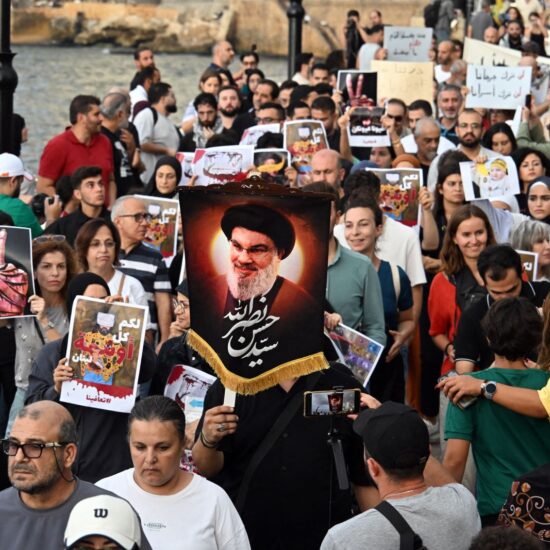
On the other side, the confessional system generates powerful and persistent pressures toward communal homogenization. Sectarian parties and elites do not merely represent their communities; they actively produce them. They do so by enforcing authorized narratives of history and memory, by defining who the community is, what it has suffered, what it must protect, and who speaks legitimately in its name. Political loyalty becomes fused with communal identity until the two are nearly indistinguishable. To dissent from the party line is to risk being read not as a political opponent, but as a traitor to one’s own people. The disagreement is immediately personalized, moralized, and communalized.
The mechanisms of this enforcement vary in form, degree per sect, and historical circumstance but converge in function.
Regarding discourse, the precise ways in which schools serve a sectarian function remain to be specified. What is clear, however, is that schools do not operate in isolation. They sit within overlapping environments of neighborhoods, families, religious communities, and social class, all sharing the same geography and kinship ties. Together, these forces tend to reproduce dominant histories, ones curated to consolidate communal memory rather than invite its interrogation.
Regarding the political economy of sectarianism, welfare networks, hospitals, and social services administered by communal organizations create material dependencies that bind the individual to the sect. Access to employment, to opportunity, to institutional support frequently passes through communal gatekeepers. Social belonging itself, friendships, marriages, professional networks, is organized along confessional lines, meaning that exit from the sectarian fold is not merely a political act but a rupture of one’s entire social world. None of this requires a security apparatus or a state censor. The community enforces itself. Discipline is administered not through coercion from above but through pressure from within, from neighbors, families, institutions, and the accumulated weight of shared memory.
The contradiction is therefore not between the individual and the state, as in classical liberal theory, but between the individual and the sect
The contradiction is therefore not between the individual and the state, as in classical liberal theory, but between the individual and the sect. The Lebanese state does not typically imprison dissidents or ban political speech. It does not need to. The sectarian community performs that disciplining work far more efficiently, and with far greater intimacy — though the form and intensity of this discipline varies considerably across communities, and is better understood as episodic than perpetual. Repression here wears the face of belonging. The quiet censor is not a functionary or an institution; it is the community itself, operating through the ordinary textures of social life.
This relationship is, at its core, a unity of opposites; at once complementary and antagonistic. What makes this contradiction particularly durable is that the two poles are not simply opposed; they are structurally intertwined. The very openness of the Lebanese system, its celebrated tolerance of pluralism between communities, depends on a degree of coherence within each community. Inter-sectarian coexistence is purchased at the price of intra-sectarian conformity. Lebanese pluralism, in other words, is not despite communal discipline; it is partly sustained by it. Yet this intertwining is not without friction. The state retains the capacity to constrain sectarian authority, through law, through cross-sectarian institutions, through the occasional assertion of a civic logic that exceeds communal boundaries. The sect, in turn, resists full absorption, guarding its autonomy over personal status, education, and social welfare. It is a unity of opposites: mutually constitutive and mutually corrosive, holding together precisely because neither can fully swallow the other.
This tension, however, is not uniform across the confessional landscape, nor across its historical circumstances. The ratio between personal freedom and communal pressure differs from one sect to another, shaped by the organizational reach of its institutions, the degree of political monopoly exercised by its leading forces, and the individual’s own position within these structures. The same act of dissent carries different costs depending on which community it is committed within.
The Lebanese individual thus inhabits a peculiar and demanding condition: simultaneously free, and constrained. The freedom to think is real. The social cost of thinking differently is equally real. Lebanon does not forbid dissent; it simply makes it expensive, lonely, and quietly illegible to the very community that forms the ground of one’s identity. To speak against the communal consensus is to speak, in some sense, into a void, heard perhaps, but not recognized.
Freedom is real. So is the pressure that disciplines it into silence.
Boghos is a researcher in political economy, social history, and intellectual history, with a focus on the modern Levant. He holds a BA in Political Science from Haigazian University and is currently a graduate student specializing in Middle Eastern Studies at the American University of Beirut. His work examines capitalist transition in Mount Lebanon, the intellectual history of the Levantine Left, and the social and historical conditions that gave rise to liberalism in Lebanon, including its structural features, its relationship to Christian communities, and its embeddedness in the socioeconomic transformations of the nineteenth and twentieth centuries.
The views in this story reflect those of the author alone and do not necessarily reflect the beliefs of NOW