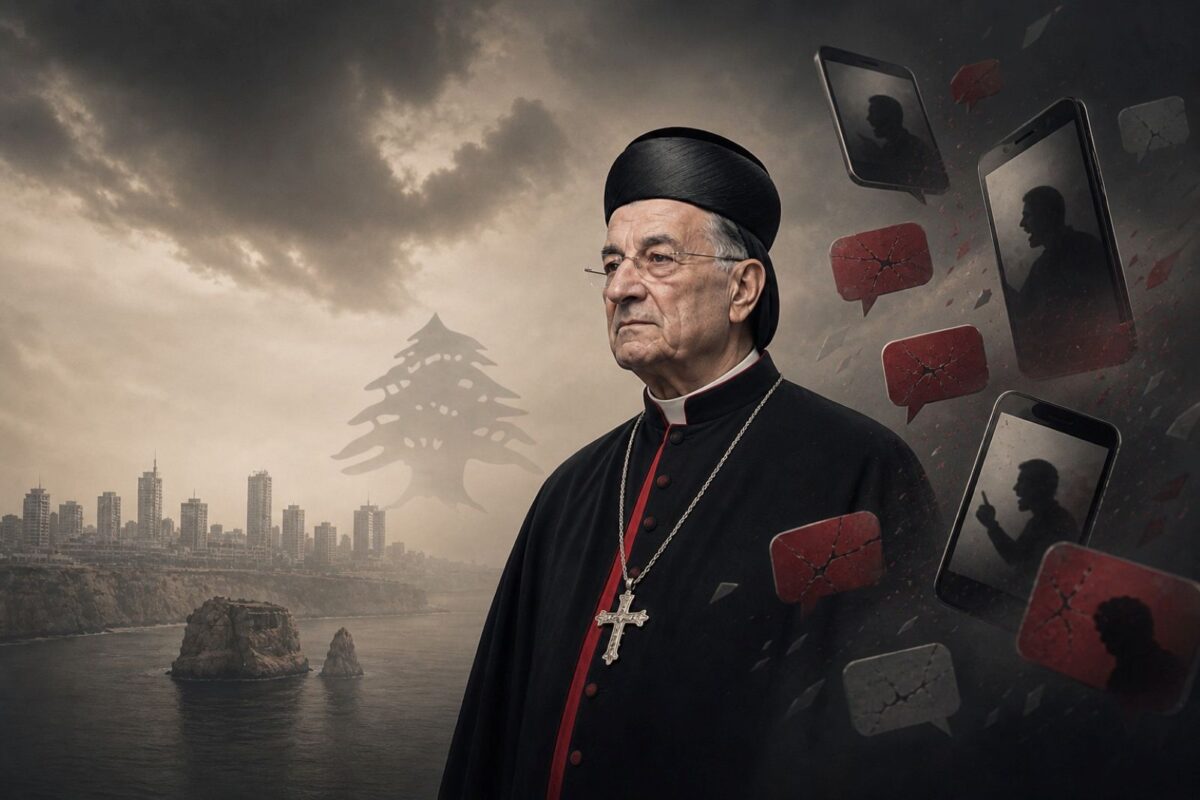
Lebanon’s week was shaped by a rapid escalation from media controversy to sectarian tension, as a coordinated online campaign targeting Maronite Patriarch Bechara al-Rai exposed the country’s deepening polarization.
The crisis was triggered by a satirical video aired by LBCI depicting Hezbollah fighters and its Secretary-General Naim Qassem in a format resembling “Angry Birds.” The segment was quickly condemned by Hezbollah, which viewed it as offensive and mocking.
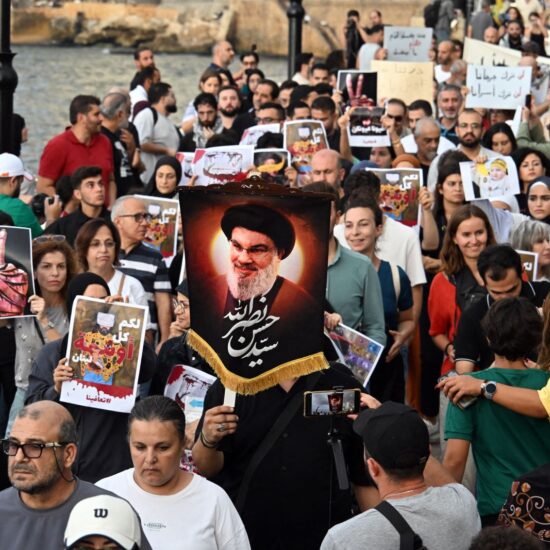
What followed was a wave of online retaliation largely driven by Hezbollah supporters. Social media platforms were flooded with edited images and videos targeting Patriarch Rai. Among the most provocative content were altered images replacing Rai’s head with a shoe, widely understood as a symbol of humiliation marking a significant escalation in tone.
Under mounting pressure, LBCI removed the video following a judicial order, a move that sparked debate over censorship, media freedom, and political influence over the judiciary.
Patriarch Rai responded during Sunday mass, warning of a “dangerous deterioration in values and discourse” and condemning what he described as violations of dignity and respect for religious figures.
President Joseph Aoun also intervened, condemning attacks on religious leaders across all sects and calling for restraint. He urged Lebanese citizens to avoid inflammatory rhetoric and emphasized the importance of national solidarity at a time of heightened internal division and ongoing regional tensions.
The developments also triggered warnings from political and religious commentators that the situation risked inflaming sectarian sensitivities at a time of heightened national fragility.
In Lebanon
“Angry Birds” case fuels censorship debate: The removal of a satirical LBCI video depicting Hezbollah figures in an “Angry Birds” style animation has triggered a renewed debate in Lebanon over freedom of expression, political pressure on the judiciary, and the limits of media satire in a highly polarized environment.
The controversy erupted after the Lebanese broadcaster LBCI aired an animated segment portraying Hezbollah Secretary-General Naim Qassem and fighters in a caricature inspired by the popular mobile game. The video, which also depicted Israeli forces in a stylized manner, was quickly condemned by Hezbollah as offensive, with the group arguing it crossed the boundaries of acceptable political discourse.
The backlash did not remain limited to the broadcaster. According to multiple reports, supporters of Hezbollah launched a wave of retaliatory posts online, targeting Maronite Patriarch Bechara al-Rai with insulting imagery and sectarian overtones, escalating what began as a media dispute into a broader political and religious flashpoint.
Under legal pressure, LBCI removed the video following a judicial order issued by the public prosecutor at the Court of Cassation, a move that further intensified the debate over whether the decision reflected legitimate legal oversight or political influence over media regulation.
Critics of the decision argue that the case reflects a growing pattern in which judicial mechanisms are used to contain politically sensitive satire, raising concerns about shrinking space for free expression in Lebanon. Others, however, maintain that the removal was necessary to prevent further sectarian escalation, particularly given the rapid spillover of the controversy into targeted religious incitement.
The episode has once again highlighted the fragility of Lebanon’s media environment, where political symbolism, sectarian sensitivities.
Gunfire during funeral raises concerns: Gunfire during a funeral procession in Beirut’s southern suburbs drew widespread criticism, renewing concerns over the normalization of armed displays in civilian areas.
The incident in the Dahye area saw sustained and heavy gunfire during the procession, with videos circulating widely showing armed individuals firing automatic weapons into the air in densely populated streets. What began as a funeral quickly turned into a public display of weapons, reviving long-standing concerns that these practices continue despite repeated official warnings.
According to reports cited in local media, tensions also emerged between the Lebanese Army and individuals linked to Hezbollah during the army’s attempt to contain the situation. Military units were reportedly deployed to restore order, but faced resistance on the ground, highlighting the sensitivity of intervention in areas where Hezbollah maintains significant influence.
Efforts to detain those involved did not result in arrests, with accounts indicating that suspects were not handed over to the authorities. This has fueled renewed frustration over the state’s limited ability to enforce its authority, particularly in areas where non-state actors retain de facto control over security dynamics.
Escalation in the South: Southern Lebanon witnessed a sharp escalation in violence following intensified Israeli airstrikes and artillery shelling.
According to reports, the Israeli military announced that it had killed around 10 Hezbollah operatives in targeted strikes in southern Lebanon, in what it described as part of ongoing operations aimed at countering threats along the frontier. The strikes hit multiple locations across border areas, reflecting an expansion in both intensity and geographic scope of the strikes.
Political divisions over negotiations: Lebanon’s political landscape remains deeply divided over how to approach the next phase following the ceasefire and ongoing border tensions with Israel, with sharp divisions emerging over the idea of entering indirect or structured negotiations.
Several Sunni MPs and centrist political figures have expressed support for pursuing a diplomatic track, arguing that negotiations represent the only viable path to prevent further escalation and stabilize the border situation. According to their position, Lebanon’s worsening economic and security conditions leave little room for continued confrontation, making engagement, however indirect, a necessary step to contain risks and secure international backing.
In contrast, opposing blocs and allied factions have firmly rejected any form of negotiation framework with Israel, framing it as politically and strategically unacceptable. They argue that such an approach risks undermining Lebanon’s traditional position and could be interpreted as a shift away from confrontation-based deterrence. Instead, they continue to advocate for a posture of resistance and caution against any diplomatic process that could evolve into direct engagement.
Beirut airport cautiously recovers: Beirut–Rafic Hariri International Airport has resumed operations at nearly 90 per cent capacity, marking a gradual recovery despite ongoing security concerns.
The improvement signals cautious optimism, though stability remains fragile as regional tensions continue to impact travel and economic activity.
In the Region
US moves to secure Strait of Hormuz shipping: The United States announced the launch of a military-led maritime initiative aimed at restoring and protecting navigation through the Strait of Hormuz, following a sharp escalation in threats to commercial shipping in one of the world’s most strategic energy corridors.
According to details of the operation, Washington is moving ahead with a coordinated plan involving naval assets, aerial surveillance, and allied coordination to ensure the safe passage of commercial vessels through the waterway. The initiative comes amid a significant disruption in maritime traffic, with shipping flows severely reduced due to ongoing regional tensions and repeated targeting of vessels in the area.
Under the plan, U.S. Central Command forces are expected to support escort operations for merchant vessels and coordinate with international partners to deter further attacks. The initiative also reflects growing concern among Western and regional actors over the risk of sustained disruption to global supply chains and energy prices.
Captagon trafficking network dismantled in Syria: Syrian authorities announced the dismantling of a major Captagon trafficking network and the seizure of around one million pills, in an operation they said intercepted a shipment originating from Lebanon.
According to Syria’s Ministry of Interior, the drugs were discovered during a security operation targeting cross-border smuggling routes, with officials stating that the shipment was being prepared for distribution through regional trafficking channels. The seized pills were reportedly hidden in a consignment designed to bypass border inspections, underscoring the sophistication of smuggling methods used by such networks.
Authorities said the operation led to the arrest of several individuals linked to the network, which is believed to be part of a wider regional Captagon trade spanning Syria, Lebanon, and neighboring states. The case is being framed by Damascus as evidence of ongoing cross-border criminal activity despite intensified security measures in recent years.
Arrest in Damascus massacre case: Syrian authorities announced the arrest of a primary suspect linked to the Tadamon massacre in Damascus, a case that has long symbolized alleged wartime atrocities and has drawn sustained international scrutiny.
According to Syrian officials, the individual arrested is believed to be connected to the 2013 killings in the Tadamon neighborhood, where graphic footage that surfaced years later showed civilians being executed and buried in mass graves. The case, widely circulated after its exposure, became one of the most notorious examples of alleged abuses during the Syrian conflict and triggered renewed global calls for accountability.
Citizenship used as a political tool across Gulf states amid regional tensions: A growing debate across Gulf countries has intensified over the use of citizenship laws as a political and security instrument, following reports that several states have revoked or reviewed the nationality of individuals accused of expressing support for Iran amid escalating regional tensions.
The issue has gained traction after cases in which Gulf authorities, particularly in Bahrain, stripped citizenship from dozens of individuals over alleged sympathy with Iranian actions or involvement in activities deemed harmful to national security. Rights groups and analysts argue that such measures reflect a broader trend in which citizenship is increasingly being used as a tool of political pressure rather than purely legal status.
UAE exit from OPEC reshapes oil power balance amid regional tensions: A major shift in global energy politics has emerged after the United Arab Emirates announced its withdrawal from OPEC and OPEC+, a move widely interpreted as a structural break within the oil-producing alliance and a signal of deeper geopolitical realignments in the region.
The exit comes amid heightened regional instability linked to the ongoing Iran-related conflict and disruptions to maritime routes in the Strait of Hormuz, which have already strained global energy flows. Analysts note that these pressures have intensified disagreements within OPEC+ over production levels and strategic direction, particularly between Gulf producers with differing economic and political priorities.
Egypt–Sudan river transport resumes: River transport between Egypt and Sudan has resumed, in a move aimed at facilitating trade and supporting cross-border movement.
The step is part of broader efforts to stabilize economic activity despite ongoing regional challenges.
What We’re Reading:
“Hezbollah’s manufactured outrage and the assault on the Maronite Patriarchate” This piece examines the recent online backlash following a satirical LBCI video and the subsequent targeting of Maronite Patriarch Bechara al-Rai, interpreting the incident as part of a broader pattern of coordinated digital mobilization rather than an isolated media dispute. The author argues that the escalation, widely amplified by networks associated with Hezbollah supporters, reflects a recurring strategy in which media controversies are rapidly transformed into sectarian and political campaigns aimed at pressuring symbolic religious and national figures.
“Saint George Returns to Lebanon” looks back at a largely forgotten text written in 1969 by the late Lebanese historian Kamal Salibi, following clashes in Sidon. The article uses Salibi’s work to reflect on Lebanon today, arguing that the same patterns of violence, political division, and myth-making he identified decades ago are still repeating. The piece also explores the symbol of Saint George in Lebanon, showing how it represents protection, resilience, and endurance in the country’s collective memory. Through this, Makram Rabah, NOW’s managing editor highlights how Salibi’s writing remains relevant, offering an early understanding of Lebanon’s ongoing crises and the narratives that continue to shape them.
“Who is Tripoli’s Liberation Day actually for?” This piece examines the political and symbolic meaning behind the annual commemoration of “Liberation Day” in Tripoli, questioning who the celebration ultimately represents and whether it reflects the lived reality of the city’s residents. Charles H. Al-Hayek argues that while the occasion is presented as a moment of unity and historical remembrance, it is increasingly shaped by competing political narratives and used by different factions to project legitimacy and influence in northern Lebanon.
“The Heresies of ‘Resistance’: From the Illusion of Sovereignty to the Fabrication of an Internal Enemy” This piece by Makram Rabah, NOW’s managing editor examines the dominant narratives surrounding Hezbollah’s concept of “resistance” in Lebanon, interpreting them as part of a broader ideological struggle over sovereignty, legitimacy, and state authority.
“The End of the Arab Consensus Illusion—and Lebanon’s Window” In this piece, Elissa El Hachem examines the weakening of long-held assumptions about a unified Arab political position, arguing that what was once perceived as a “consensus” among Arab states has increasingly fragmented under the weight of diverging national interests and shifting regional alignments. The author suggests that this breakdown is not simply diplomatic but structural, reflecting deeper changes in how Arab states engage with regional conflicts, security priorities, and international partnerships.
Follow NowLebanon on social media: X , Instagram and Facebook