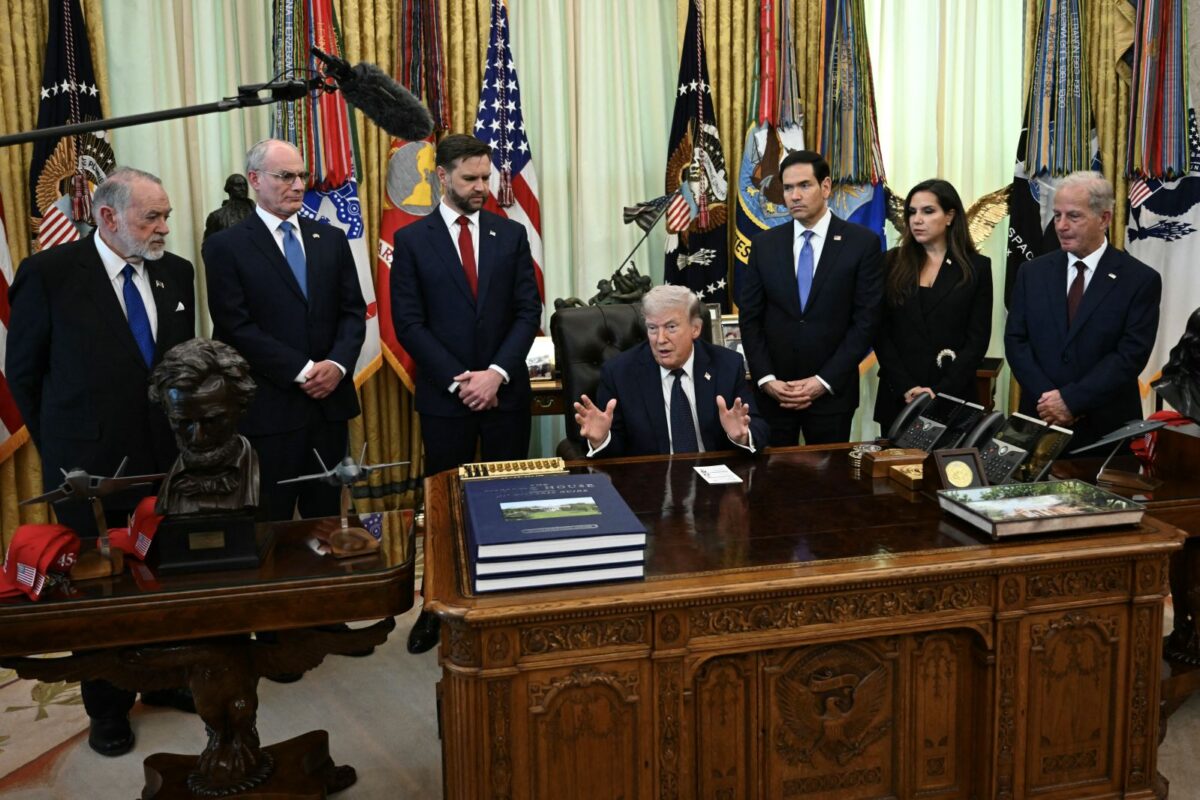
Photo by BRENDAN SMIALOWSKI / AFP. US Ambassador to Israel Mike Huckabee, Israel Ambassador to US Yechiel Leiter, US Vice President JD Vance, US Secretary of State Marco Rubio, Lebanon Ambassador to the US Nada Hamadeh Moawad and US Ambassador to Lebanon Michel Issa listen as US President Donald Trump speaks during a meeting with Lebanon Ambassador to the US and Israel Ambassador to the US, at the White House in Washington, DC on April 23, 2026.
US President Donald Trump met Lebanese and Israeli envoys at a new round of peace talks Thursday, with Beirut seeking a one-month extension of a shaky ceasefire set to expire.
The latest round of Lebanon-Israel talks in Washington has unfolded just days before the ceasefire between Israel and Hezbollah was due to expire. The two-day negotiations led to a renewed 45-day ceasefire.
The meetings, described as the third round of talks this year, focused on border security arrangements, the withdrawal of Israeli forces from Southern Lebanon and the disarmament of Hezbollah.
American officials described the two-day discussions as “productive,” adding that another round of talks is scheduled for June 2 and 3 as diplomatic efforts continue to prevent renewed escalation along the border.
US State Department spokesperson Tommy Pigott said on his X account Washington hopes the negotiations will help move both sides toward a more lasting arrangement based on border security, sovereignty, and stability between Lebanon and Israel.
While Lebanese officials publicly framed the talks as part of ongoing diplomatic efforts to stabilize the border, the broader message coming from Washington and Western mediators was clear: maintaining calm in southern Lebanon is now directly linked to the issue of Hezbollah’s arms and the authority of the Lebanese state.
The talks come as Israel continues near-daily strikes across parts of southern Lebanon, arguing that Hezbollah activity still violates existing agreements, while Hezbollah insists its operations remain tied to Israeli aggression and occupation. The continued violence has left many Lebanese questioning whether the ceasefire exists in practice or only on paper. Diplomatically, however, the negotiations reveal a larger shift taking place around Lebanon. International actors appear increasingly unwilling to separate border stability from broader security reforms inside the country.
For Lebanon, the challenge remains deeply political as much as military. The government faces mounting pressure to prove it can enforce state authority while also navigating internal divisions over Hezbollah’s role, regional alliances, and the risks of another devastating war.
In Lebanon
Ceasefire extension faces its first real test: Efforts to preserve the ceasefire between Lebanon and Israel entered a critical phase this week. Lebanese officials have publicly called for what they describe as a “real ceasefire,” arguing that repeated Israeli strikes undermine the credibility of ongoing negotiations and place civilians at continued risk.
The extension discussions come as Washington intensifies pressure on both sides to avoid escalation while broader negotiations continue. Lebanese political figures have attempted to present the ceasefire as an opportunity to stabilize the border and reduce the humanitarian and economic burden of war, but skepticism remains widespread inside Lebanon.
Israeli airstrikes continued across several southern areas throughout the week, while Hezbollah maintained some military operations targeting Israeli positions near the border. The exchanges have reinforced fears that the ceasefire is functioning more as a temporary pause than a sustainable political solution. Analysts also warn that the absence of a long-term agreement addressing Hezbollah’s military infrastructure south of the Litani River leaves the situation vulnerable to sudden escalation. For now, the ceasefire remains active diplomatically, but increasingly unstable militarily.
Israeli strikes continue across Southern Lebanon: Southern Lebanon witnessed another week of escalating violence as Israeli airstrikes targeted multiple villages and border areas, causing casualties, displacement, and renewed destruction. Israeli officials said the strikes targeted Hezbollah military sites and surveillance positions, while Hezbollah announced retaliatory attacks against Israeli military gatherings and equipment along the frontier.
The intensity of the strikes has deepened concerns among residents who had hoped diplomatic negotiations in Washington would reduce tensions on the ground. Instead, many communities in the south remain trapped between ongoing military exchanges and uncertainty over whether a wider conflict could resume at any moment.
Lebanon’s economy sinks deeper under the weight of war: Lebanon’s economic crisis continued to worsen this week as the ongoing conflict and political uncertainty placed additional pressure on an already collapsing financial system. Economists and officials warned that reconstruction costs, infrastructure damage, declining investment, and the disruption of economic activity in the south are pushing the country toward an even deeper social crisis.
The war’s impact is now visible across multiple sectors. Tourism expectations for the summer season remain weak, agricultural losses continue to rise, and many businesses have delayed expansion or suspended operations entirely due to instability. At the same time, the government faces increasing difficulty securing international financial support without broader political and economic reforms.
Reports published this week estimated that the eventual reconstruction bill could reach staggering levels if the war continues, especially given the extensive destruction already recorded in border areas. Meanwhile, ordinary Lebanese citizens continue to absorb the direct consequences through inflation, rising food prices, unemployment, and the collapse of purchasing power.
Food security concerns grow: Rising transportation costs, disrupted agricultural production, and instability linked to the war in the south have all contributed to increasing pressure on food supplies and consumer prices.
Agricultural officials warned that ongoing insecurity is damaging production cycles in several southern regions, particularly areas dependent on seasonal farming. Farmers have faced difficulties accessing land near conflict zones, while transportation routes and export activity remain vulnerable to disruption. The result has been reduced local production alongside growing fears of higher dependency on imports.
Aid organizations have also expressed concern about the growing number of families relying on food assistance, especially in communities hosting displaced residents from the south.
Political divisions deepen around Hezbollah’s role: The latest diplomatic discussions have added new pressure on the Lebanese government to clarify its position regarding the implementation of international resolutions tied to border security and disarmament. Western officials increasingly link financial assistance and diplomatic support to broader reforms that include strengthening state institutions and limiting non-state military authority.
Hezbollah and its allies, however, continue to reject what they describe as external pressure designed to weaken the “resistance.” The group maintains that its weapons remain necessary as long as Israeli threats continue and disputed territories remain unresolved.
At the same time, critics warn that Lebanon risks remaining trapped in cycles of war and economic isolation if the state cannot assert full authority over security decisions.
Displacement and humanitarian pressures continue: Local municipalities and humanitarian groups warned that resources are becoming increasingly strained as displacement stretches into another prolonged period of uncertainty. Schools used as shelters, healthcare centers, and local services in some host communities are struggling to cope with increased demand, particularly as Lebanon’s broader economic collapse limits state support.
The humanitarian dimension of the conflict has often received less attention than the military and diplomatic developments, yet for many Lebanese it represents the most immediate reality of the crisis. Aid organizations continue to warn that prolonged instability risks creating deeper social and economic consequences, especially in already vulnerable regions of the country. As negotiations continue abroad, communities in southern Lebanon remain caught between uncertainty, exhaustion, and the growing fear that temporary displacement may become permanent.
In The Region
UAE condemns threats to regional stability: The United Arab Emirates strongly condemned attacks targeting the area surrounding the Barakah nuclear plant this week, describing them as a dangerous escalation that threatens regional security and stability. Gulf Cooperation Council states also issued statements warning that attacks on strategic infrastructure in the Gulf could have serious consequences for the wider region.
Gulf officials stressed the importance of protecting civilian infrastructure and avoiding actions that risk broader confrontation. The statements also reflected increasing Gulf concern over the security of energy facilities, shipping routes, and strategic economic assets amid rising regional tensions.
US-Iran tensions continue amid new diplomatic efforts: Tensions between Washington and Tehran remained high this week despite renewed diplomatic activity aimed at preventing direct confrontation. Reports indicated that Pakistani officials traveled to Tehran as part of broader regional efforts to facilitate dialogue and reduce escalation risks between the United States and Iran.
At the same time, Iranian officials warned about the economic and security consequences of instability in the Strait of Hormuz, while US President Donald Trump issued renewed warnings toward Tehran. The developments highlighted the fragile balance between diplomacy and escalation currently shaping regional politics, particularly as conflicts in Gaza, Lebanon, and the Red Sea continue to fuel broader instability.
Tom Barrack visits Damascus amid renewed focus on Syria: US envoy Tom Barrack held meetings in Damascus this week focused on Syria’s political transition, reconstruction challenges, and regional reintegration efforts. Syrian state media described the discussions as part of ongoing dialogue over economic recovery and international engagement following years of conflict and isolation.
The visit reflects a broader regional shift toward cautiously re-engaging with Damascus despite continued Western sanctions and unresolved political disputes.
Hamas leader killed as Gaza war continues: The killing is of Izz al-Din al-Haddad, the head of Hamas’s armed wing in Gaza amid Israeli military operations and continued humanitarian deterioration inside Gaza, where aid agencies warn conditions remain catastrophic for civilians.
Trump in China for state talks: US President Donald Trump arrived in Beijing this week for high-level talks with Chinese President Xi Jinping amid growing global economic and geopolitical tensions. The meetings focused on trade disputes, regional security, technology competition, and ongoing conflicts affecting global markets.
The visit comes at a particularly sensitive moment internationally, with Washington managing crises in the Middle East, tensions with Iran, and strategic competition with China. Analysts view the talks as an attempt to stabilize relations between the world’s two largest economies while navigating increasingly complex global power dynamics.
What we’re reading:
“The Maronites of Aleppo: The Forgotten Connection” by Charles H. al-Hayek explores the long-overlooked historical and cultural ties between the Maronite community of Lebanon and the Maronites of Aleppo in Syria. Al-Hayek traces the community’s roots back centuries, showing how Aleppo once played a central role in shaping Maronite intellectual, religious, and educational life. The article highlights influential figures, monastic reforms, literary contributions, and the importance of Aleppo as a Levantine cultural hub.
“When the Ceasefire Holds, the Classroom Decides the Peace” by Mostafa Geha argues that sustainable peace in Lebanon cannot be achieved through military agreements alone, but through education and civic transformation. The article focuses on how classrooms shape future generations’ understanding of identity, coexistence, and conflict. Geha emphasizes that sectarian narratives embedded within Lebanon’s educational system continue to reproduce division and mistrust among communities.
“Lebanon Between War and Negotiation” by Farid Fakherddin examines Lebanon’s position amid ongoing regional negotiations and conflict dynamics involving Hezbollah, Israel, and international actors. Fakherddin argues that Lebanon has spent decades trapped in wars and geopolitical struggles that exceeded the state’s capacity and weakened its institutions.
“Peace Born Dead” by Elissa El Hachem reflects on the contradictions surrounding negotiations, resistance rhetoric, and political paralysis in the Middle East, particularly in Lebanon and Iran. El Hachem contrasts Iran’s willingness to negotiate directly with the United States when necessary with Lebanon’s continued hesitation and ambiguity in confronting its political realities.
“Lebanon’s General Amnesty Law becomes stage for sectarian fighting” by Laura Hülsemann explores how Lebanon’s proposed General Amnesty Law has evolved from a humanitarian and judicial issue into a deeply sectarian political battle. The article explains how overcrowded prisons, delayed trials, and the collapse of the justice system created pressure for reform, but political factions quickly turned the law into a negotiation over communal interests.