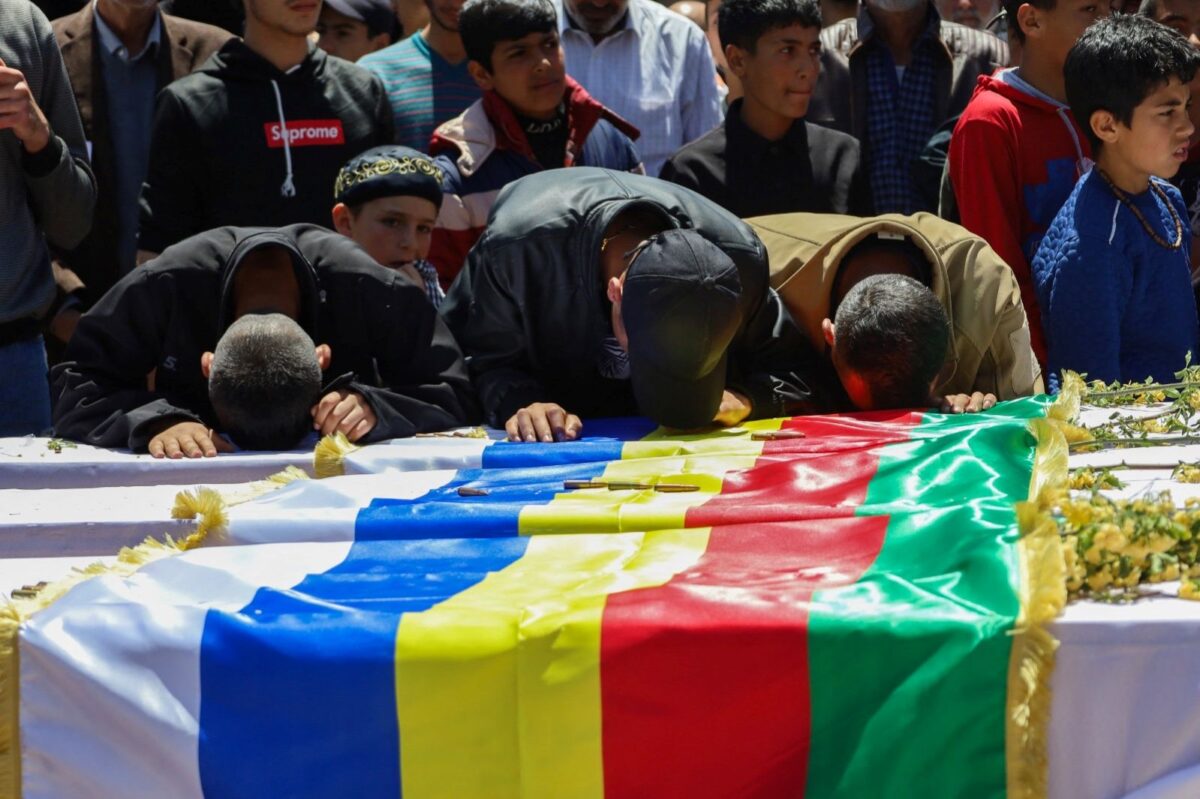
PHOTO CAPTION: People mourn by coffins of members of the Syrian minority who were killed in recent sectarian clashes during their funeral in Salkhad village in Syria’s southern Suwayda governorate on May 3, 2025. A day earlier a war monitor and Druze residents said forces affiliated with the new Syrian authorities attacked Jaramana and Sahnaya near Damascus and clashed with Druze gunmen, while Syria’s government blamed “outlaw groups” for the violence, before a de-escalation deal prompted government troop deployments in Sahnaya and tighter security around Jaramana. (Photo by Shadi AL-DUBAISI / AFP)
Every time this region erupts, there are those who rush to request that the Druze once again “prove” their belonging. That they declare their loyalty, define their position, and demonstrate that they are not a “separate project,” not a “weak flank,” not a “tool in the hands of the enemy.” As if this community is condemned to stand perpetually before a public tribunal, submitting credentials in blood, paying a double price simply because its boldest decision, then and now, has been to endure and to survive.
The Druze are not sandbags in other people’s wars, nor are they fixed frontlines to be summoned whenever someone seeks rhetorical heroism or geopolitical balance. This discourse, dressed in the language of history, Arabism, and orientalism, is nothing more than a blunt invitation to place the Druze in the line of fire, and then blame them when they dare to bend to avoid the bullet.
Who decided that the Druze, or any other community for that matter, must undergo a perpetual blood test of patriotism every time this region collapses? Who decreed that patriotism here is not a contract that protects life, but an endless exam that threatens it? And why is this test imposed on some, while others are spared even the question?
The uncomfortable truth many prefer to ignore is this: the Druze, like all peoples, are not an abstract idea. They are human beings who have written history in blood, endured betrayal and abandonment, and witnessed grand projects raised in their name only to be crushed upon their heads. From Arab nationalism, which ended in defeat and fragmentation, to political Islam, which turned societies into arenas of exclusion and excommunication, to nation-states that collapsed at the first real test leaving their communities exposed, stripped of any protection before the blade.
And still, they are asked for more.
Even more dangerous is the crude ignorance that seeks to demonize any connection between the Druze of Lebanon, and to some extent Syria, and the Druze of Israel. Suddenly, any solidarity, any communication, any sense of shared belonging becomes a “political project,” a “Zionist infiltration,” or a “disguised betrayal.” This is not analysis. It is intellectual laziness masquerading as moral certainty.
The Druze in Lebanon and Syria do not view the Druze in Israel solely through the prism of the state. They see them as part of a broader social and human continuum, one that cannot be erased by ideological rhetoric.
The Druze in Lebanon and Syria do not view the Druze in Israel solely through the prism of the state. They see them as part of a broader social and human continuum, one that cannot be erased by ideological rhetoric. They see relatives, shared memory, and a history that long predates modern borders. Those who fail to grasp this do not understand the Druze. In fact, they do not understand the very fabric of this region, whose reality has always extended beyond the artificial lines drawn on maps.
Does this absolve Israel? Of course not. But to reduce every social bond to a political conspiracy is not a sign of awareness, it is a symptom of failure.
The real problem lies elsewhere: in a discourse that seeks to monopolize the definition of “legitimacy” and “patriotism,” distributing both selectively, according to its own whims. It is the same discourse that was conspicuously absent when massacres were broadcast in real time, only to rediscover its moral outrage the moment it sensed that the Druze might not conform to the role assigned to them.
Thus, let us ask the obvious question: where was this fervor when massacres were unfolding? Where was the “center”? Where were the “voices of reason”? Where was the “nation”? Who acted? Who protected? Who offered a single credible guarantee to any threatened community?
No one.
But the moment the victim begins to think about survival, they become the accused.
This is hypocrisy in its purest form.
As for the historical narratives being revived today, from “guardians of the frontiers” to calls for “integration into the center”, they may sound polished, but they are wholly unfit to serve as death sentences for the present. History is not a mobilization order, and memory is not a weapon to be wielded against those seeking safety. What brought us to this collapse is precisely this addiction to weaponizing the past, turning it into a burden on the present instead of a lesson for it.
The grand projects have already been tried: Nasserism, Baathism, political Islam. All raised the banners of unity, liberation, and identity, only to dismantle societies, crush individuals, and institutionalize fear. These projects failed to protect majorities. How, then, are they expected to protect minorities that they remember only when convenient?
The grand projects have already been tried: Nasserism, Baathism, political Islam. All raised the banners of unity, liberation, and identity, only to dismantle societies, crush individuals, and institutionalize fear. These projects failed to protect majorities. How, then, are they expected to protect minorities that they remember only when convenient?
And yet, amid this wreckage, there are those who seek to recycle failure, and demand that the Druze dissolve into it once again.
It is precisely here that a different understanding of history must be reclaimed, not as a collection of slogans, but as a lived experience of survival. Figures such as Emir Sayyid Abdullah al-Tanukhi did not carve their place through collective suicide or blind submission to any center. They did so by rationalizing their relationship with reality, producing compromises that ensured continuity. Adaptation was not betrayal. It was the condition for survival.
That is the lesson many refuse to learn.
The future of this region will not be built through the forced imposition of collective identities, nor through the coercion of entire communities in the name of patriotism. If a future is to exist at all, it will rest on something far simpler: that a Druze, a Sunni, a Jew, and an atheist can coexist without one being turned into fuel for another. That citizenship becomes a real contract, not an empty slogan. That this region ceases to punish those who seek to survive.
Persisting in the current path, of accusation, mobilization, imposed roles, and selective readings of history, will only yield more bodies and more isolated mountains, as communities are pushed further into existential anxiety in search of escape.
Persisting in the current path, of accusation, mobilization, imposed roles, and selective readings of history, will only yield more bodies and more isolated mountains, as communities are pushed further into existential anxiety in search of escape.
At that point, the question will no longer be why the Druze, or anyone else, are reconsidering their place within the “center.”
It will be why there is no center left at all.
And at the end of this endless argument, one image remains more truthful than all the rhetoric: Mount Hermon, covered in white, like the turban of Druze elders. It is not merely a landscape, it is a stark reminder that survival in this region has never belonged to those who shout the loudest, but to those who understand how to balance courage with reason, dignity with survival.
So, when they repeat the old maxim, “A people without the bold lose their rights, and a people without the wise are led to slaughter”
So, when they repeat the old maxim, “A people without the bold lose their rights, and a people without the wise are led to slaughter”
its meaning today is clearer than ever. What is required is not that the Druze, or anyone else, become permanent fuel to prove belonging, nor that they be pushed into battles they neither choose nor control. What is required, simply, is recognition of their right, as with all others, to live as human beings, not as deferred martyrs in someone else’s narrative.
That is the lesson many refuse to hear: nations are not built by extorting their people, and dignity is not preserved by marching them toward death in the name of history. Those who fail to understand this will keep demanding more sacrifices, until there is no one left to sacrifice.
This article originally ran in al-Majjalla
Makram Rabah is the managing editor at Now Lebanon and an Assistant Professor at the American University of Beirut, Department of History. His book Conflict on Mount Lebanon: The Druze, the Maronites and Collective Memory (Edinburgh University Press) covers collective identities and the Lebanese Civil War. He tweets at @makramrabah