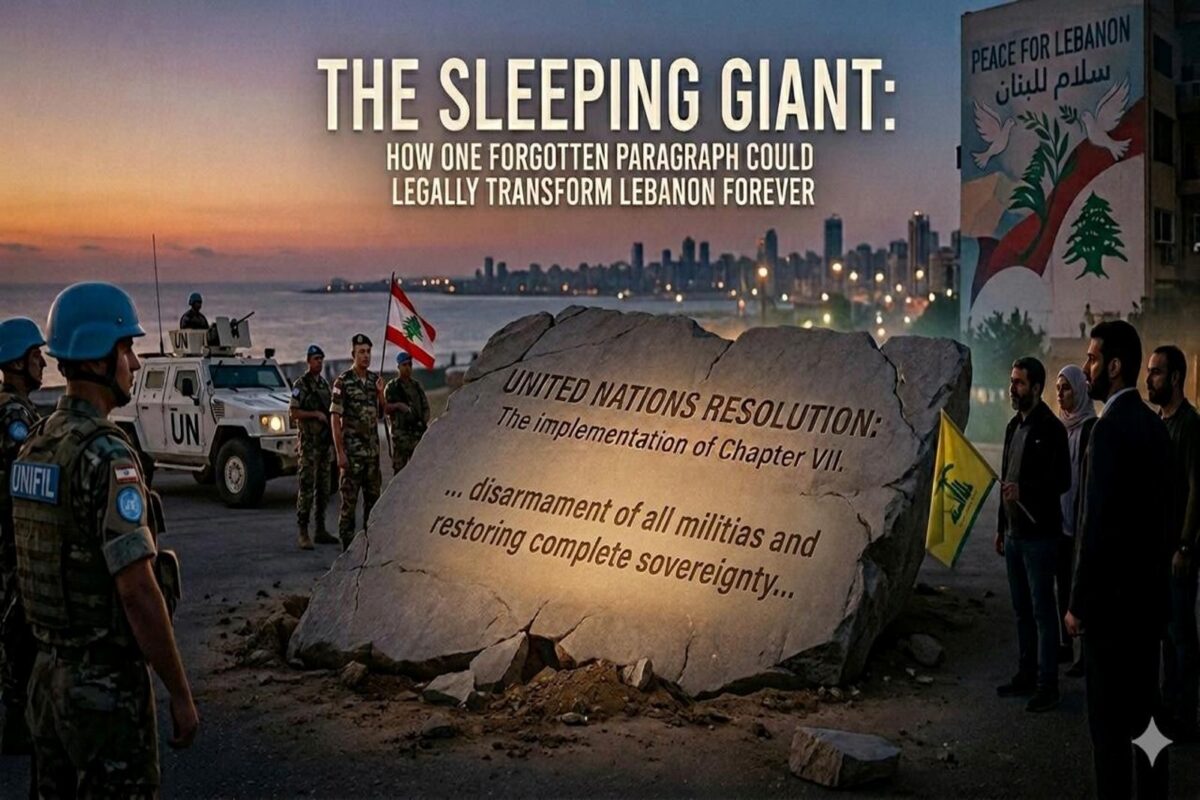
Twenty years ago, the Security Council handed the Lebanese government a key. It has never used it. That omission may be the most consequential political failure in Lebanon’s modern history.
In August 2006, the UN Security Council adopted Resolution 1701 to end the war between Israel and Hezbollah. Most remember it for UNIFIL and the demand for Hezbollah withdraw north of the Litani River. But buried within it for nearly two decades sits Paragraph 12, a clause rarely invoked in public discourse.
Paragraph 12 calls on the Security Council to authorize, upon request of the Lebanese government, an expanded UNIFIL mandate and additional international forces to help extend state authority. The operative word is request. The Lebanese government must ask. No external power can impose this. The legal key sits in Beirut, in the hands of the cabinet, and it has sat there, unused, for two decades years. This is not foreign intervention. It is the legitimate exercise of sovereign invitation.
UNIFIL today operates under Chapter VI. It observes violations and reports them. It cannot physically interpose itself between armed groups and civilian populations. It watches. It documents. It reports.
Chapter VII represents the enforcement arm of international law. It can impose sanctions, authorize member states to use all necessary means, and deploy forces mandated to actively enforce peace, not merely observe its absence. A Chapter VII mandate in Lebanon would mean international forces empowered to physically assist the state in extending its authority, including confronting armed groups that refuse to disarm. Every legal instrument needed to act already exists. The only missing element is political will.
The case for invoking Paragraph 12 rests on three interlocking facts. The Lebanese government has repeatedly issued cabinet decisions, in August 2025 and March 2026 under Prime Minister Salam, ordering the monopoly of arms, disarmament and full army deployment across national territory. These are not suggestions. They are sovereign decisions of a legitimate government that has said, twice and in writing, exactly what it wants. Hezbollah has made it clear it will not comply. The government has the will. It does not have the capacity. Paragraph 12 covers the gap between sovereign decision and impotence. Using it would not be a surrender of sovereignty. It would be its most assertive possible expression.
How would the government invoke this? The cabinet would pass a resolution formally requesting Security Council action under Paragraph 12. The Foreign Ministry would transmit this to the Secretary-General and the President of the Security Council, who would then deliberate and adopt a resolution authorizing an expanded mandate under Chapter VII. It is legally clean. The government has both the right and the tools.
The political reality, however, is that elegant legal architecture does not vote in the Security Council. Russia and China hold vetoes and would almost certainly block any Chapter VII expansion tied to Hezbollah disarmament. Iran’s allies will call it foreign interference, as they always do, about everything, whenever Lebanon tries to become a sovereign state. Yet pursuing this track is itself a form of power. Building international pressure and isolating Hezbollah diplomatically could shift the calculus, or at minimum force Hezbollah into a position where the cost of defiance exceeds the cost of compliance, rendering enforcement unnecessary by the very credibility of its invocation.
If Chapter VII were to take place on Lebanese soil, the consequences would be historic and irreversible: international forces deploying with authority to enforce disarmament, the Lebanese Army extended into territories it has never fully controlled, Hezbollah’s parallel military state facing compliance or direct confrontation, and Lebanon having, for the first time since 1975, a genuine chance at becoming a country where the state alone decides questions of war and peace.
The law has already answered every question except one, and that one is not legal. It is a matter of whether this government wants to be remembered as the cabinet that had the courage to finally act, or the latest in a long line that chose not to.”
Cathryn Papadopoulo is the Secretary of Foreign Affairs and The Diaspora, in Lebanon’s National Liberal Party, called Ahrar.
The views in this story reflect those of the author alone and do not necessarily reflect the beliefs of NOW.