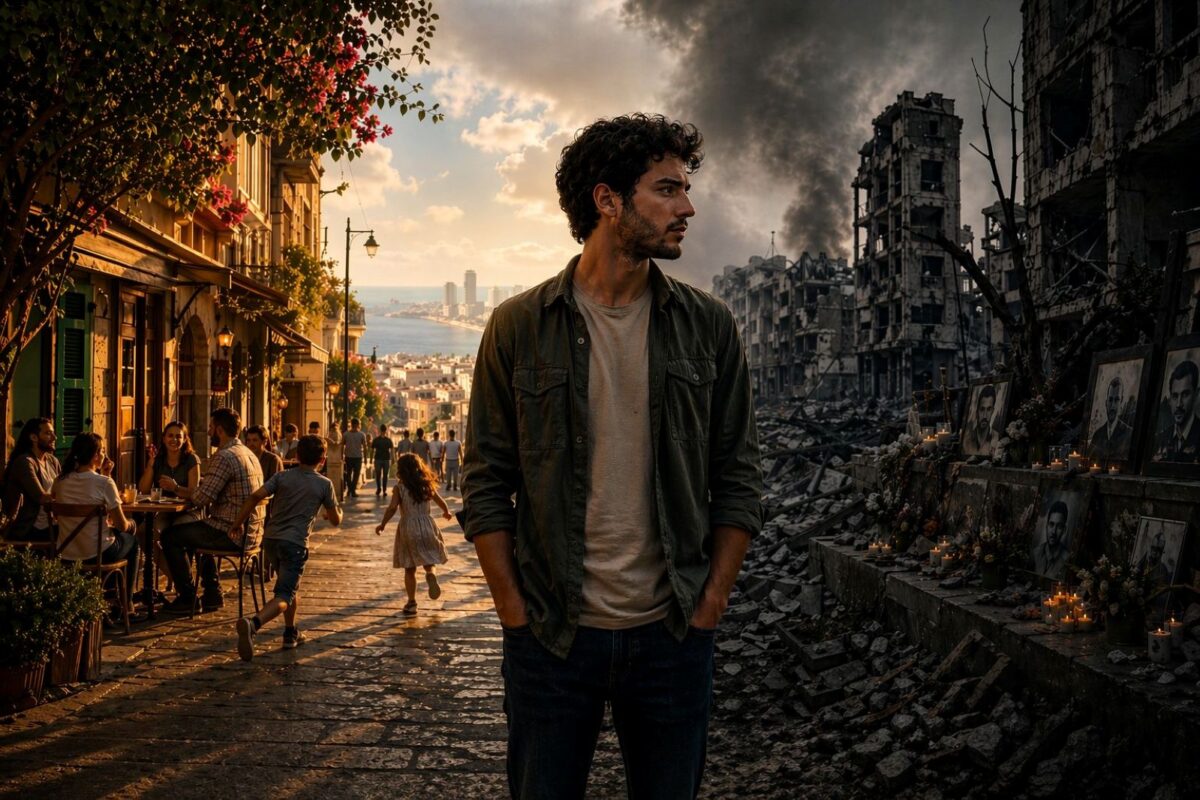
On Wednesday, April 8, Israel attacked residential areas in central Beirut. More than 300 people were killed, according to reports, and I recognized only one of them from a photo, a young man who worked as a barista at a café where I sometimes sat. He had prepared my order many times. The only thing I knew about him was his name, Ali, from the tag on his t-shirt. He seemed quiet, even a bit shy. Later, when I spoke with one of his coworkers, she told me he was an only child, 20 years old, and that day he had left his shift early to go home, and that was the end of his life.
One of his coworkers told me, “Khalas, at least he’s in a better place now.” I asked, how? He could have lived. And isn’t living itself a kind of resistance? He replied, “We have a case and we’re ready to die for it and he used to accept that”. He added that many people are ready to die for their country. The conversation didn’t go anywhere, and I didn’t feel like continuing it. At the end, he said he knew that most people in Iran are against them, and that just because there are many of you, it doesn’t mean you are right.
These questions are not meant to ignore the violence that caused these deaths. The attack that took their lives is a clear reality. But what I want to question here is the meaning we give to these deaths afterward.
This conversation took me back to my childhood. We were raised in a similar environment. The idea of “resistance” was very present in the official language of Iranian society after the 1979 revolution. When the Iran–Iraq War began, this idea became closely tied to fighting and martyrdom. Resistance was meant to be part of every aspect of life, in war, in everyday life, in what we ate, in what we said, and in what we denied ourselves. It showed up in small, daily things: standing in lines, using ration coupons for basic goods, in school, where bringing certain foods that had a strong smell, things that might make others want them, was not allowed; in the clothes we wore, the shoes, socks, and even school supplies that were not supposed to make us stand out. In that same atmosphere, even teenagers under the legal age were encouraged to go to the front, my own brother was one of them, at just sixteen. We also had places dedicated to the war dead “Tekkiye Shohada”, and we would sometimes visit their graves, people who, now, are younger than many of us, as if time had stopped for them. We were told to resist what was called “global arrogance” and “imperialism,” against an enemy that was presented as Iraq and its supporters.
This atmosphere was also reflected in wartime media. There were documentary series like Revayat-e Fath by Morteza Avini, broadcast on national television on Thursday nights, with Avini’s voice, something about it drew you in. There were also war chants and voices like Sadegh Ahangaran, singing lines like “I once had a white horse / I once longed for martyrdom,” along with phrases such as “Do not close the gates of martyrdom.” Together, they created an atmosphere that pulled you in. Without even realizing it, we would cry for the fighters who were risking their lives at the front. In these narratives, martyrdom was not just an end, but a kind of arrival, a way of reaching heaven, as it was often said: “The martyrs do not die; they are alive and provided for by their Lord” (Qur’an 3:169).
As Ali Shariati argued, Hussain saw martyrdom as a conscious choice. But later, we began to ask: if he knew he would be killed in Karbala, why did he choose that path? How does that choice relate to the idea in the Qur’an that one should not “throw oneself into destruction” (2:195)?
This “death or freedom” mindset shaped our schools, our society, and everything around us. In religious classes, Qur’an lessons, and school programs, as well as in marches and ceremonies, sometimes mandatory and held in the streets, martyrdom was presented as one of the highest forms of death, a kind of death that defined a person’s worth through sacrifice. Alongside this, we were given a certain image of heaven: one where men were promised companions often described as houris, and women were told they would be reunited with their husbands, an image that was repeated through common interpretations and religious narratives.
And we, as Shi’a teenagers who deeply believed in the core principles of our faith, including the afterlife, were looking for a path to martyrdom. In our prayers, in the moments when we raised our hands, in prostration, in supplications and extra prayers, we would cry and ask God to grant us the blessing of martyrdom and heaven. Even after the war ended, this belief remained, that the path to that “garden” was still open. The war was over, but its logic, the logic of martyrdom, continued.
In the end, those who were killed were seen as a source of blessing for their parents; it was believed they could intercede for them. But at the same time, there was a broader way of thinking, and a set of policies, that sought to replace the soldiers who had been lost, because the “front lines of truth against falsehood” were not supposed to be left empty. During the Iran–Iraq War, the government promoted higher birth rates through radio, television, and other media. This was not presented only as a demographic need, but also as a way to continue the “path of the martyrs.” In this context, having children was often seen as a way of carrying that path forward, a way of responding, at a collective level, to the loss of those who had died.
Perhaps what stands out in this environment is a kind of focus on death, a way of thinking in which human life can sometimes seem less important when compared to larger ideals. This is not limited to one society or one group; it can be seen, in different forms, in parts of the Middle East, where states often treat people less as individuals with a right to live, and more as workers or soldiers. In such a context, when someone is killed and called a “martyr,” there is a risk that their loss is understood in broader, abstract terms, as if it can somehow be replaced by someone else.
This way of thinking continues today in some movements in the region, including among some supporters of Hezbollah. In this view, resistance is sometimes understood less as a way of living, and more as a readiness to be killed. Here, resistance becomes tied not to sustaining life, but to a willingness to die.
In all of this, what is often overlooked are the human bonds: a family that has lost a child, a friend who will never return, a life that could have continued. My cousin had only one week left of his military service when he was killed by a single bullet. He did not believe in martyrdom; he was simply completing his service. But after his death, he was placed into that same framework, they called him a “martyr.” He never turned 24. For me, all that remains is a faded photograph on his gravestone. My mother always spoke of him with tears, she would say he had come to visit before leaving and told her he had only one week left. And then, while crying, she would say: it was such a waste… a young man so handsome, so full of life. What a good person he was. Why did he have to be killed? Losing a person is not just a concept or a title. Calling someone a “martyr,” with all its meaning, cannot take away the pain of that loss for their family and those close to them.
But a question that is rarely asked is this: does resistance necessarily mean death?
Perhaps resistance can be understood differently, as the act of staying alive, of protecting life, of allowing it to grow, and of refusing to accept death as the only way to give life meaning. If death becomes an ideal, then life is pushed to the margins. A society that places death at its center will, sooner or later, lose its ability to build, to live, and to move forward.
Maybe this is where the real issue begins.
Elham Adimi is an Iranian freelancer journalist based in Beirut
The views in this story reflect those of the author alone and do not necessarily reflect the beliefs of NOW.