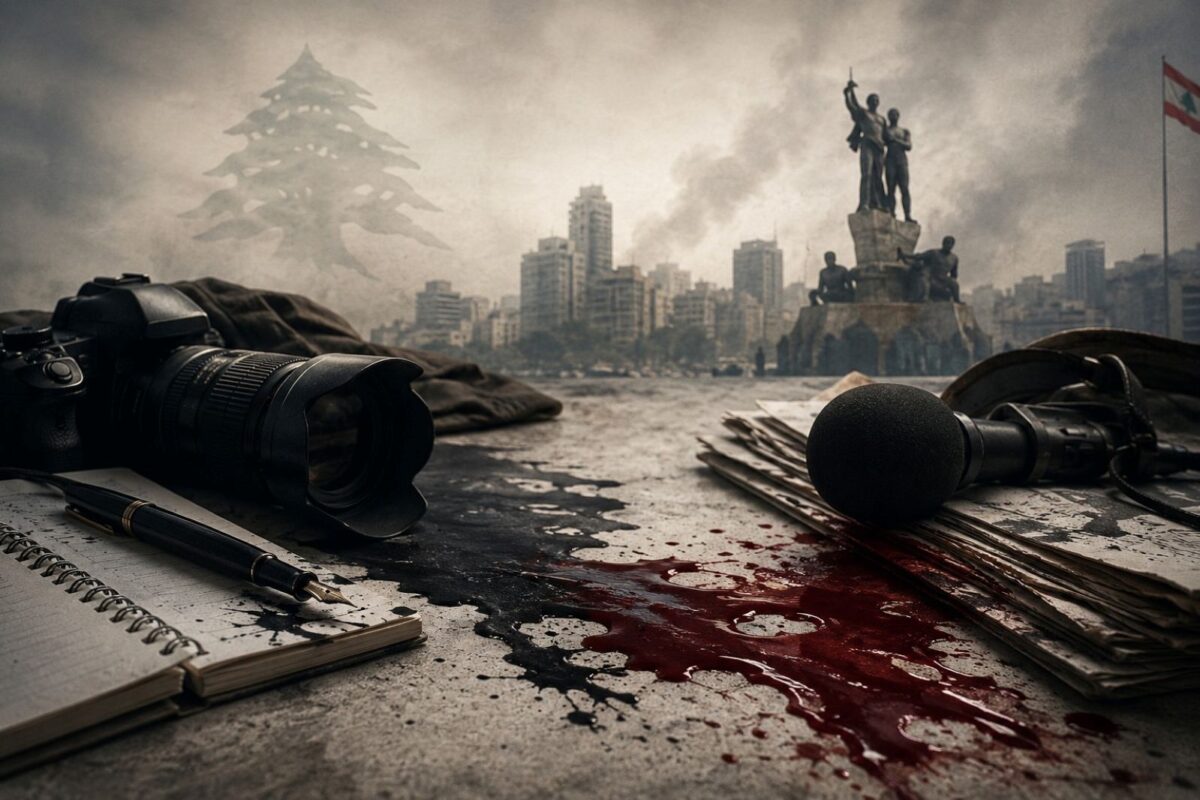
May 6 commemorates Martyrs’ Day, and with it the Day of the Fallen Members of the Lebanese Press. It is an anniversary that traces its origin to 1916, when the Ottoman authorities executed leading members of what was then the liberation movement against Turkish oppression, under the reign of terror of Jamal Pasha.
More than a century later, Lebanon remains trapped in a wicked circle of verbal and physical violence against members of the press, intellectuals, activists, and all those who dare to speak in search of a decent and prosperous country.
More than a century later, Lebanon remains trapped in a wicked circle of verbal and physical violence against members of the press, intellectuals, activists, and all those who dare to speak in search of a decent and prosperous country. The names change, the methods change, the slogans change, but the logic remains the same: silence those who expose, intimidate those who question, and eliminate those who refuse to bow.
Commemorating this day cannot be reduced to ceremonies, speeches, wreaths, and empty official statements. It cannot happen while impunity is still the law of the land. It cannot happen while killers walk free, while investigations are buried, while justice is delayed until it becomes another form of denial.
Gebran Tueni, Samir Kassir, Lokman Slim, Mustafa Geha, and many others were not killed by alien space invaders. They were not victims of some mysterious force floating above Lebanon. They were killed because they represented a free word, a sovereign idea, and a refusal to submit. They were killed by an entity and a political culture that has repeatedly dragged Lebanon into the abyss of hell: Hezbollah and the system of fear that protects it.
To say this is not hatred. It is memory. It is accountability. It is the minimum respect owed to those whose blood was spilled because they believed Lebanon deserved better than militias, intimidation, and the rule of the gun.
Israel, too, has killed and injured Lebanese journalists, among them the brave Issam Abdallah. His killing was a wound not only to his family and colleagues, but to journalism itself. Yet in that case, there was at least the possibility of judicial action, international condemnation, and public naming of the state responsible. There was a path, however imperfect, toward accountability.
Inside Lebanon, the tragedy is different and more suffocating. Here, justice is often stopped before it begins. Files disappear into silence. Accusations are treated as sectarian provocation. Fear becomes part of public life. The victim is mourned for a day, then buried again under compromise, cowardice, and political convenience.
This is why May 6 must not be turned into a museum date. It is not only about the martyrs of 1916. It is about the long, unfinished struggle between freedom and domination, between the word and the weapon, between a republic of citizens and a jungle ruled by those who kill and then lecture us about dignity.
The Lebanese press has paid with blood and ink for every inch of freedom this country still possesses.
The Lebanese press has paid with blood and ink for every inch of freedom this country still possesses. Its fallen members were not perfect saints, nor did they all belong to one ideology or one camp. But they shared something essential: they believed that words matter, that truth matters, and that Lebanon cannot survive if fear becomes stronger than conscience.
Anyone who wishes to honor the blood and ink of Lebanese journalism must first stand firm against impunity. Not selectively. Not when it is politically convenient. Not only when the killer is foreign and the victim is ours. Justice must have one standard, whether the crime is committed by an enemy across the border or by an armed force inside the country.
Anyone who wishes to honor the blood and ink of Lebanese journalism must first stand firm against impunity. Not selectively. Not when it is politically convenient. Not only when the killer is foreign and the victim is ours. Justice must have one standard, whether the crime is committed by an enemy across the border or by an armed force inside the country.
Only then can May 6 become more than a ritual. Only then can we reflect honestly on our past and look with some dignity toward our future. Until then, every commemoration remains incomplete, every speech remains hollow, and every silence becomes another betrayal of the dead.
Makram Rabah is the managing editor at Now Lebanon and an Assistant Professor at the American University of Beirut, Department of History. His book Conflict on Mount Lebanon: The Druze, the Maronites and Collective Memory (Edinburgh University Press) covers collective identities and the Lebanese Civil War. He tweets at @makramrabah
Follow NowLebanon on social media: X , Instagram and Facebook