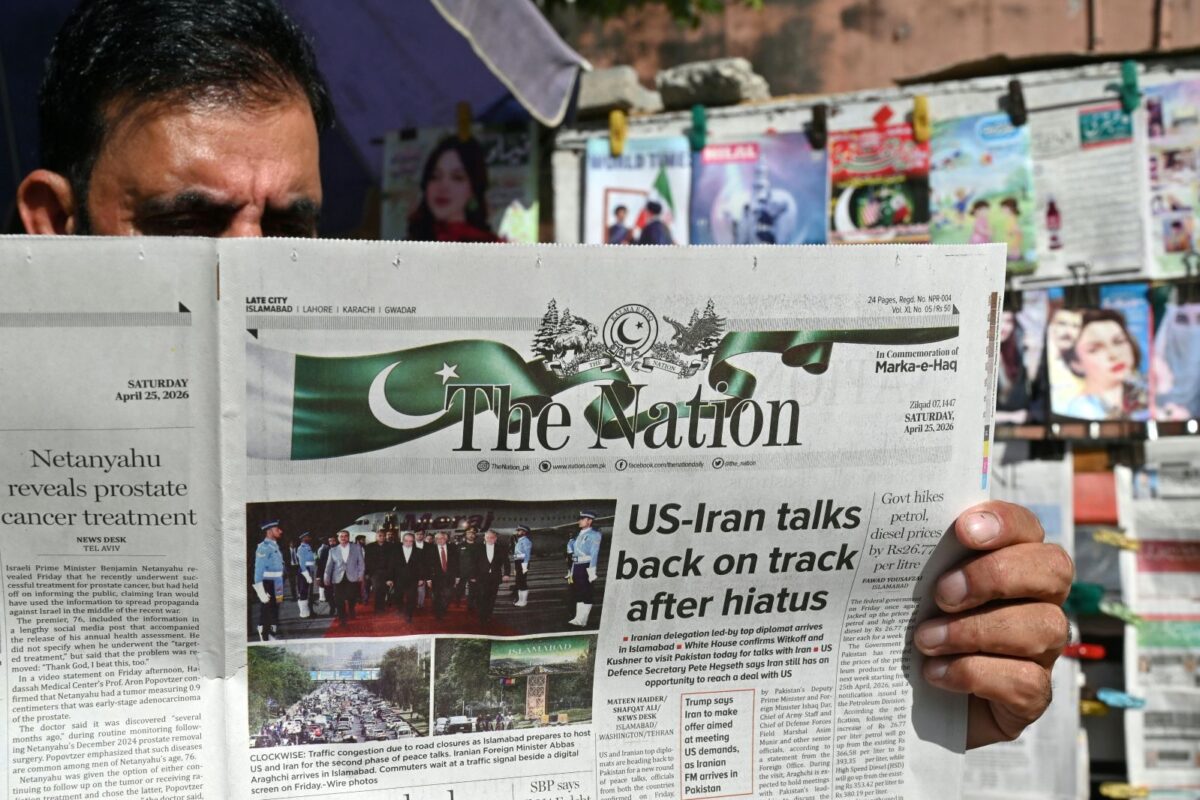
Islamabad, Pakistan, Photo by ASIF HASSAN / AFP
A man reads a newspaper at a roadside stall in Islamabad on April 25, 2026.
US envoys headed to the Pakistani capital on April 25 in a bid to kickstart a new round of peace negotiations with Iran amid a fragile ceasefire, though the prospect of direct talks remained uncertain.
“We will never bow our heads before the enemy, and if talk of dialogue or negotiation arises, it does not mean surrender or retreat. Rather, the goal is to uphold the rights of the Iranian nation and to defend national interests with resolute strength.”
That statement was delivered by Iranian President Massoud Pezeshkian without embarrassment, apology, or ideological hesitation. Tehran may still call America the “Great Satan”, but it negotiates with Washington openly, directly, and repeatedly whenever the regime’s survival requires it.
And here lies the question Lebanon refuses to confront honestly:
Why is what is permitted to Iran forbidden to Lebanon?
Why does Tehran reserve for itself the sovereign right to negotiate with its enemies while Hezbollah and Amal deny the Lebanese state the same right? Why can Iran sit across the table from the United States, yet Lebanon is threatened politically and morally for merely contemplating direct talks with Israel?
Is the objection truly about negotiations? Or is it about who gets to sit at the table?
This contradiction sits at the heart of the coming Lebanese-Israeli talks scheduled in Washington on May 14 and 15 under American sponsorship. Before the delegations even arrive, the process already appears structurally broken, burdened by incompatible objectives, fragmented sovereignties, and a state too weak to impose its own decisions.
Prime Minister Nawaf Salam attempted to navigate this minefield carefully. “We are open to a peace agreement with Israel after our demands are met,” he stated, while also emphasizing that Lebanon seeks bilateral peace “within the Arab framework.” The wording was deliberate. He avoided explicit reference to the Arab Peace Initiative because every word in Lebanon has become a sectarian detonation device. Even language itself now requires internal permission.
Salam understands the limits of the Lebanese state better than most. His government is not negotiating from a position of strength, nor even from strategic coherence. It is negotiating from exhaustion. Israel speaks of reshaping the region, dismantling Hezbollah, and building long-term security architecture. Lebanon merely hopes to secure a ceasefire, Israeli withdrawal, prisoner releases, and enough stability to begin reconstruction.
These are not two negotiating parties pursuing the same destination. They are two actors inhabiting entirely different political realities.
Israeli Prime Minister Benjamin Netanyahu made this unmistakably clear in his recent interview with CBS’s 60 Minutes. For Netanyahu, the war is not over because the underlying strategic infrastructure remains intact: Iran’s enrichment capabilities, its missile systems, and above all its regional proxy network, including Hezbollah.
Israel is therefore not entering negotiations to manage tensions. It is entering them to alter realities.
Lebanon, meanwhile, lacks even the ability to define its own strategic doctrine. The Lebanese state knows, as Washington knows, and Tel Aviv certainly knows, that Beirut may sign understandings it cannot enforce.
This is the central tragedy of modern Lebanon: sovereignty exists formally on paper while actual coercive power exists elsewhere.
For decades, Hezbollah transformed itself from an armed organization into a parallel governing structure embedded inside nearly every nerve of the Lebanese system. It penetrated the security sphere, political decision-making, economic channels, border management, and entire social environments. Like a chronic disease fused into the body itself, it became nearly impossible to isolate without threatening the collapse of the host.
And this is precisely why every simplistic slogan about “disarmament” misses the deeper reality.
States do not surgically remove such structures overnight. Not without risking civil fracture, institutional implosion, or regional explosion. Even Hezbollah’s adversaries understand this privately, though few admit it publicly. The issue is no longer merely military. It is structural.
States do not surgically remove such structures overnight. Not without risking civil fracture, institutional implosion, or regional explosion. Even Hezbollah’s adversaries understand this privately, though few admit it publicly. The issue is no longer merely military. It is structural.
The Lebanese state today resembles a patient trapped in prolonged treatment rather than approaching recovery. Sometimes pressure is applied economically, sometimes diplomatically, sometimes militarily, sometimes through attrition and isolation. But nobody involved, not Washington, not Paris, not Riyadh, not even Israel, appears fully convinced that Lebanon can survive a sudden rupture with Hezbollah without entering a new phase of systemic collapse.
This explains the strange paradox governing the negotiations.
Israel wants a historic strategic outcome. Lebanon seeks temporary stabilization. Hezbollah seeks survival. Iran seeks leverage retention. Washington seeks to separate the Lebanese track from the Iranian file entirely, depriving Tehran of one of its most valuable regional pressure cards. But Tehran appears equally determined to keep Lebanon tied to the broader regional bargaining architecture.
For Iran, Lebanon is not merely a neighboring arena. It is strategic depth.
And Hezbollah knows this well.
The current talks therefore resemble less a peace process than a suspended confrontation managed through diplomacy. A fragile negotiating truce unfolding under the shadow of potential escalation. Every file is connected to another: the southern border, Hezbollah’s weapons, reconstruction funds, sanctions, regional normalization, Iranian-American bargaining, and the future balance of power across the Middle East itself.
One miscalculation in one arena could collapse the entire structure.
The deeper problem, however, is psychological as much as political.
Lebanon still negotiates as though time works in its favor. It does not.
The old doctrine of postponement, avoiding decisive choices, balancing contradictions, appeasing every axis simultaneously, has exhausted itself. Lebanon spent decades surviving through ambiguity. But ambiguity becomes fatal when the surrounding region is reorganizing itself through force.
The old doctrine of postponement, avoiding decisive choices, balancing contradictions, appeasing every axis simultaneously, has exhausted itself. Lebanon spent decades surviving through ambiguity. But ambiguity becomes fatal when the surrounding region is reorganizing itself through force.
Even the language of “resistance” no longer carries the certainty it once did. Hezbollah itself has entered an era of strategic attrition. Militarily wounded, financially constrained, regionally pressured, and internally challenged by the devastation inflicted upon its own social base, the organization faces a reality very different from the triumphalist rhetoric of previous years. Yet despite this weakening, nobody has yet produced a viable mechanism for what comes after Hezbollah.
And that is the real terror haunting every capital involved.
Because dismantling a deeply embedded power structure is one challenge. Preventing the country from collapsing alongside it is another entirely.
The Americans understand this. The Israelis understand this. Even many within Hezbollah’s own environment understand it quietly.
Which is why the coming talks may ultimately produce neither war nor peace, but something in between: a managed instability, endlessly negotiated yet never resolved.
A peace born dead.
And perhaps the bleakest truth of all is this: nobody today seems capable of explaining how Lebanon eventually exits this tunnel. Not politically. Not economically. Not institutionally. Not strategically.
And perhaps the bleakest truth of all is this: nobody today seems capable of explaining how Lebanon eventually exits this tunnel. Not politically. Not economically. Not institutionally. Not strategically.
The country remains suspended between a state too weak to rule and a militia too entrenched to disappear; between external negotiations and internal paralysis; between reconstruction promises and the permanent possibility of renewed war.
Lebanon has become a nation trapped inside other peoples’ calculations.
And until that changes, every negotiation will merely postpone the next crisis rather than resolve it.
Elissa E Hachem is a journalist and political writer specializing in regional affairs and governance. Former Regional Media Advisor at the U.S. State Department’s Arabic Regional Media Hub, with broad experience in strategic communication across government and private sectors.
The views in this story reflect those of the author alone and do not necessarily reflect the beliefs of NOW.