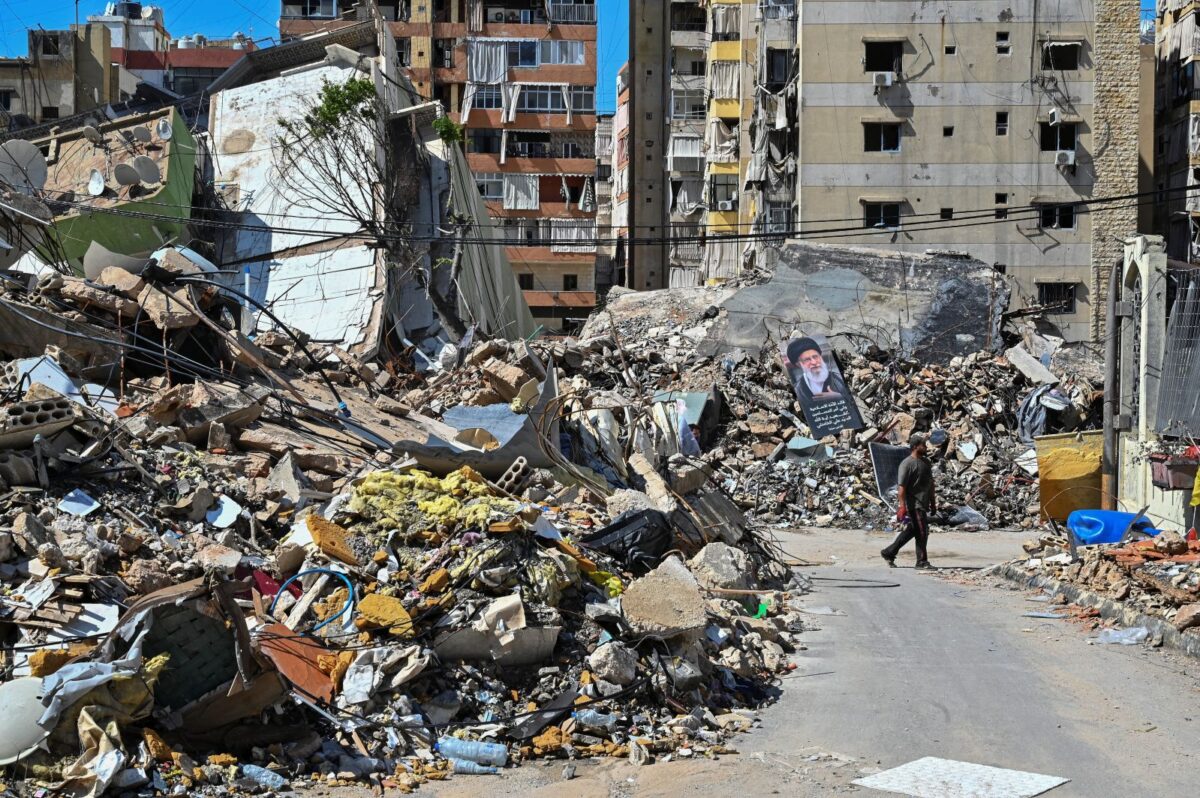
A media tour organized by Hezbollah's media office shows a view of destroyed buildings and the Sayyid al-Shuhada complex in Beirut's southern suburbs on May 6, 2026. Israel and Hezbollah have been trading accusations of violating the ceasefire agreement in force since April 17. Hezbollah has claimed responsibility for several operations targeting Israeli forces in southern Lebanon, as well as actions in northern Israel. (Photo by STR/NurPhoto) (Photo by NurPhoto / NurPhoto via AFP)
There is a particular kind of political cowardice that dresses itself as dignity. It refuses to negotiate because negotiation looks like weakness. It mistakes silence for sovereignty and absence for strength. It would rather Lebanon continue absorbing destruction than sit at a table, look its adversary in the eye, and say: here are our terms.
Hezbollah and its allies have spent the past weeks framing Lebanon’s direct talks with Israel as an act of submission, a nation on its knees signing away what remains of its dignity under fire. This framing is not just wrong. It is the inverse of reality. And it reveals more about Hezbollah’s existential panic than it does about Lebanon’s negotiating position.
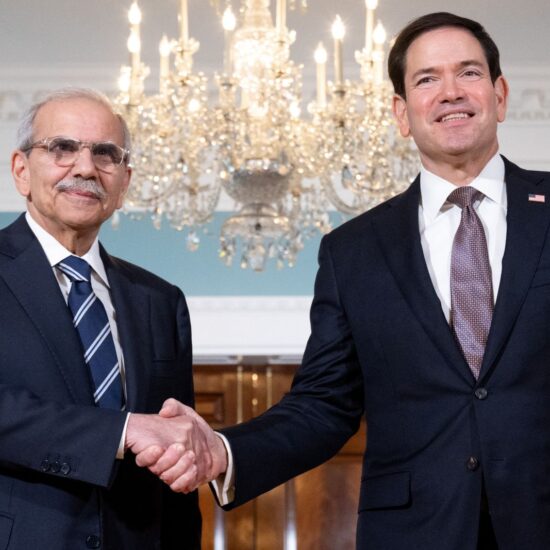
Let us be precise about what actually happened in Washington. The Lebanese ambassador walked into the State Department, sat across from her Israeli counterpart, with the American Secretary of State in the room and the world’s media outside it, and spoke on behalf of the Lebanese state. She called for full sovereignty over Lebanese territory. She insisted on the implementation of international resolutions. She demanded a ceasefire and raised the humanitarian catastrophe Israel’s campaign has inflicted on Lebanese civilians. The whole world heard it.
Tell me: how exactly is that submission?
Negotiations are not the language of the defeated. They are the language of states. Every war in modern history, from the armistice that ended World War One to Camp David to the Dayton Accords to every ceasefire Lebanon itself has ever signed, ended with adversaries sitting across from each other, often while still bleeding, and converting military reality into political terms. That is not weakness. That is statecraft. The alternative – refusing to engage until some mythical moment of perfect leverage arrives – is not resistance. It is a guarantee that Lebanon remains a battlefield indefinitely, with its people paying the price for a confrontation they never voted for.
There is something profoundly powerful about Lebanon going to the White House, sitting in front of the American president, and articulating what it wants: its borders demarcated, its sovereignty respected, Israeli forces out of its territory, international law honored. These are not small demands. These are the terms of a state that knows its rights. The world hearing them – on record, in public, with American and Israeli officials present – is itself a form of leverage that years of so-called resistance have never produced.
The objection that the talks are “direct” rather than “indirect” is a procedural distraction. Indirect negotiations still produce agreements; the channel does not determine the content. What Hezbollah actually objects to is not the format but the actor: the Lebanese state speaking for Lebanon. An independent Lebanese foreign policy, one that does not pass through Tehran or require Hezbollah’s blessing is precisely what the organization cannot tolerate, because its entire political existence depends on the state’s incapacity to do exactly this.
Which brings us to the point that must be stated without diplomatic softening.
Hezbollah is now demanding “national consensus” before Lebanon can pursue peace talks. The party insists that a decision of this magnitude cannot be taken unilaterally, that all Lebanese political forces must be consulted, and that the country must speak with one voice. The principle, in the abstract, is sound. The problem is that Hezbollah has never once applied it to itself.
In 2006, Hezbollah made the decision to capture two Israeli soldiers and drag Lebanon into a war that killed over a thousand Lebanese civilians, displaced a million more, and set the country’s infrastructure back by decades. No consensus was sought. No cabinet was convened. No parliament debated. The Lebanese state learned about the war the same way the rest of us did.
Then came the decision to open a “support front” after October 7, 2023 committing Lebanon to a conflict in solidarity with Gaza, again without any national deliberation. And then the escalation that brought us to where we are now: cities bombed, a capital struck, an entire generation of southerners displaced again.
Three wars in roughly twenty years. Zero consultations. Zero consensus. Zero accountability.
And now, when a Lebanese president and prime minister attempt to exercise the most basic function of a sovereign state: negotiating the terms of their country’s security, Hezbollah suddenly discovers the sacred value of national consensus.
The hypocrisy would be almost impressive if it were not so costly. What Hezbollah wants is not consensus as a principle. It wants consensus as a veto. It wants to be able to take Lebanon to war without asking permission and prevent Lebanon from making peace without its approval. That is not a political party operating within a state. That is a state operating within a state, and it is precisely that arrangement that these negotiations, whatever their outcome, have the potential to finally begin dismantling.
Lebanon sitting at that table is not Lebanon on its knees. It is Lebanon, perhaps for the first time in a very long while, standing up.
Ramzi Abou Ismail is a Political Psychologist and Senior Research Fellow at the Institute for Social Justice and Conflict Resolution at the Lebanese American University.
The views in this story reflect those of the author alone and do not necessarily reflect the beliefs of NOW.