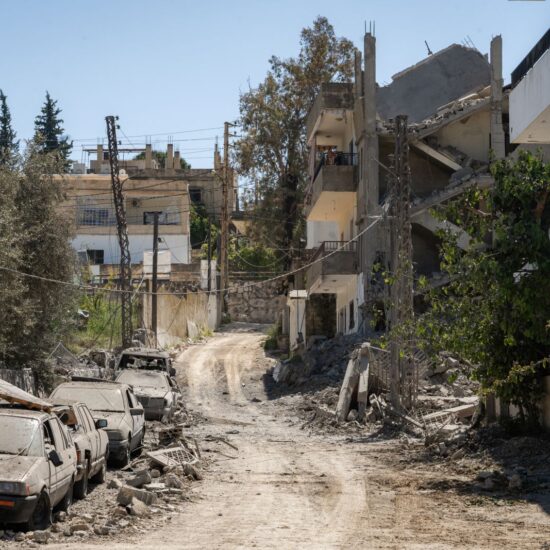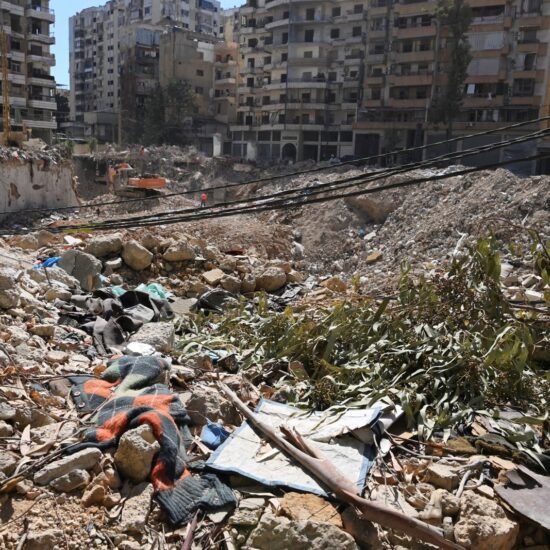
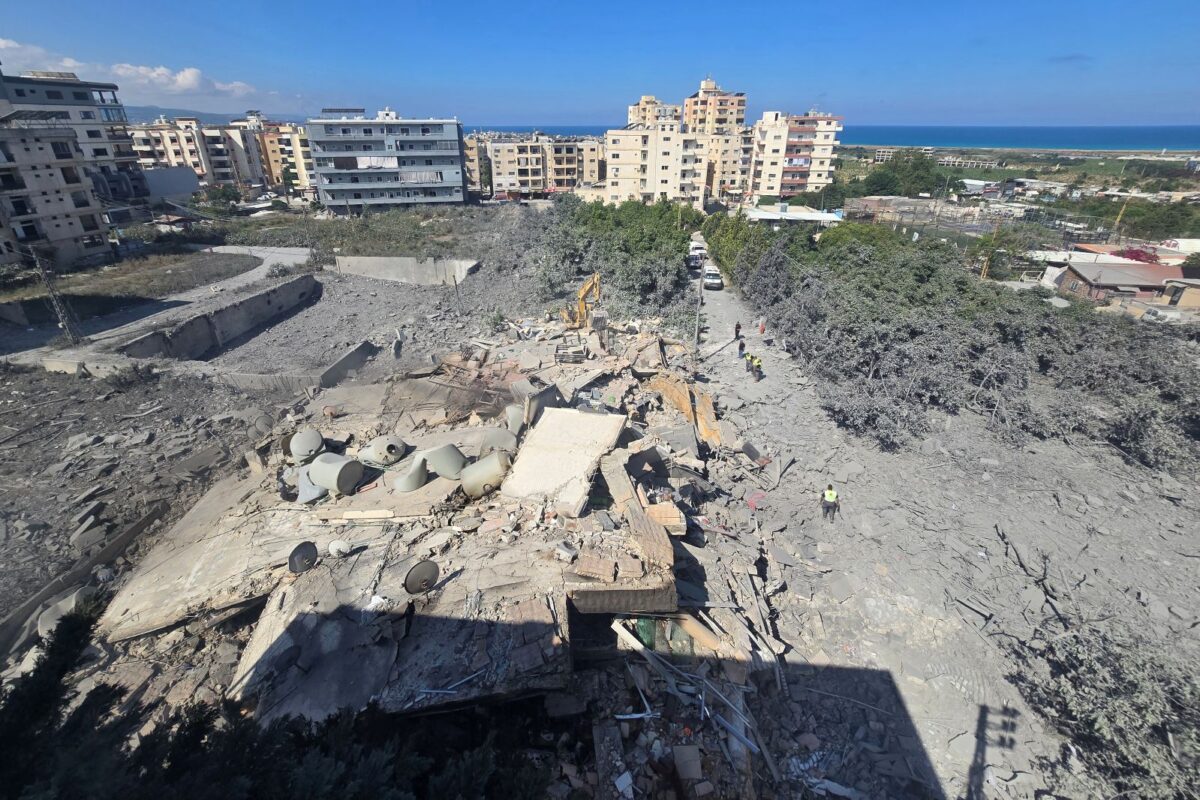
Photo by - / AFP. Lebanese civil defence workers search through the rubble of a building following an Israeli strike at dawn in the southern Lebanese area of al-Hosh, near the coastal city of Tyre on May 26, 2026.
Israeli Prime Minister Benjamin Netanyahu said on May 25 he had ordered the military to intensify its offensive in Lebanon in an effort to "crush" Hezbollah, accusing the group of targeting Israeli forces with drone attacks.
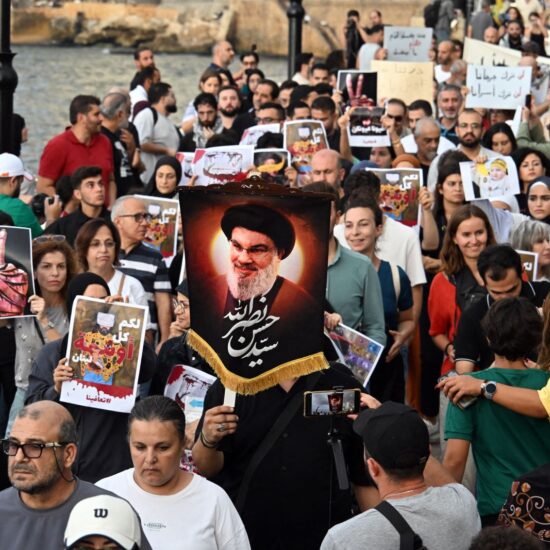
On May 25, Lebanon performed a memory. Twenty-six years ago the last Israeli soldier left the south, and a country that agrees on almost nothing agreed, for one day, that it had won. This year it performed the same memory while drones crossed Beirut at low altitude, while fresh orders emptied another ten villages, while three more people were killed in the south before the speeches were finished. We lit the candle for a liberation that is, at this very moment, being undone.
There is a name for marking the end of something that has not ended. It is not commemoration. It is denial.
There is a name for marking the end of something that has not ended. It is not commemoration. It is denial.
Two men spoke into that denial, and the distance between them is the whole story. Naim Qassem, on Sunday, did not merely refuse to surrender Hezbollah’s weapons, refusal would have been the ordinary position. He asked the state to keep him armed. He demanded that the government underwrite the very structure whose existence is a standing verdict that the government is not enough. Read it slowly, because the absurdity is precise: he wants the Lebanese state to spend its sovereignty, its budget, and its diplomatic credit financing the instrument that makes it not a state. This is not a defense of the resistance. It is a request that the republic pay for its own negation.
The demand cannot be met, and not for political reasons, for logical ones. A state that funds a parallel army is no longer the thing being protected; it is the thing being used. Either Beirut holds the monopoly on force, in which case it cannot subsidize a competitor to that monopoly, or it subsidizes Hezbollah, in which case there is nothing left to call Beirut. Qassem knows this. The impossibility is the point. An offer designed to be refused turns whoever refuses it into the traitor.
And then he said the quiet thing aloud: if the government cannot protect sovereignty, it should resign. Coming from the man whose weapons are the reason the government cannot exercise sovereignty, it is a remarkable sentence the arsonist auditing the fire brigade.
But notice what the whole performance requires. Qassem needs May 25 to remain a living war, not a closed chapter. The moment liberation becomes history, his weapons become an anachronism, a tool kept long past the job it was forged for. So he keeps the wound open on purpose. He promises a “third liberation.” He insists the enemy is at the gate, because a permanent siege is the only condition under which a permanent militia makes sense. His relationship to the occupation is not opposition. It is dependence. He needs Israel in the south the way the holiday needs a victory: to stay relevant.
Joseph Aoun understood exactly this, which is why his Liberation Day statement was a small masterpiece of avoidance. He honored the day in the past tense. He credited “the steadfastness and sacrifices of the people of this land”, the people, not the resistance, not the party, not the gun. It was a quiet act of confiscation: the slow transfer of a national memory away from the organization that has owned it for a generation. Symbolic disarmament always comes before the real kind. Aoun is trying to nationalize the holiday before he can dream of nationalizing the weapon.
So both men are fighting over the same corpse of a memory, one to keep it breathing, the other to bury it with honors. Neither is fighting over the present, because the present is unbearable. And that is the deeper sickness, the one that did not begin with Hezbollah and will not end with it.
Lebanon does not resolve its history. It sediments it. Every catastrophe is layered over the last, pressed down, and turned into ritual instead of processed into knowledge. The civil war became amnesia. The occupation became a holiday. The defeat of 2024 is already curdling into a story about steadfastness.
Lebanon does not resolve its history. It sediments it. Every catastrophe is layered over the last, pressed down, and turned into ritual instead of processed into knowledge. The civil war became amnesia. The occupation became a holiday. The defeat of 2024 is already curdling into a story about steadfastness. We do not metabolize what happens to us; we embalm it. And an embalmed past is wonderfully useful, because it spares you from looking at the living one. The candle for the year 2000 is held up precisely so that no one has to see 2026.
This is what nostalgia does inside a broken collective self. It is not sentiment. It is anesthesia. It numbs the gap between the country we narrate and the country we inhabit, and the wider that gap grows, the louder the narration has to get. We have never been louder about liberation than in the year we were least free.
So we will keep the holiday. We will deliver the speeches. We will argue about who owns the memory of a soldier who left in 2000, and say nothing about the soldier who arrived this spring. And next May 25, if the pattern holds, we will do it all again. A nation lighting a candle for an ending that refuses to end, mistaking the ache of the flame for proof that it is still alive.
Ramzi Abou Ismail is a Political Psychologist and Senior Research Fellow at the Institute for Social Justice and Conflict Resolution at the Lebanese American University.
The views in this story reflect those of the author alone and do not necessarily reflect the beliefs of NOW.