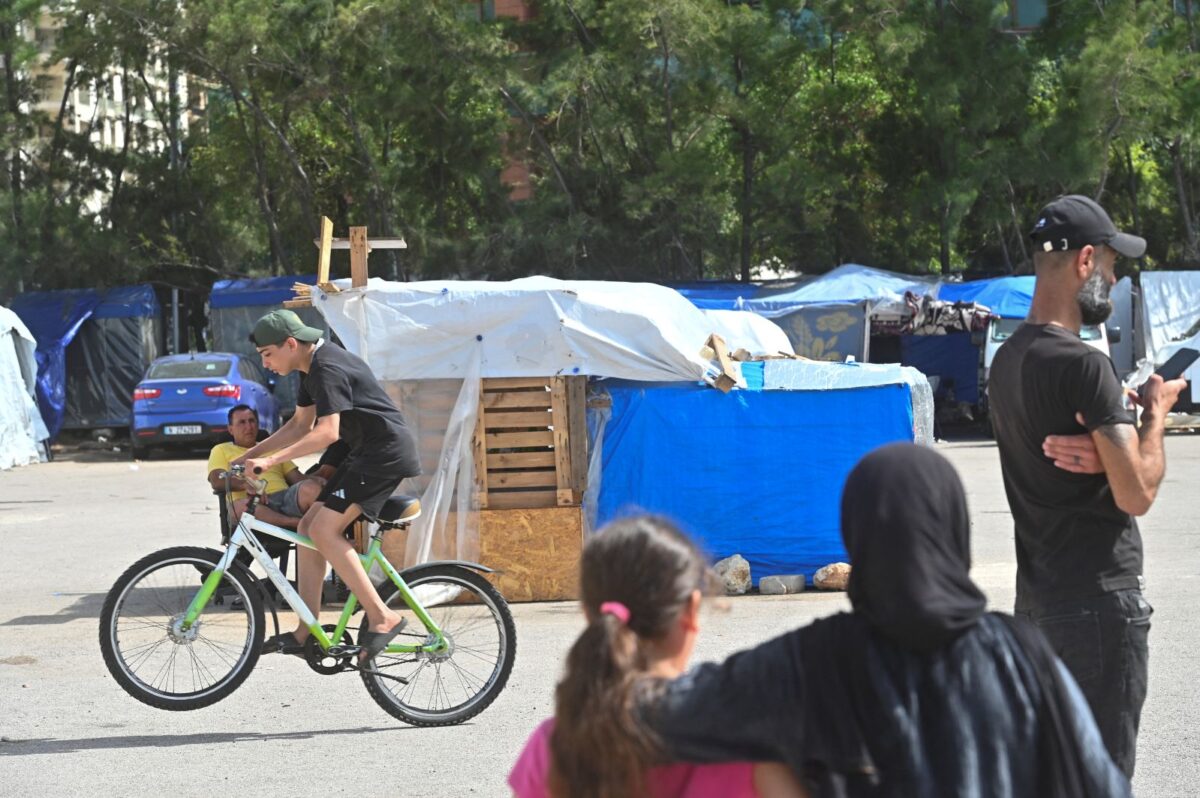
Displaced people who had set up tents on Beirut's waterfront in the BIEL area agree to relocate to land belonging to the Beirut Municipality in Beirut, Lebanon, on May 19, 2026. Initially, they rejected the idea of moving to shelters in the north or to the Sports City complex. The Ministry of Social Affairs had previously attempted to negotiate with them, but they refused. They later agreed to the move after being instructed by the Amal Movement. The relocation will be to land owned by the Beirut Municipality, not far from their current encampment. (Photo by Fadel Itani/NurPhoto) (Photo by Fadel Itani / NurPhoto / NurPhoto via AFP)
The rows of blue tents now stretching across Beirut’s waterfront were meant to solve a problem. Instead, they have become a symbol of a far deeper crisis: a country struggling to manage the consequences of war, mass displacement, and years of institutional dysfunction.
In recent weeks, Lebanese authorities moved hundreds of displaced families from an informal tent settlement on privately owned land along Beirut’s waterfront to a nearby plot owned by the municipality. Officials said the relocation was a temporary measure aimed at managing the growing displacement crisis. Critics, however, argue that the move simply relocated the camp without addressing the underlying problem or providing a long-term solution for those affected.
The controversy surrounding the camp has evolved into more than a debate over housing. It has reopened questions about government preparedness, the economic future of downtown Beirut, and the broader consequences of a war that has displaced more than one million people across Lebanon.
A temporary solution or administrative surrender?
The original encampment emerged after families fleeing Israeli airstrikes sought refuge near the former Beirut International Exhibition and Leisure Center (BIEL) and surrounding waterfront areas. As tents multiplied across sidewalks and open spaces, pressure mounted on authorities to intervene, particularly as many of the occupied plots belonged to private landowners.
Rather than relocating the displaced population to alternative shelters, authorities opted to move families onto nearby municipal land. Officials stressed that the camp would remain temporary and that no permanent infrastructure would be established.
For Karim Chebaklo, board member of Port de Beyrouth and a specialist in institutional reform and geopolitics, the decision reflects a deeper failure of governance.
“This decision was made because it was the easiest path for the government at that exact moment,” Chebaklo told NOW. “It is a classic case of choosing temporary, band-aid logistics over real, responsible governance.”
According to Chebaklo, government institutions effectively retreated when efforts to relocate families elsewhere encountered resistance.
“Instead of standing firm and enforcing the law to protect public space, they took the path of least resistance. They moved the tents a few hundred meters, slapped a municipal stamp on it, and called it a day,” he said.
For him, the issue extends beyond the tents themselves.
“What this reveals is a deeply concerning crisis in how our state manages public space. It tells us that the government no longer views public land as a strategic asset for the city’s economic and civic life, but rather as an emergency escape valve to hide its own planning failures.”
Why many families refused to leave
Government officials maintain that alternative accommodation was available.
For weeks, the Ministry of Social Affairs encouraged displaced families to move to designated shelters, including Beirut’s Sports City complex and facilities elsewhere in the country. While some accepted, many refused.
Their reasons reveal the complexity of Lebanon’s displacement crisis.
Many families expressed concerns about security, arguing that some proposed shelters were located close to areas that had repeatedly been targeted during the war. Others cited overcrowding, limited privacy, and difficult living conditions within collective shelters.
Several displaced residents also preferred to remain in Beirut, where access to employment opportunities, aid networks, healthcare, and relatives was more readily available.
The result was a difficult dilemma for authorities. Forcing people to relocate risked confrontation, while allowing them to remain effectively normalized a camp in one of Beirut’s most prominent public spaces.
For many residents, however, the issue highlights failures that predate the current crisis.
Jessica Mitri, a Beirut resident, said she sympathizes with families who lost their homes but believes the situation reflects a lack of planning by the state.
“No one can blame people for looking for safety,” she said. “The real question is why there was no clear plan for where hundreds of thousands of displaced people would go. We knew this war could lead to displacement, yet it feels like the government was improvising every step of the way.”
Economic fears in Beirut’s recovery zone
The location of the camp has amplified concerns among business owners and investors attempting to revive Beirut’s struggling downtown district.
The waterfront area includes some of the capital’s most important commercial and tourism assets, including Zaituna Bay and several major redevelopment projects intended to attract investment after years of economic decline.
Chebaklo argues that placing a displacement camp in the heart of this zone risks undermining an already fragile recovery.
“We need to look at the hard data because this is about real livelihoods, not abstract business complaints,” he said.
According to Chebaklo, the hospitality sector covering downtown Beirut, Park Avenue and Zaituna Bay directly supports thousands of workers and families.
“Premium commercial zones rely entirely on two very fragile things: aesthetic appeal and the absolute perception of safety,” he said. “When the government officially licenses an open-air displacement camp next to a luxury marina or major reinvestment project, it structurally changes the entire area.”
He warned that international investors and local businesses may simply choose to direct their resources elsewhere.
“Capital is incredibly risk-averse. Investors will not issue angry statements. They will quietly move their money elsewhere.”
Anthony Karam, who works in Beirut’s hospitality sector, echoed concerns about the district’s future.
“This isn’t about blaming displaced people,” he said. “The problem is that Beirut’s economy is already hanging by a thread. If investors see the government struggling to manage basic urban planning challenges, it raises larger questions about stability and long-term recovery.”
The shadow of war
The debate surrounding the waterfront camp cannot be separated from the political circumstances that created it.
The displacement crisis emerged as a direct consequence of the war between Hezbollah and Israel, which devastated large parts of southern Lebanon and Beirut’s southern suburbs.
For many Lebanese, the tents represent not only a humanitarian emergency but also the costs of a war that placed enormous burdens on an already fragile state.
Mohammed Chehab, a resident of Beirut, said many people distinguish between supporting displaced families and questioning the political decisions that led to their displacement.
“People deserve dignity and support regardless of politics,” he said. “At the same time, many Lebanese feel the country was dragged into a confrontation without any serious preparation for what would happen to civilians if entire communities had to flee.”
He added that the crisis exposed weaknesses both within state institutions and among political actors who failed to anticipate the humanitarian consequences of escalation.
What could have been done differently?
Critics argue that the government had alternatives.
Chebaklo maintains that genuine humanitarian protection requires more than simply relocating tents from one plot of land to another.
“True compassion is not leaving vulnerable families in basic tents on concrete docks with substandard sanitation,” he said. “True compassion means moving people into dignified, secure and fully serviced institutional shelters.”
He noted that facilities such as Sports City already housed thousands of displaced people and had established systems for aid distribution and security management.
According to Chebaklo, the government’s failure was as much political as logistical.
“The Prime Minister’s Office and the Ministry of Interior should have provided full political backing to support the Ministry of Social Affairs’ original plan,” he said.
He also argued that authorities should have protected key economic areas while simultaneously ensuring adequate shelter for displaced communities.
“You cannot manage a humanitarian crisis by destroying the country’s remaining economic foundations,” he said.
The controversy surrounding Beirut’s waterfront tents settlement has become a microcosm of Lebanon’s wider culture of corruption.
It reflects the human cost of war, the absence of effective crisis planning, and the growing tension between humanitarian needs and the preservation of public and economic spaces.