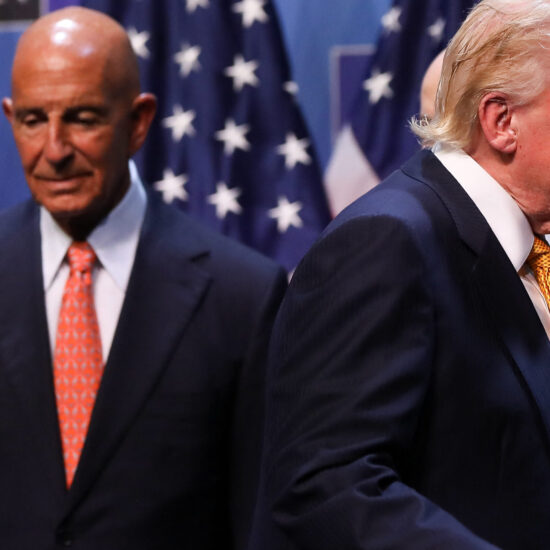
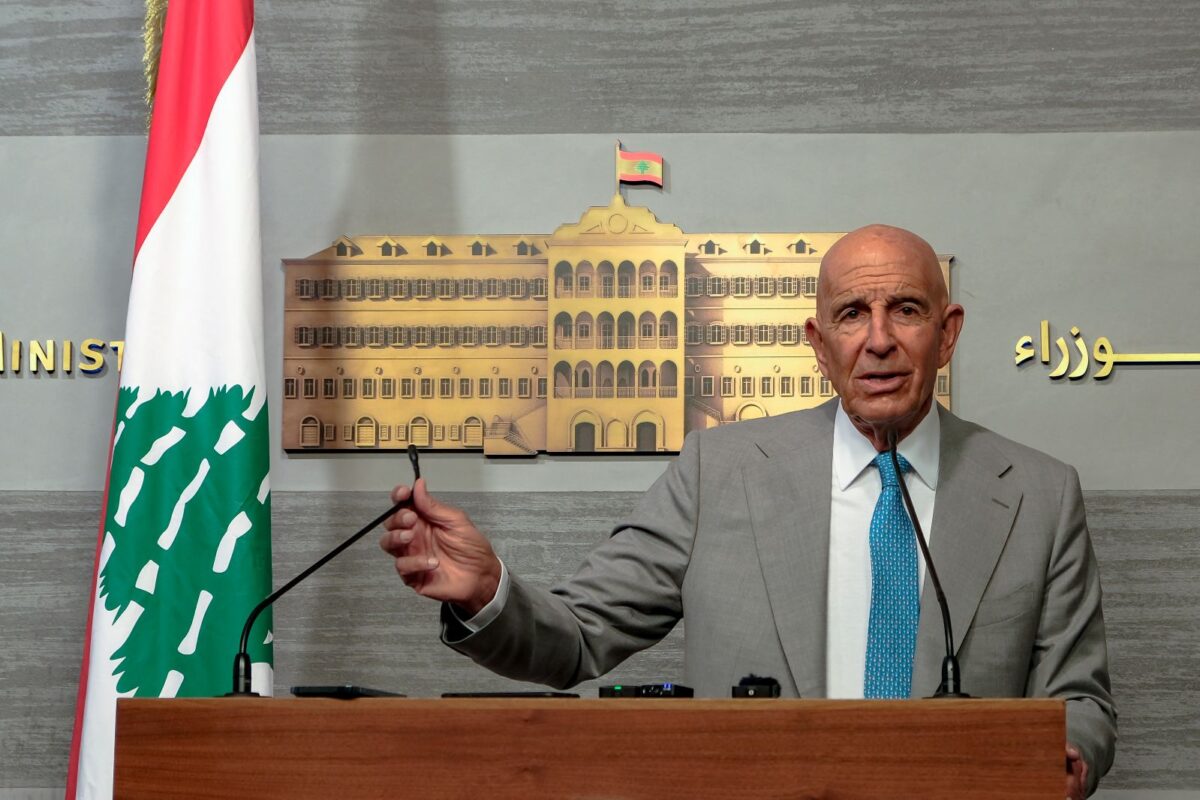
US Special Envoy Thomas Barrack and US Ambassador to Lebanon Lisa A. Johnson met with Lebanese Prime Minister Nawaf Salam at Salam’s office in Beirut, Lebanon, on July 21, 2025. (Photo by Courtney Bonneau / Middle East Images / Middle East Images via AFP)
The problem with Tom Barrack is not that he is of Lebanese origin. The problem is that he sometimes appears to behave as if this origin gives him an innate understanding of Lebanon. It does not. Family memory, ancestral nostalgia, and immigrant sentiment do not produce political knowledge. They do not equip anyone to read a country as complicated, wounded, and weaponized as Lebanon, especially at a moment when war, illegal arms, institutional collapse, and negotiations under fire all intersect.
Lebanon is not a place that can be understood through folklore, old family stories, or the sentimental confidence of those who imagine that bloodlines are a substitute for analysis. It is a country whose state has been systematically hollowed out, whose institutions have been paralyzed, and whose sovereignty has been confiscated by an armed organization that operates above the constitution, beyond accountability, and in direct service of Iran’s regional project.
This is what Barrack either misses or chooses to ignore: Hezbollah is not a normal political party. It is not one faction among others in a domestic Lebanese game. It is an armed organization, designated as terrorist by the United States, which hides behind a parliamentary and social façade while retaining the structure, behavior, and mission of a military-security force tied to Tehran. Anyone who does not begin from this fact cannot propose a serious solution for Lebanon. He becomes, knowingly or not, part of the problem.
The danger of Barrack’s approach is that it seems trapped in an old Orientalist reflex: the belief that the Middle East is managed through personal relations, sectarian bosses, local intermediaries, and a little political theater. It is the worldview of the American Arabist who thinks that if he knows the right zaim, drinks coffee in the right salon, and speaks warmly about the region’s “complexities,” he has somehow unlocked its politics.
The danger of Barrack’s approach is that it seems trapped in an old Orientalist reflex: the belief that the Middle East is managed through personal relations, sectarian bosses, local intermediaries, and a little political theater. It is the worldview of the American Arabist who thinks that if he knows the right zaim, drinks coffee in the right salon, and speaks warmly about the region’s “complexities,” he has somehow unlocked its politics.
This is not diplomacy. It is nostalgia dressed up as policy.
Worse, it serves neither Lebanon nor the United States. It does not serve Lebanon because it recycles the very forces that destroyed the Lebanese state. And it does not serve American interests because it builds policy on the illusion that the man who can open doors is also the man who can deliver a solution. In Lebanon, that illusion has a long record. It always ends in the same place: the state retreats, the militias advance, and Washington convinces itself that failure was realism.
This is why allowing Nabih Berri to invest in his relationship with Tom Barrack is so dangerous. Berri is not a neutral speaker of parliament. He is not a constitutional referee. He is a central pillar of the political order that protected Hezbollah’s weapons, crippled state institutions, and turned every sovereign decision into an internal bargain. When Berri becomes Washington’s gateway to Lebanon, Washington has not discovered a path to a solution. It has entered the same maze that has consumed the Lebanese state for decades.
The ongoing American-sponsored negotiations between Lebanon and Israel are not a technical detail. They are a real opportunity. But they are also an opportunity that can be wasted very quickly if they are handled through the same bankrupt logic: personal channels, side messages, recycled demands, and no implementation plan.
The understandings reached between the parties do not need more Lebanese rhetoric. They need execution. They need a state that decides that the monopoly over arms is not a negotiating point but the condition of its own existence. Sovereignty is not a slogan to be invoked abroad while being surrendered at home. It is an act of authority. It is the ability to decide who carries weapons, who deploys along the border, who speaks in the name of the country, and who controls the decision of war and peace.
Lebanon cannot return to the negotiating table simply to repeat the same demands: stop Israeli attacks, withdraw from occupied points, respect Resolution 1701, support the Lebanese Army. These demands are legitimate. But they are no longer sufficient. The world has heard them too many times. The question today is no longer what Lebanon wants from others. The question is what Lebanon is prepared to do itself.
When will the Lebanese Army actually deploy? What is the timeline for dismantling illegal military infrastructure south of the Litani and beyond it? Who controls the decision of war and peace? What happens if Hezbollah refuses? Who will be held accountable if the Lebanese state remains a spectator on its own territory?
Without answers to these questions, negotiations become another exercise in delay. Israel will argue that Lebanon is buying time. Washington will start looking for alternative arrangements. Hezbollah will use the vacuum to regroup and reposition. Nabih Berri will turn the process into another season of bargaining. And the Lebanese state will once again appear as a power that demands sovereignty from others while refusing to exercise it at home.
This is the core of the Lebanese tragedy. Lebanon asks the world to treat it as a sovereign state while allowing a non-state army to decide its fate. It asks Israel to withdraw while refusing to confront the force that gives Israel the justification to remain. It asks for reconstruction while leaving the country under the shadow of Iranian weapons. It asks for international confidence while demonstrating that the most important decisions are still made outside the state.
Nor is it accidental that this approach coincides with talk of a role for the new Syrian regime in containing or encircling Hezbollah. This is not a practical idea. It is an insult to Lebanese sovereignty. To ask Syria to help manage Hezbollah is to admit that Lebanon cannot clean its own house. It returns the country to the logic of tutelage, the very logic for which the Lebanese paid such a heavy price: Lebanon’s sovereignty becomes a regional file, its borders become bargaining material, and its security becomes something negotiated by others.
Lebanon does not need a new guardian. It does not need a mediator driven by vague ancestral nostalgia. It does not need a domestic zaim who markets the paralysis of the state as political wisdom. It needs a decision.
Lebanon does not need a new guardian. It does not need a mediator driven by vague ancestral nostalgia. It does not need a domestic zaim who markets the paralysis of the state as political wisdom. It needs a decision.
That decision begins with a simple truth: Hezbollah is not a southern problem, not a Shiite file, and not a bargaining chip. Hezbollah is the heart of the sovereignty crisis. Every attempt to avoid this fact — whether through Berri, Damascus, or an American mediator enchanted by the myths of the region — will lead to the same result: a weaker Lebanon, a bolder Hezbollah, and more foreign powers deciding the country’s future.
The warning today is clear. The American window will not remain open forever. Diplomacy can create an opportunity, but it cannot replace political courage. No envoy, no agreement, no ceasefire mechanism, and no regional arrangement can save Lebanon if the Lebanese state refuses to act like a state.
If Lebanon enters negotiations without a clear roadmap, without a timeline, and without the political will to impose sovereignty, then Lebanon will not negotiate its future. Its future will be negotiated for it.
If Lebanon enters negotiations without a clear roadmap, without a timeline, and without the political will to impose sovereignty, then Lebanon will not negotiate its future. Its future will be negotiated for it.
And that is the real catastrophe.
This article originally appeared in Elaph.
Makram Rabah is the managing editor at Now Lebanon and an Assistant Professor at the American University of Beirut, Department of History. His book Conflict on Mount Lebanon: The Druze, the Maronites and Collective Memory (Edinburgh University Press) covers collective identities and the Lebanese Civil War. He tweets at @makramrabah