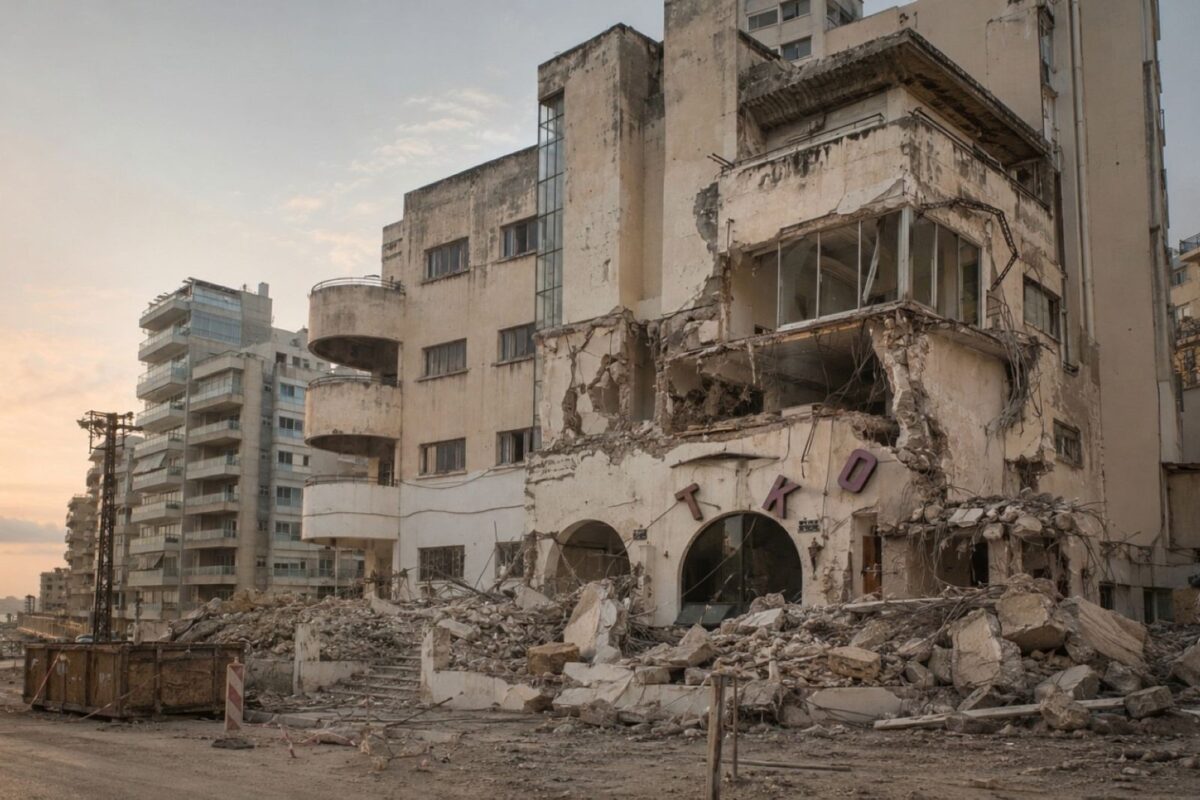
This morning, while driving to work along the Beirut waterfront, I passed near the old Tokyo restaurant, that strange and unforgettable building by the old Manara lighthouse, facing the Sporting Basketball Club. It was being demolished. For a brief moment, I slowed down, not because traffic forced me to, but because something in the scene demanded that I look. The building, which had stood there for decades as part of the visual vocabulary of West Beirut, was coming down, piece by piece, with the indifference of machinery and the finality of dust.
I felt a strange sadness, the kind that is difficult to explain because it is not only about the building itself. It was not a home, nor a school, nor a place where I had spent my childhood afternoons. I had never even eaten there. Yet its demolition felt personal. Tokyo restaurant had somehow belonged to my memory without ever belonging to my experience.
For those who remember Beirut before sushi became a routine delivery order, Tokyo was more than just a restaurant. It was one of the first, if not the first, Japanese restaurants in Beirut and Lebanon. Its very presence was unusual. In a city still trying to understand itself through war, destruction, scarcity, and survival, there stood this oddly shaped building serving a cuisine that few people in Beirut at the time could afford, and even fewer could understand. Sushi was not yet fashionable. It was not yet part of the lifestyle vocabulary of a city that now consumes it casually, almost automatically. In the 1980s, for most families in West Beirut, Japanese food was not simply exotic; it belonged to another world.
My parents never took us there. Part of the reason was obvious: they could not afford it. Beirut during the civil war was not a place where middle-class families casually experimented with expensive foreign restaurants. But the other reason was perhaps more important and more honest: they had no taste for sushi, nor did most people around them. The idea of eating raw fish would have probably sounded absurd, if not mildly offensive, to a generation raised on tabbouleh, kibbeh, grilled meat, and the familiar rituals of Lebanese food. Tokyo existed in our imagination precisely because it was beyond our reach.
And yet, this is why its demolition saddened me. Some places become landmarks not because we enter them, but because they accompany us from the outside. Tokyo was one of those places. With its rounded balconies and its strange architecture, it stood there as an object of curiosity, almost out of place, but never entirely alien. Over time, it became part of the city’s landscape. It was a foreign implant, perhaps, but one that Beirut had absorbed and made its own.
This is what cities do when they are alive. They absorb what is foreign, domesticate it, and then pretend it was always there. Tokyo may have begun as an imported idea, a Japanese restaurant on the edge of the Mediterranean, but it eventually became a Beirut memory. It became part of the scenery of Ras Beirut, of Manara, of that stretch of coastline where the sea, the lighthouse, the Sporting Club, and the stubborn architecture of older Beirut still tell stories that no official archive can fully preserve.
This is what cities do when they are alive. They absorb what is foreign, domesticate it, and then pretend it was always there. Tokyo may have begun as an imported idea, a Japanese restaurant on the edge of the Mediterranean, but it eventually became a Beirut memory. It became part of the scenery of Ras Beirut, of Manara, of that stretch of coastline where the sea, the lighthouse, the Sporting Club, and the stubborn architecture of older Beirut still tell stories that no official archive can fully preserve.
Its abandonment in recent years had already been a kind of slow death. The building stood there as a remnant, no longer alive but not yet erased, a reminder of a Beirut that many insist on calling golden. Of course, memory is never innocent. The golden age of Beirut, especially West Beirut, is often reconstructed through nostalgia, photographs, family stories, and selective forgetting. It was not golden for everyone, nor was it free of violence, inequality, or fear. But for those of us who grew up around these places, such buildings become containers of emotional history. They remind us not only of what Beirut was, but of what we imagined it could be.
This is why watching Tokyo come down felt like losing touch with a piece of myself. Not because I had a personal story inside that restaurant, but because I had a personal story around it. It was part of the road to work, part of the city’s face, part of the silent geography of childhood and adulthood. Its demolition was a reminder that memories are not protected by affection. Buildings do not survive because we loved seeing them from afar. Cities do not preserve themselves simply because we feel sad when they change.
But nostalgia, however powerful, cannot be a political program or an urban plan. Beirut cannot live only as a museum of what we remember. If something rises in Tokyo’s place, whether a skyscraper, a residential tower, or yet another luxury project that most Beirutis will never enter, it will still be part of the city’s next chapter. We may dislike it. We may resent it. We may mourn what it replaces. But we cannot only cling to memory as if the past, by virtue of being past, is automatically more noble than the future.
The tragedy of Beirut is not that it changes. The tragedy is that it often changes without mercy, without beauty, and without regard for the emotional life of its people. What we need is not to freeze the city, but to allow it to move forward without erasing every trace of what made it meaningful. We need a future that does not require amnesia.
The tragedy of Beirut is not that it changes. The tragedy is that it often changes without mercy, without beauty, and without regard for the emotional life of its people. What we need is not to freeze the city, but to allow it to move forward without erasing every trace of what made it meaningful. We need a future that does not require amnesia.
Tokyo’s demolition reminded me that Beirut is always negotiating with its ghosts. Some ghosts are political, some are architectural, and some are simply the places we passed by thousands of times without ever entering. This morning, one of those ghosts disappeared into dust. And yet, as sad as I felt, I could not escape another thought: perhaps the duty of memory is not to imprison us in what was, but to teach us how to build what comes next with a little more tenderness.
Makram Rabah is a lecturer at the American University of Beirut, Department of History. His forthcoming book Conflict on Mount Lebanon: The Druze, the Maronites and Collective Memory (Edinburgh University Press) covers collective identities and the Lebanese Civil War.