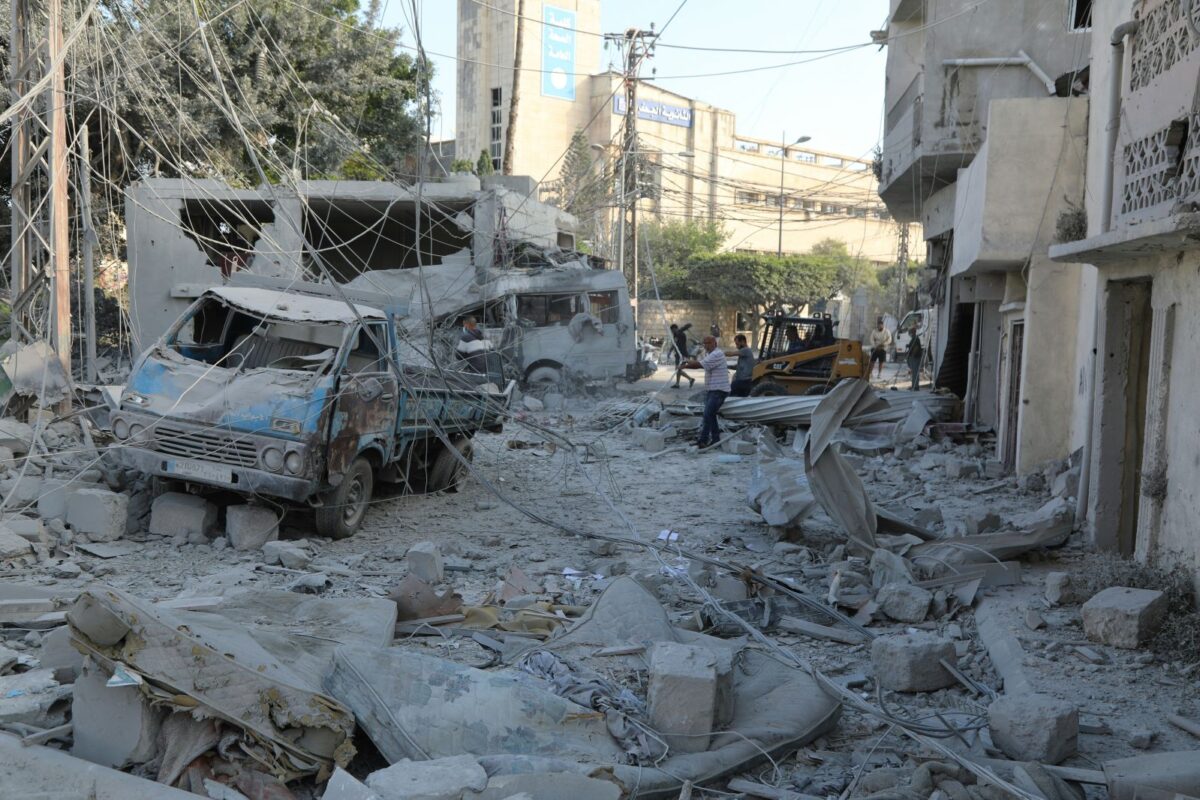
KAWNAT HAJU / AFP. Workers clean the debris following Israeli airstrikes that hit the previous day, near the archaeological site of the Roman baths in the southern Lebanese city of Tyre on June 8, 2026.
On June 7, the Israeli military issued an evacuation warning for most of Tyre and its surroundings. The coastal city shelters thousands of displaced people and has been heavily bombed since the fighting began.
On Sunday, Israel’s military attacked the southern suburb of the Lebanese capital Beirut. Tehran then fired rockets at Israel, leading to a bigger escalation as Israel retaliated. Trump urged both sides to refrain from fighting.
Sunday’s attack on Beirut marked a major escalation in the broader U.S.-Iran war. Since the ceasefire took effect, Beirut has largely been spared from Israeli attacks. In last week’s attack, at least two people were killed and 20 wounded, according to the Lebanese Health Ministry.
Israel’s Prime Minister Benjamin Netanyahu said the attack targeted “terrorist headquarters in the Dahieh district” and was a response to Hezbollah’s attacks on north Israel. Hezbollah then shot rockets toward Israeli troops in Lebanon.
Last week, Lebanon and Israel agreed that Beirut would establish zones without Hezbollah-access, once Israeli forces would withdraw. The Iran-backed group rejects the renewed ceasefire-agreement between both countries. The group’s leader Naim Qassem condemned the deal, saying it was “humiliating” and “futile”.
On Sunday, Iran fired missiles at Israel as retaliation for the attack in Dahieh. Tehran accused the government in Jerusalem of repeated ceasefire violations in Lebanon. According to an Israeli official, around 30 Iranian ballistic missiles were launched.
Israel responded with strikes all across Iran, including the country’s aerial defense systems and a petrochemical complex. According to news reports, Israel did not receive U.S. approval for those strikes. Ahead of the Israeli response, U.S. President Donald Trump urged Israeli Prime Minister Benjamin Netanyahu not to retaliate, arguing that nobody was hurt in Iran’s attacks on Israel.
Trump called on both countries to stop fighting. “Israel and Iran must immediately stop ‘shooting’,” he said on Monday afternoon. The recent strikes mark the biggest escalation since the Pakistani-brokered ceasefire took effect at the beginning of April.
While the bombings are putting a strain on the Iran-U.S.-negotiations, the U.S. president reiterated on Monday that both sides remained interested in a ceasefire.
Shortly after, Iran’s military joint command said it would stop attacking Israel, but strikes would resume if Israel targets Lebanon. Meanwhile, two Israeli military officials said that Netanyahu ordered his military to stop preparing renewed attacks on Iran. But strikes on the south of Lebanon would continue, another Israeli official said.
In Lebanon
Tit for tat: U.S. ambassador to Lebanon, Michael Issa, said Israel would stop attacking the Lebanese capital if Hezbollah refrained from targeting northern Israel. He made the comments after meeting Parliament speaker Nabih Berri. A similar proposal was made last week, after Israel said it would bomb Beirut.
Lebanon at the negotiating table: Lebanon’s Prime Minister Nawaf Salam said it was up to the government in Beirut to hold talks with Israel, rather than relying on Iran’s claim to defend Lebanon.
The escalation drags on: On Monday, Israeli Finance Minister Bezalel Smotrich said that Israel should destroy 20 to 30 buildings in Dahieh for every Iranian missile.
Trump wants targeted strikes: In an interview with NBC, Trump said he wants more “surgical” strikes against Hezbollah in Lebanon.
In The Region
Israel and Iran prepare for prolonged conflict: The Iranian military forces warned they would respond with “more violence” to the escalation, while the Israeli army said it was preparing for several days of fighting with Iran.
Trump wants to end the fighting: The U.S. President called on both sides to refrain from attacking each other, saying an immediate ceasefire was nearing. He also told the Financial Times that he was in charge of the negotiations with Iran — and that Netanyahu had no power over them. Despite the escalations, Trump said that the developments would not derail the talks with Iran. Iran also said that ceasefire negotiations are still ongoing with the help of Pakistani mediators.
The Houthis join the fight: According to one Israeli official, the Yemeni group also shot missiles towards Israel since Sunday. The Houthis’ military spokesperson, Yahya Saree, said the group will block “enemy ships” in the Red Sea and target “any Zionist movement”.
What We’re Reading
The Castle on the Hill, Fouad Ajami, Beaufort and Hezbollah’s Defeat. Now’s managing editor Makram Rabah argues that the Israeli capture of the Beaufort castle is not only a military setback for Hezbollah. The capture also underlines Lebanon’s long history of foreign influence — from the Crusaders to the PLO, to Israel, Iran and Hezbollah. By drawing on the Lebanese-American intellectual Fouad Ajami, Rabah argues that both Hezbollah and Israel see southern Lebanon through strategic and ideological lenses, rather than as the homeland of its people. The fall of the castle not only underlines Hezbollah’s military weakness but also the lack of the Lebanese state to assert sovereignty, he argues.
Beirut’s waterfront tent camp: A symbol of displacement, war and state failure. Now’s Rodayna Raydan analyses how Beirut’s waterfront tent camp has become a symbol of state failure. With authorities unable to adequately respond to the mass displacement, the temporary tent camp underlines the failure to implement long-term housing strategies. Amid the ongoing war in Lebanon, the state is not able to soothe the human cost and alleviate the suffering of the displaced, Raydan argues.
Who Owns Kisrawan? Charles H. Al-Hayek argues that Hezbollah-affiliated media have recently used historic events to underline their political narrative. The Mamluk campaign against Kisrawan has been portrayed as targeting mainly Twelver Shiites. This is used by Hezbollah-affiliated media to prove the unique historical ownership of the region. But this narrative fails to acknowledge that many different groups were affected—including the Druze, the Alawites, the Maronites, the Shiites and other groups. Al-Hayek argues that Kisrawan has historically been made up of a heterogeneous society rather than only by one faith.
Lebanon’s Final Chance to Bury the Hezbollah Era. Now’s managing editor Makram Rabah argues that the U.S.-brokered ceasefire between Lebanon and Israel is the final chance for Lebanon to assert sovereignty. Rabah says that lasting peace and stability require the disarmament of Hezbollah, as well as strengthening the Lebanese military as the only force with arms. The weapons of Hezbollah have weakened the Lebanese state, dragged the country into war, and put its fate into the hands of Iran. The ceasefire should be used by the government in Beirut to reclaim state authority, Rabah argues.
The State That Wasn’t There. Now’s Ramzi Abou Ismail argues that the U.S.-led negotiations are exposing the parallel state inside Lebanon. While the government in Beirut formally represents the country, Hezbollah effectively decides on the country’s security outcomes. He argues that this division stems from external diplomacy. But the Lebanese state also failed to weaken Hezbollah’s military role at a time where there was political momentum for it. Instead, Beirut relied on ambiguity and now faces the consequences for it — with limited control over its country and sovereignty.