Photo by MAHMOUD ZAYYAT / AFP
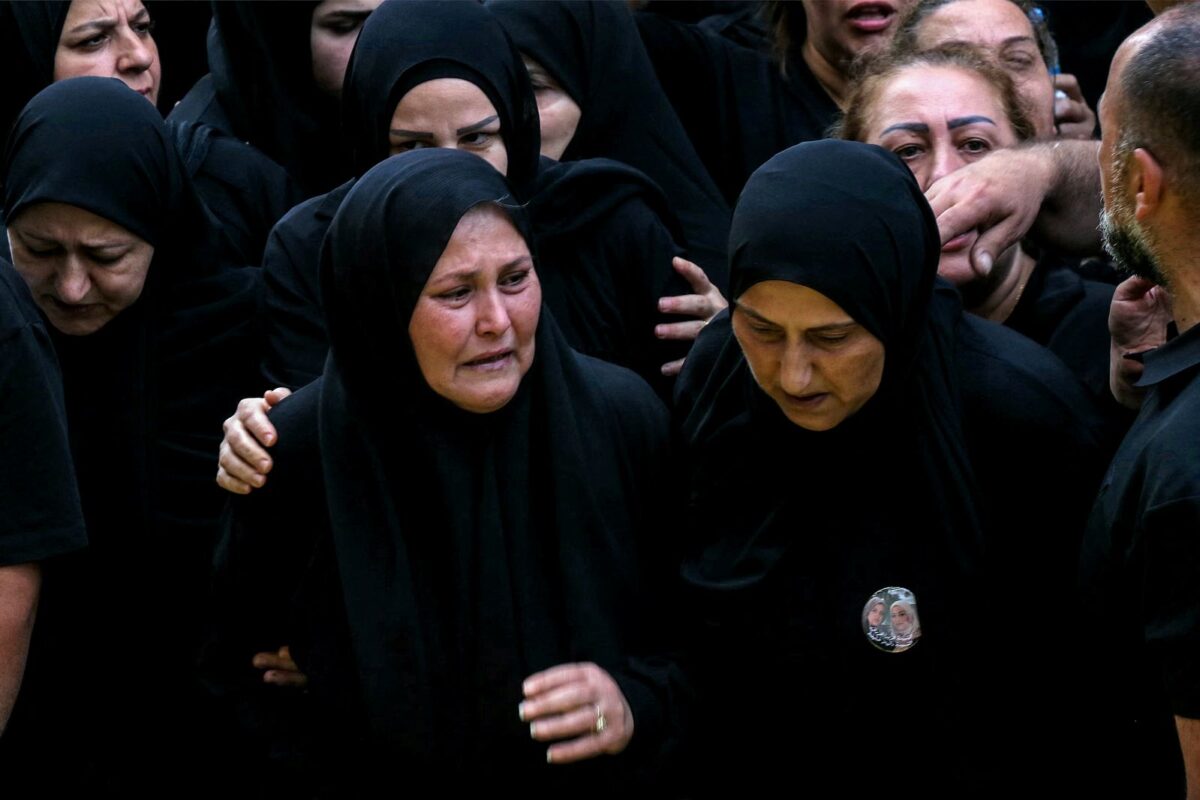
Graphic content / Mourners attend the funeral of four women who were killed the previous day following Israeli bombardment on the village of Qannarit, south of Sidon in southern Lebanon, in the village on June 21, 2026.
One after another, they flooded Hezbollah’s media platforms. Mothers standing before rows of coffins wrapped in yellow flags. Women speaking with unsettling serenity, even exhilaration, declaring how proud they were that their sons had fallen. Grandmothers holding the hands of young boys, children who had barely begun to understand life, telling them, your turn will come; this is your honour. Mothers sitting beside living sons, urging them toward death as though they were sending them toward graduation, while those sons nodded with smiles of acceptance.
I watched the videos in disbelief.
As the mother of three sons, I could not simply watch these scenes as a political analyst. I watched them as a mother, and one sentence kept echoing in my mind: our sons are meant to live, not die. This should never be a controversial statement. Yet in today’s Lebanon, it has become one of the deepest political, cultural and civilizational divides, because what these videos reveal is not spontaneous grief transformed into pride. They reveal something far deeper: the triumph of a doctrine in Shiite “Tayfé”, that has slowly redefined motherhood itself.
Every civilization tells mothers what it means to raise a child. Most teach them to prepare their sons for life, to build, to create, to marry, to protect, to discover, to teach, to heal and to dream. Their children’s future becomes the continuation of the nation.
Revolutionary movements built around perpetual conflict teach something radically different. The child becomes a weapon before he becomes a citizen. His highest achievement is no longer the life he builds but the death he offers.
Psychologists have long studied how totalizing ideological movements reshape identity. Individual aspirations are gradually replaced by collective purpose. Personal fulfilment becomes secondary to the cause. The self dissolves into the movement while sacrifice is elevated above achievement, until death itself is moralized and presented as the highest expression of belonging.
Once this transformation is complete, the greatest fear is no longer losing a son, but raising one who chooses life over sacrifice.
This is not simply religion, nor is it Shiism. Millions of Shiites around the world raise their children exactly as every other parent does, hoping they become doctors, engineers, artists, entrepreneurs, scholars and loving parents themselves. What Lebanon has witnessed over the past four decades is something entirely different. It is the gradual importation of a revolutionary Khomeinist doctrine whose political theology sanctifies permanent confrontation and glorifies martyrdom as a collective ideal.
It substitutes the nation with the revolution, citizenship with ideological allegiance, and life with sacrifice. This culture did not emerge organically from Lebanon. It was imported, and over the years it has profoundly altered part of Lebanese society. The tragedy extends far beyond the battlefield. When children grow up surrounded by funeral processions, martyr posters, songs celebrating death and endless narratives of sacred sacrifice, death gradually ceases to appear exceptional. It becomes familiar, expected and even beautiful. That may be one of the greatest psychological victories any ideological movement can achieve: persuading mothers to celebrate the very event nature has designed them to fear above all else.
This is why these videos are so disturbing. They are not merely documenting reality; they are manufacturing it. Every image serves a purpose, funeral becomes recruitment. Every grieving mother becomes a model for another, a child watching learns what is expected of him. Every society exposed to these images is quietly asked to normalize what should never become normal.
Meanwhile, another Lebanon continues imagining an entirely different future. Its parents save for university tuition, not funerals. Its children dream of start-ups, literature, medicine, diplomacy, tourism, artificial intelligence, music, cinema and global achievement. Their highest ambition is not martyrdom. It is life.
This divergence raises perhaps the most important question facing Lebanon today. How do two societies, living within the same borders, coexist when they are raising their children for entirely opposite destinies? One educates for continuity while the other educates for sacrifice. One invests in tomorrow while the other sanctifies yesterday.
The timing of this question could not be more consequential. As Washington hosted the June 26 trilateral framework between Lebanon, Israel and the United States, discussions moved decisively beyond managing conflict toward constructing a post-conflict order. The framework places the restoration of Lebanese sovereignty and Hezbollah’s disarmament within a political process, even if implementation remains fiercely disputed today. The debate is therefore no longer whether Lebanon can indefinitely preserve an armed parallel order. Increasingly, it concerns what Lebanon becomes once that order reaches its conclusion.
The real question is no longer if the myth of the “eternal resistance” eventually collapses but what comes after. How will generations raised inside a culture of permanent mobilization rediscover ordinary citizenship? How does a young man taught that dying is life’s highest achievement suddenly learn that building a business, raising a family, restoring heritage, creating wealth or debating ideas are equally honourable? How does a mother who spent decades believing paradise begins with burying her son embrace the ordinary miracle of watching him grow old?
These are not military questions. They are psychological, educational, cultural and civilizational. They concern the difficult work of reintegration after decades during which identity itself was built around an ideology of permanent resistance. Disarmament, whenever it comes, will not simply require collecting weapons. It will require rebuilding imaginations, restoring faith in ordinary life and convincing an entire generation that dignity can also be found in peace, productivity and citizenship.
Lebanon’s national project has always been infinitely richer than endless war. It is peace with its neighbours. It is sovereignty. It is prosperity. It is universities admired throughout the region. It is culture, arts, entrepreneurship, and intellectual influence. It is the extraordinary ability of Lebanese men and women to succeed wherever opportunity exists.
As I looked at those videos, I did not see heroic mothers. I thought of my own three sons. I have never raised them to become martyrs. I have raised them to become men. There is no greater honour a mother can hope for, because our sons are meant to live, not die.
Elissa E Hachem is a journalist and political writer specializing in regional affairs and governance. Former Regional Media Advisor at the U.S. State Department’s Arabic Regional Media Hub, with broad experience in strategic communication across government and private sectors.
The views in this story reflect those of the author alone and do not necessarily reflect the beliefs of NOW.