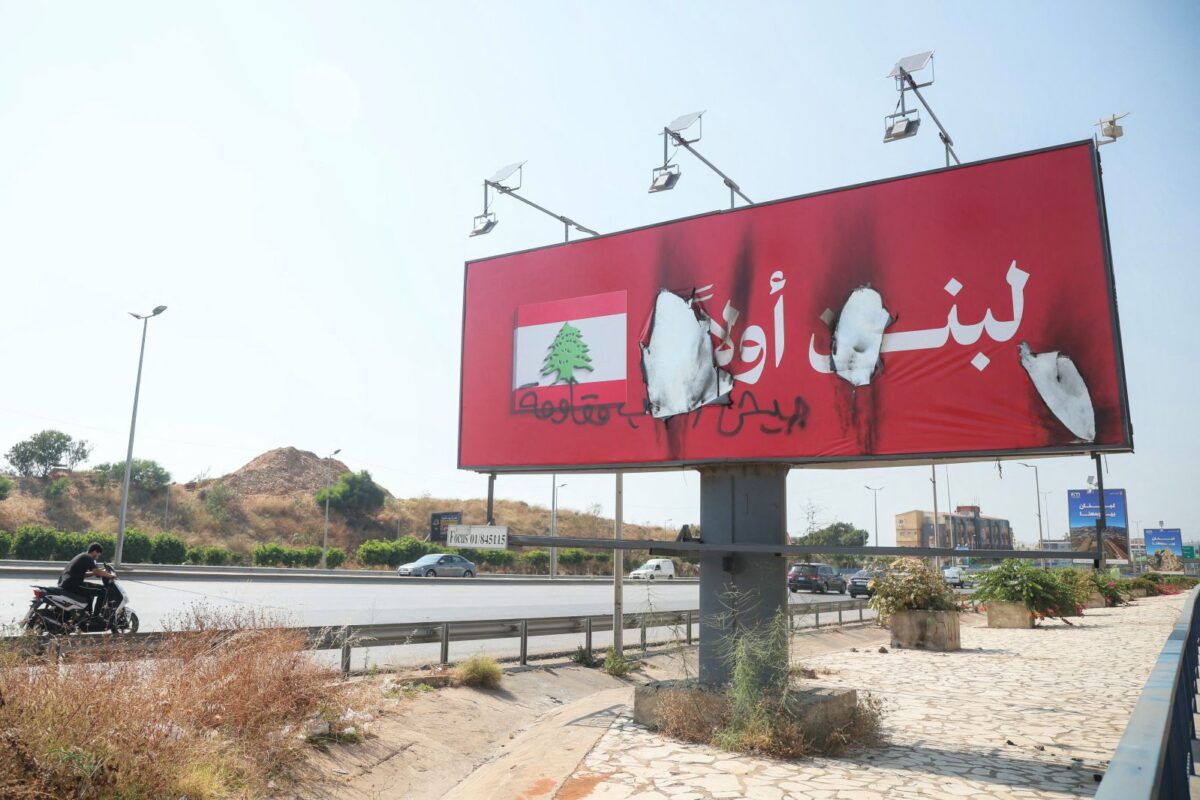
Beirut, Lebanon. Photo by IBRAHIM AMRO / AFP
Vehicles drive past a billboard that reads in Arabic "Lebanon first" (in white) after it was defaced with the words "Army, People, Resistance" and set on fire along Beirut's airport road near Tehran-backed Hezbollah's stronghold, amidst tensions following Lebanon's framework agreement with Israel on June 28, 2026.
The current billboards recently replaced previous billboards that read “Thank you, loyal Iran”, Hezbollah's main backer. The militant group has rejected the agreement, which was signed in Washington on June 26, after five rounds of talks and aims to pave the way to peace between the neighbours, includes plans to disarm Hezbollah.
One of the most striking aspects of the framework agreement between Lebanon and Israel is not what it says. It is what happened inside Lebanon before and after it was signed. Within hours of the signing, Hezbollah rejected the framework, Nabih Berri warned that it risked “fitna” and Hezbollah supporters took to the streets in protest. To many observers, the message appeared straightforward: the Shiite political leadership had rejected the agreement.
Yet that is only half the story.
Before the agreement was signed, the Lebanese government granted the negotiating delegation the legitimacy to proceed. The ministers representing the Shiite Duo did not bring down the government, resign, or publicly block the negotiating mandate. The state moved forward with the blessing of a cabinet that included representatives of Amal and Hezbollah. This creates what appears to be a contradiction. Did the Shiite leadership support the negotiations or reject them? The answer may be both.
This is not necessarily a split in political objectives. Rather, it is a split in political roles. Inside the state, the Shiite leadership behaved as partners in government. They preserved institutional continuity, avoided a constitutional crisis, and allowed Lebanon’s official institutions to negotiate. Outside the state, they resumed their traditional role as guardians of their community’s political narrative, denouncing the agreement as surrender and warning against internal conflict.
The contradiction is therefore less ideological than institutional. For years, Hezbollah and Amal have occupied two identities simultaneously. They are both pillars of the Lebanese state and movements that derive much of their legitimacy from operating outside the state’s monopoly over security. That duality has often been manageable because crises could be blamed on external actors or on Lebanon’s fragmented political system.
The new framework changes that equation.
It places the Lebanese state – not Israel, not international mediators, but the Lebanese state – at the center of implementation. If the framework proceeds, it will be Lebanese institutions that must expand state authority, verify security arrangements, and eventually address the question of armed groups.
It places the Lebanese state – not Israel, not international mediators, but the Lebanese state – at the center of implementation. If the framework proceeds, it will be Lebanese institutions that must expand state authority, verify security arrangements, and eventually address the question of armed groups.
That leaves the Shiite Duo balancing two competing responsibilities. As members of government, they cannot easily obstruct every institutional decision. As leaders of their political constituency, they cannot be seen as endorsing a process many supporters interpret as a pathway to disarmament. The result is a form of political duality. Institutional consent. Popular rejection. Neither position necessarily cancels the other.
This distinction matters because many analysts are asking whether the agreement has fractured the Shiite political leadership. The evidence so far suggests something different. The leadership appears broadly coordinated, but it is communicating through two different arenas simultaneously. One language is spoken in cabinet meetings. The other is spoken at political rallies and through public statements. Whether this strategy is sustainable is another question entirely.
Sooner or later, the government will move from authorizing negotiations to implementing commitments. At that stage, symbolic opposition may no longer be sufficient. Ministers may be required to vote on concrete security measures.
Sooner or later, the government will move from authorizing negotiations to implementing commitments. At that stage, symbolic opposition may no longer be sufficient. Ministers may be required to vote on concrete security measures. State institutions may have to make decisions that directly affect Hezbollah’s military presence. The distance between institutional responsibility and political rhetoric will become increasingly difficult to maintain. That may prove to be the framework’s most important consequence.
Not because it immediately changes the balance of power with Israel, but because it forces Lebanon’s governing actors to answer a question they have postponed for decades: Can a political movement simultaneously govern the state and reject the consequences of the state’s decisions? The coming months may provide the first real answer.
Ramzi Abou Ismail is a Political Psychologist, Researcher and Analyst.
The views in this story reflect those of the author alone and do not necessarily reflect the beliefs of NOW.