Beirut, Lebanon, Photo by HOUSSAM SHBARO / ANADOLU / ANADOLU VIA AFP
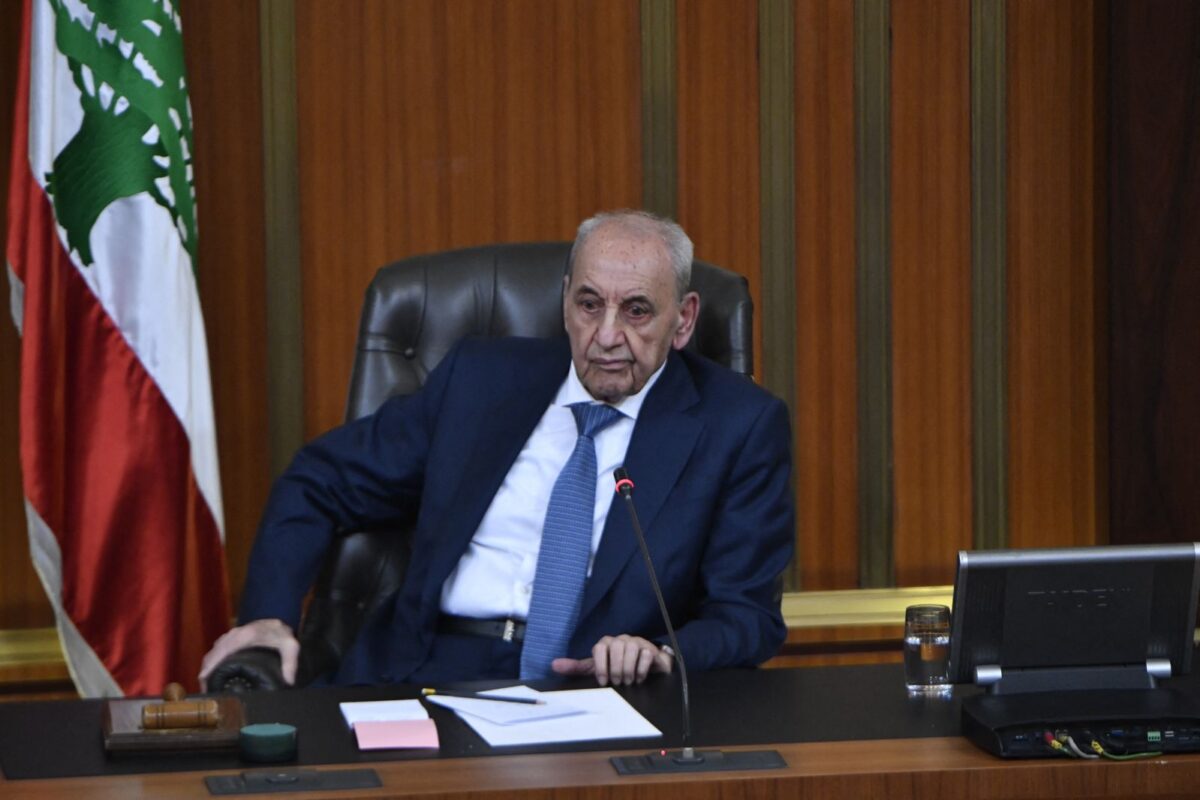
BEIRUT, LEBANON - FEBRUARY 26: Lebanese Parliament Speaker Nabih Berri attends a parliamentary session in Beirut, Lebanon on February 26, 2025.
Nabih Berri’s real problem with the framework agreement signed in Washington has very little to do with the text itself. His objection is neither legal nor diplomatic, nor is it rooted in some principled concern over Lebanon’s sovereignty or constitutional order. Rather, his opposition stems from something far more consequential: the agreement represents, despite its many imperfections, one of the first serious attempts in decades to restore political agency to the Lebanese state. It challenges a system that has survived by ensuring that no institution of the Republic can exercise genuine authority without first passing through the political and military gatekeepers of the so-called “Axis of Resistance.” For a political class that has built its legitimacy upon keeping the state permanently subordinate to armed power, that prospect is infinitely more threatening than any clause contained in the agreement itself.
For more than two decades, the Lebanese Republic has existed in a condition of suspended sovereignty. Its institutions continued to function in appearance, elections were held, governments were formed, and presidents were elected—when political circumstances permitted—but the fundamental decisions concerning war and peace, national security, foreign policy, and increasingly domestic governance migrated outside constitutional institutions. The language used to justify this gradual transfer of authority varied according to circumstance. Sometimes it was resistance. At other times it was the protection of the Shiite community, the preservation of sectarian balance, or the necessity of confronting Israel. Whatever the justification, the result remained the same: the state steadily surrendered its monopoly over political decision-making while Hezbollah, under Iranian patronage and with the active political protection of Nabih Berri, consolidated itself as the country’s ultimate sovereign.
It is against this backdrop that Berri’s increasingly public frustration with President Joseph Aoun and the presidential palace should be understood. His carefully orchestrated leaks, his warnings that the agreement cannot succeed, and his repeated attempts to revive the ghosts of the May 17 Agreement are not expressions of patriotic anxiety. They are the political reflexes of a man who recognizes that the balance of power upon which his influence has rested for decades is beginning to shift. For perhaps the first time since Syria’s withdrawal from Lebanon, the Lebanese presidency is attempting—however cautiously and however imperfectly—to conduct state policy without first seeking permission from Berri or Hezballah. For Berri, that is the true crisis.
It is therefore hardly surprising that he has once again reached for the oldest instruments in Lebanon’s political repertoire. The agreement is portrayed as an American diktat. Civil strife is invoked as the inevitable consequence of any attempt to alter the existing balance. The language of existential threat replaces political debate, while Berri once again casts himself as the indispensable guardian of Lebanon, the protector of the Shiite community, the defender of southern Lebanon, and the final guarantor of civil peace. This performance has become so familiar that it is almost accepted as part of Lebanon’s political folklore. Yet familiarity should not obscure its purpose. The invocation of catastrophe has long served as the preferred mechanism through which reform is postponed, accountability deferred, and political privilege preserved.
The irony, however, is impossible to ignore. Few figures in contemporary Lebanon have done more to undermine the sovereignty they now claim to defend than Nabih Berri himself. Long before the assassination of former Prime Minister Rafik Hariri, and certainly long before Hezbollah emerged as the country’s undisputed military force, Berri had become one of the principal architects of the political order that systematically hollowed out Lebanon’s constitutional institutions. Parliament gradually ceased to function as an independent legislative authority and instead evolved into a mechanism through which political patronage, negotiated paralysis, and institutional obstruction became normalized. The state was transformed from an arbiter into a marketplace, where constitutional principles could be traded for political expediency and sovereignty itself became little more than a slogan invoked selectively whenever it served the interests of those already in power.
To describe Berri as merely complicit in Lebanon’s institutional decline would therefore be historically inaccurate. He was one of its principal engineers. More importantly, he supplied Hezbollah with something that military power alone could never secure: political legitimacy within the constitutional order. It was this alliance that allowed Hezbollah to evolve from an armed movement claiming to resist Israeli occupation into a political-military authority exercising effective veto power over every major decision of the Lebanese state. The fiction that Lebanon possessed both a sovereign government and an autonomous armed organization operating independently of that government could only survive because figures such as Berri were willing to normalize the contradiction and transform constitutional exceptionalism into permanent political practice.
This is precisely why Berri’s repeated insistence that the framework agreement “will never pass” deserves careful attention. He is not speaking primarily as the Speaker of Parliament defending constitutional procedure. He is speaking as the political patron of a system whose defining characteristic has always been the ability to prevent the Lebanese state from exercising authority independently of armed power. Likewise, when he insists that Lebanon’s future should remain tied to the outcome of negotiations between Washington and Tehran, he is not defending Lebanese national interests. He is openly reaffirming the principle that has governed Lebanon for years: that decisions concerning the country’s future cannot ultimately be made in Beirut, but must remain contingent upon Iranian regional strategy.
There could hardly be a clearer admission that, in Berri’s political imagination, Lebanon continues to function not as a sovereign republic but as a strategic asset within a wider regional project. Under such a conception, the reconstruction of southern Lebanon, the return of displaced families, the implementation of security arrangements, the future of the Lebanese Armed Forces, and even the political destiny of Lebanon’s Shiite community itself become matters to be negotiated elsewhere. Sovereignty is emptied of its meaning precisely because its exercise is always deferred to actors operating beyond Lebanon’s borders.
Perhaps nowhere is this contradiction more evident than in Berri’s repeated invocation of civil peace. For years he has presented himself as the indispensable guarantor of domestic stability, warning that any challenge to Hezbollah’s military dominance risks plunging Lebanon into sectarian conflict. Yet this argument deliberately reverses cause and consequence. Lebanon’s recurring instability has not resulted from attempts to strengthen the state. It has resulted from the persistent existence of an armed organization operating outside that state and enjoying complete political protection from figures such as Berri. The very weapons supposedly intended to preserve Lebanon have repeatedly transformed the country into a battlefield for conflicts determined elsewhere, exposing Lebanese civilians—and particularly the people of southern Lebanon—to cycles of destruction from which they derive neither security nor political benefit.
Equally troubling is Berri’s claim to speak on behalf of Lebanon’s Shiite community. Such a claim assumes that the interests of an entire community are inseparable from the continued existence of Hezbollah’s military project. Nothing could be further from reality. Indeed, it is Lebanon’s Shiites who have paid the highest price for this political arrangement. Their villages have repeatedly become battlefields, their economy has suffered under the weight of isolation and sanctions, their youth have borne the burden of endless militarization, and their political representation has been reduced to a binary choice between loyalty and betrayal. To suggest that this constitutes protection is to redefine the very meaning of the word.
The restoration of state authority should therefore never be portrayed as a campaign against Lebanon’s Shiites. On the contrary, it represents perhaps the greatest opportunity in decades to liberate them from a political system that has monopolized their representation while demanding extraordinary sacrifices in return. A sovereign Lebanese state capable of exercising equal authority over all its territory is not a threat to any community. It is the only political framework capable of guaranteeing genuine equality among them.
The framework agreement itself is, of course, neither flawless nor sufficient. Like every negotiated settlement emerging from decades of conflict, it contains ambiguities, compromises, and implementation challenges that will require considerable political courage to overcome. Yet its importance lies less in its technical provisions than in the political question it finally forces Lebanon to confront. After decades of avoidance, the country must answer a question that has haunted every constitutional crisis since the end of the civil war: who ultimately governs Lebanon?
The answer cannot continue to be deliberately obscured. Lebanon cannot simultaneously demand Israeli withdrawal, international reconstruction assistance, economic recovery, and renewed international confidence while refusing to address the existence of an armed organization operating beyond state authority. Nor can it continue insisting that the Lebanese Armed Forces should assume responsibility for national security while denying those same armed forces the exclusive constitutional authority to exercise force. The contradiction has become impossible to sustain. A state cannot exist alongside a parallel military structure indefinitely without eventually surrendering the very sovereignty it claims to defend.
For this reason, the appropriate response to Berri’s threats cannot be accommodation disguised as pragmatism. Nor should his rhetoric be dismissed as merely another episode in Lebanon’s familiar political theatre. Successive Lebanese governments, as well as successive American administrations, have too often convinced themselves that Berri represented an indispensable interlocutor whose participation was necessary to preserve stability. In reality, that assumption has repeatedly strengthened precisely those political forces responsible for weakening the Lebanese state. Stability purchased through permanent institutional paralysis is not stability at all. It is simply managed decline.
Washington, particularly under the Trump administration, should therefore resist the temptation to continue treating Berri as a constructive intermediary or indispensable broker. Such an approach mistakes longevity for legitimacy and confuses political endurance with statesmanship. Berri has survived every transformation in modern Lebanese politics not because he has adapted the state to changing realities, but because he has consistently adapted himself to whichever regional order best preserved his own influence. The result has been the steady erosion of Lebanese institutions and the normalization of political extortion as a governing principle.
Accordingly, meaningful sanctions targeting Berri’s political and financial networks should not be viewed as acts of retaliation but as instruments of political clarity
Accordingly, meaningful sanctions targeting Berri’s political and financial networks should not be viewed as acts of retaliation but as instruments of political clarity. Those who provide political cover for armed organizations operating outside constitutional authority, who transform Parliament into a mechanism of obstruction, and who repeatedly subordinate Lebanon’s national interest to external regional agendas cannot reasonably expect to remain accepted as indispensable partners in rebuilding the very state they helped dismantle. Accountability is not vengeance; it is a prerequisite for institutional recovery.
Ultimately, Nabih Berri’s struggle against this agreement is not about diplomacy, borders, or negotiations. It is about preserving a political order in which the Lebanese state remains permanently incomplete because its incompleteness guarantees the survival of those who have profited most from its weakness. The framework agreement threatens that equilibrium precisely because it reintroduces a dangerously simple proposition into Lebanese politics: that the Republic should once again possess the authority to govern itself.
Whether this agreement ultimately succeeds or fails is almost secondary to the debate it has already forced upon the country. Lebanon can no longer postpone the fundamental choice that it has evaded for decades. Either it becomes a state governed by its constitutional institutions, accountable to its citizens and capable of exercising sovereignty over its own territory, or it remains a republic in name but a protectorate in practice, where decisions of national consequence continue to be outsourced to militias, political brokers, and foreign capitals.
Nabih Berri has spent much of his political career presenting himself as the indispensable guardian of Lebanon’s fragile equilibrium. History may ultimately remember him differently: as one of the principal custodians of a system that confused paralysis with stability, patronage with governance, and armed domination with national sovereignty
Nabih Berri has spent much of his political career presenting himself as the indispensable guardian of Lebanon’s fragile equilibrium. History may ultimately remember him differently: as one of the principal custodians of a system that confused paralysis with stability, patronage with governance, and armed domination with national sovereignty. If the Washington framework agreement has achieved anything, it is that it has exposed this contradiction with unusual clarity. Those who genuinely fear the emergence of a sovereign Lebanese state invariably fear the peace that makes such a state possible. And those who continue to place the survival of parallel power structures above the survival of the Republic cannot credibly claim to speak in Lebanon’s name.
This article originally appeared in Elaph.
Makram Rabah is a lecturer at the American University of Beirut, Department of History. His forthcoming book Conflict on Mount Lebanon: The Druze, the Maronites and Collective Memory (Edinburgh University Press) covers collective identities and the Lebanese Civil War.