Photo by - / LEBANESE PRESIDENCY / AFP
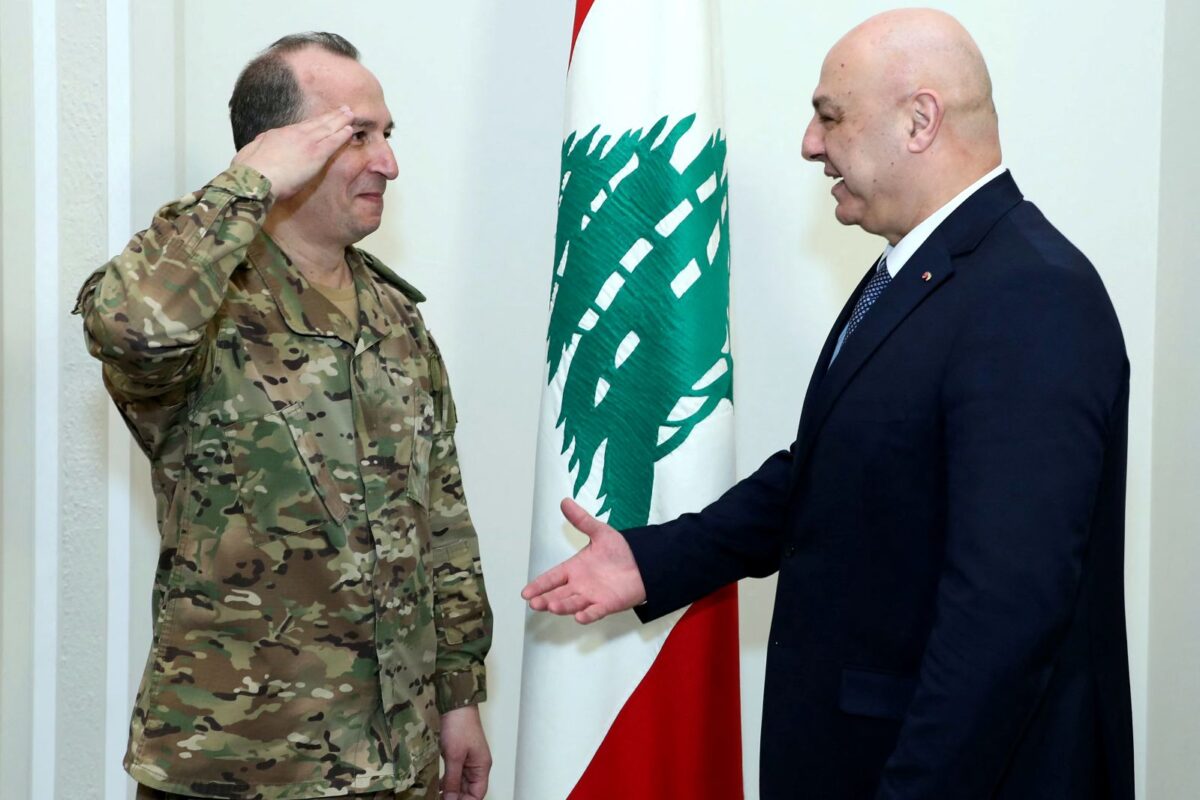
A handout photo provided by the Lebanese presidency on March 13, 2025 shows Lebanese President Joseph Aoun (R) congratulating the newly appointed Army Commander in Chief Rodolphe Haykal, at the presidential palace of Baabda, east of Beirut
For months, Lebanon’s political debate has revolved around one man: Lebanese Army Commander General Rodolphe Haykal. His statements, his meetings, his reported disagreements with foreign officials, and more recently the public defense of his position by Speaker Nabih Berri have transformed him into one of the country’s most discussed figures. Supporters describe him as a responsible commander protecting Lebanon from another civil war. Critics argue that he lacks the resolve required to implement the state’s commitment to monopolize the use of force.
Both sides, however, may be asking the wrong question. The real issue is not whether Haykal is the right man for the job. The real issue is that Haykal has exposed a contradiction that has existed within the Lebanese state for years but has never been clearer than it is today. For the first time in decades, Lebanon officially speaks the language of state sovereignty. The government has committed itself to extending state authority across all Lebanese territory, while the framework reached with international partners places the Lebanese Army at the center of that process.
Yet at almost the same moment, the commander entrusted with carrying out this mission has consistently emphasized that the army will not be drawn into a military confrontation with Hezbollah. Reports suggesting that he would rather step aside than lead the army into an internal war have only reinforced that perception. Whether one agrees with Haykal or not is almost secondary. His position forces Lebanon to confront a far more fundamental question. Can a state establish a monopoly over the use of force if it simultaneously removes force from its own strategic toolbox?
This is not an argument in favor of military confrontation. States should always seek political solutions before coercive ones. Dialogue, negotiation and gradual implementation are preferable to violence whenever possible. But sovereign states derive credibility from something deeper than their willingness to use force. They derive it from the belief that they ultimately possess the authority and, if absolutely necessary, the capacity to enforce their own decisions.
The purpose of coercive power is not constant use. It is deterrence. Its value lies precisely in making its use unnecessary. Once every political actor becomes convinced that the state has already ruled out enforcement under any circumstances, negotiations themselves begin to change. The balance of incentives shifts. Compromise becomes less urgent for those who already possess leverage. This is where the Lebanese debate becomes particularly revealing.
Washington increasingly measures Lebanon by its ability to implement its commitments. Israel links its own obligations to visible changes on the ground. Hezbollah rejects any process that begins with its disarmament. The Lebanese government insists that state sovereignty remains its objective. Standing at the intersection of all these competing expectations is the Lebanese Army. General Haykal has effectively been asked to satisfy four audiences simultaneously. He must reassure international partners that implementation is serious. He must preserve the unity of an army that reflects Lebanon’s sectarian diversity. He must avoid dragging the country into another internal conflict. And he must somehow convince Hezbollah that the state’s decisions carry authority without demonstrating how that authority would ultimately be enforced if challenged.
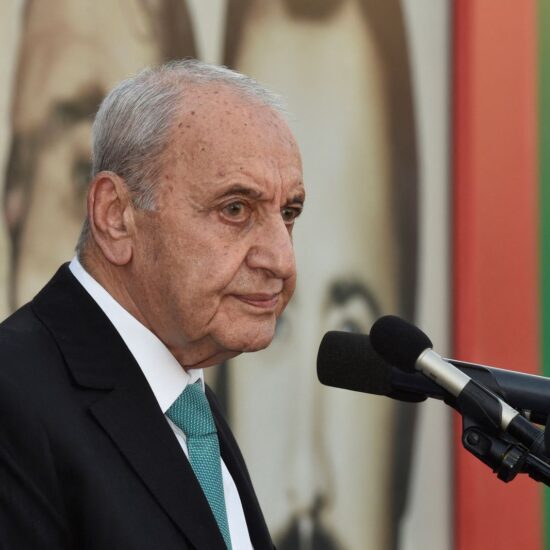
These objectives are not merely difficult. They are, to a significant extent, incompatible. Perhaps this explains why Speaker Nabih Berri was so quick to defend Haykal. His intervention may have been less about the individual commander than about preserving a particular doctrine: that the army’s first responsibility is maintaining domestic stability rather than imposing political outcomes through force. That doctrine has undoubtedly spared Lebanon from dangerous confrontations in the past.
Yet today’s political environment asks a different question. Can the Lebanese Army remain solely a stabilizing institution while simultaneously becoming the instrument through which the Lebanese state re-establishes its exclusive authority over arms? The answer is not obvious. What is becoming increasingly obvious, however, is that replacing the army commander would not automatically resolve the dilemma.
A different general would inherit the same political reality. He would face the same divided political class, the same armed non-state actor, the same international expectations, and the same fear of civil conflict. The commander, therefore, is not the problem. He is the symptom. The deeper problem lies in the gap between Lebanon’s political ambitions and its strategic doctrine. The state has declared where it wants to arrive. It has not yet decided what instruments it is prepared to use to get there.
Until that contradiction is resolved, debates over personalities will continue to distract from the more important reality. The future of Lebanese sovereignty will not be determined by the name of the commander leading the army. It will be determined by whether the Lebanese state can reconcile its political objectives with a doctrine capable of achieving them.
Ramzi Abou Ismail is a Political Psychologist, Researcher and Analyst.
The views in this story reflect those of the author alone and do not necessarily reflect the beliefs of NOW.