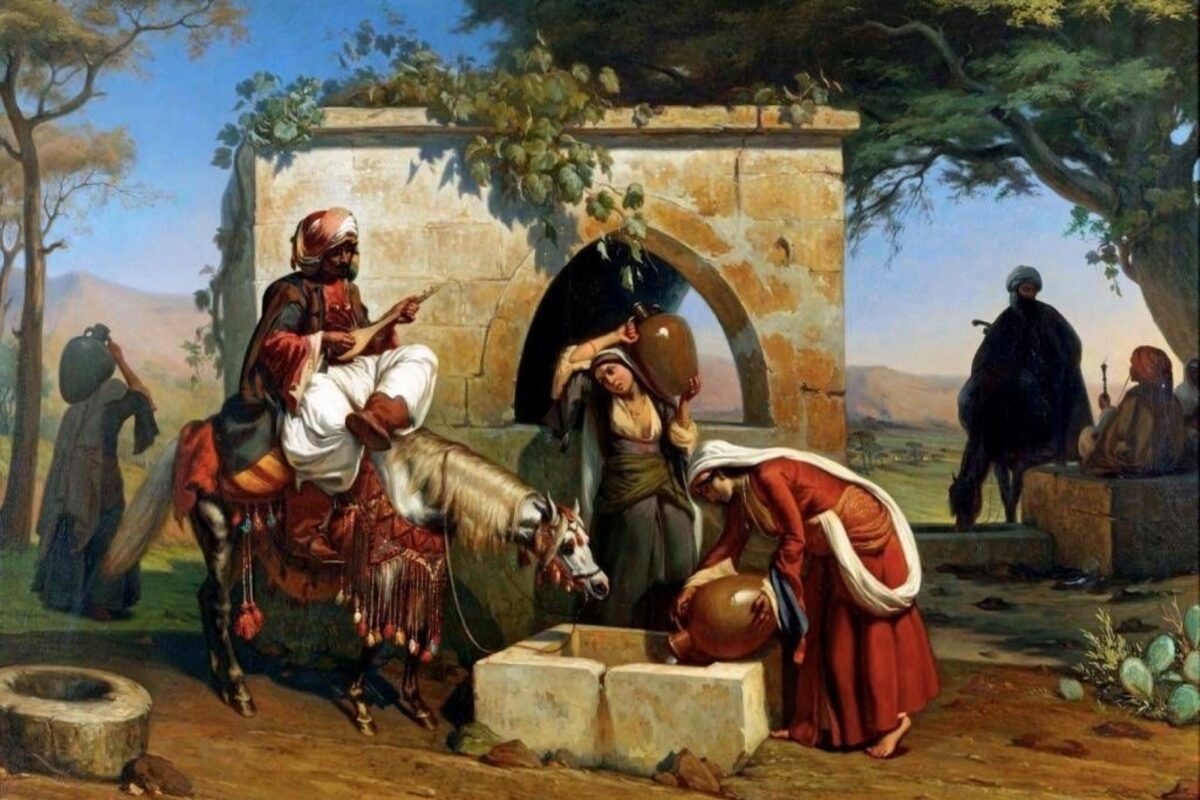
Pierre-Francois Lehoux (1803 – 1892) Oil on canvas, Maronite women at the fountain, 91.5 x 132 cm. Philippe Jabre Collection-Lebanon.
What if one of the founding movements of Lebanese history, the migration of the Maronites from northern Mount Lebanon into the Kisrawan and the Shuf, could be read through snow, locusts, plague, and the price of wheat?
Mobility is one of history’s major dynamics. Lebanese history was shaped by the mobility of communities, both within the territories that make up the present-day Lebanese republic and from beyond them.
For generations, this southward movement, which unfolded between the fourteenth and nineteenth centuries, has been told as a story of persecution and protection. Maronites, with little space to expand in their homeland of Jibbet Bsharri, Bilad al-Munaytra, Batroun, and Jbeil, found refuge under the Assaf emirs of the Kisrawan and later under Fakhr al-Din and the Ma’nid, later Shihabi emirs of the Shuf. This framing is grounded in historical fact, and the encounter between Maronite and Druze was the seed of the “emirate of Mount Lebanon,” the Mutasarrifiyya and, eventually, the Lebanese state. Environmental history, however, invites us to ask additional questions of the same past.
So far, this mobility has been explained in terms of political upheaval and persecution. Few, however, have engaged with environmental history, the field that investigates humanity’s changing ecological entanglements over time.
The Maronite southward movement offers a sample case: an opportunity to understand how Lebanese history can be read through one additional lens, the environment.
The political story remains essential. Maronites were already on the move under Mamluk rule: from the fourteenth century, a flow of migration turned toward the Kisrawan, where the Assaf emirs, governing from Ghazir, welcomed hard-working Maronite farmers and herdsmen and appointed stewards from the Maronite Hobeish clan, the beginning of a new secular leadership within the community. The movement continued into the nineteenth century.
When the Assafs fell in 1591, Fakhr al-Din Ma’n emerged as the new patron. From 1605, when he added the Kisrawan to his domains and, in time, most of the territories that make up Lebanon today, the Druze Ma’nid and later the Sunni Shihabi emirs actively encouraged Maronite settlement in the Shuf and beyond. The Ottoman punitive campaigns against the rebellious Druze mountain in 1522, 1560, 1585, 1618, and 1635 had devastated the Shuf and reduced its population. The Druze ruling class needed skilled Maronite peasants, artisans, and traders, to repopulate the land and relaunch the economy, above all sericulture, Mount Lebanon’s main cash crop until the end of Ottoman rule. In return, they offered protection, economic opportunity, and religious freedom, laying the foundations of what would become the “Lebanese entity.” Protection and economic opportunity: these are the classic “pull factors.” But what pushed the Maronites out of the north?
Two contemporary chronicles, among many, read from a new angle, offer an answer. The first is Mufakahat al-Khillan fi Hawadith al-Zaman by Ibn Tulun (1475–1546), the diary-like chronicle of a Damascene scholar who lived through the transition from Mamluk to Ottoman rule. The second, and the richer for our purposes, is Tarikh al-Azmina by Maronite Patriarch Istifan al-Duwayhi (1670–1704).
Al-Duwayhi has been used extensively by historians of politics and religion. Few scholars, however, have paid attention to the remarkable body of environmental data his chronicle contains. Year after year, between 1503 and 1686, precisely the period of the great Maronite influx southward, he records, drawing on numerous sources, floods, plagues, irregular weather, failed harvests, and fluctuations in prices.
The evidence is striking. For 1503, he records twenty-seven days of rain that flooded the rivers, destroying bridges, houses, and orchards, followed by an epidemic. In 1508 and 1516, extraordinary snowfalls buried the coast, killed livestock, and burned the crops. In 1526, a locust invasion covered the entire country and triggered nine months of soaring prices for wheat, olive oil, grapes, and bread. Snow destroyed silkworms in 1557; plague swept the province of Tripoli in 1579, followed by inflation in the basic foodstuffs of the local diet. The chronicle continues through the seventeenth century: droughts and locusts in 1625 and 1649, the “great plague” of 1653–54 that drove the people of Jibbet Bsharri to seek shelter in Zgharta and the Dinniyeh, twenty days of destructive rain in 1674, and in 1677 a locust swarm so dense it “covered the eye of the sun,” followed by hail and hot winds that killed the silkworms on the coast.
Beyond this, al-Duwayhi provides a rare window into the socio-economic conditions of a rural area: in several passages, he explicitly connects price inflation to climatic causes. His reports are also the first to attest the effects of the sixteenth-century “Price Revolution” that affected the Ottoman empire, al-Ghala’ al-‘Azim, as he calls it, on Mount Lebanon.
Placed in this context, the Maronite movement takes on a new dimension. The Maronites were one of many Mediterranean mountain populations, and as John McNeill has shown in The Mountains of the Mediterranean World: An Environmental History, Mediterranean mountains are ecologically fragile environments with a finite carrying capacity. Life there depended on a delicate balance between resources, demography, and climate. When harvests failed, epidemics struck, and political violence flared, village life became vulnerable, and movement became a strategy of survival.
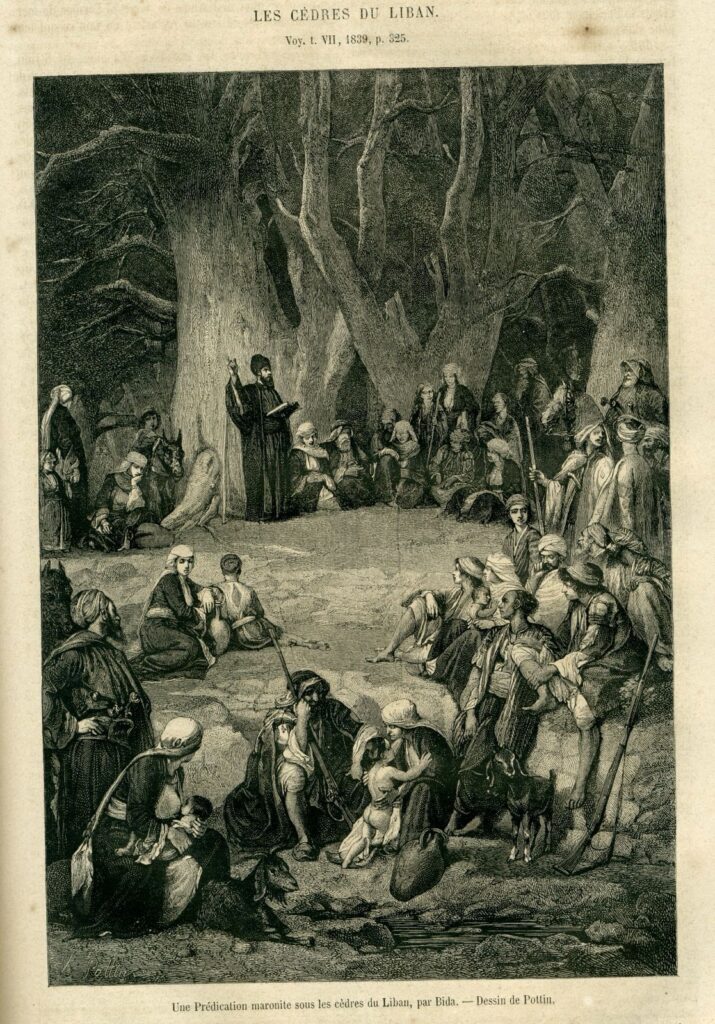
A Maronite Preaching under the Cedars of Lebanon, Engraving from a painting by Alexandre Bida, Le Magasin Pittoresque, 1861
The geography of the migration confirms this reading. Maronites moved south, toward politically more stable districts placed under the protection of the Druze lords of the Shuf. Movement eastward into the semi-arid Hermel, for example, suited to pastoralism and already occupied by Shiite herdsmen, remained extremely limited.
The timing, too, is suggestive. The period of migration coincides with the great crisis of the Ottoman Empire in the late sixteenth century, when the onset of the Little Ice Age brought cooler temperatures, droughts, and extreme weather.
Reading the migration environmentally reframes it as a conjuncture: political crisis in the north, economic opportunity in the south, and, running through both, environmental pressure, cold winters, failed crops, locusts, plague, and inflation, falling hardest on poor and marginalized peasant communities, those least able to absorb the shocks. Migration emerges as one of the adaptation strategies of the Maronites and other rural communities; sericulture, perhaps, as another, an economic strategy for securing revenue in a period of climatic pressure on agriculture.
That adaptation transformed the community. Migration turned the Maronites from a small, marginal, quasi-tribal peasant population into a well-organized community with a keen sense of identity, one that would later play a foundational role in the “Lebanist” idea and in the establishment of the Lebanese state.
Beyond this single case, the environmental lens offers something larger: it helps us move past the narrow focus on religious, and political categories that still dominates the study of history in Lebanon. Environmental history could also become one of the components of a pluralistic history, presenting this environmental setting as a heritage shared by all the communities that make up Lebanon. It also challenges monolithic perspectives of unchanged sectarian geographies, and draws the story of communities as that of humans, facing and adapting to the ever-changing context of nature.
The chronicles have been on our shelves all along. It is time we read them for what they say about the land itself, and to add that reading to our understandings of our past, whether shared or contested.
Charles al-Hayek is a public historian and the founder of Heritage and Roots.
The views in this story reflect those of the author alone and do not necessarily reflect the beliefs of NOW.