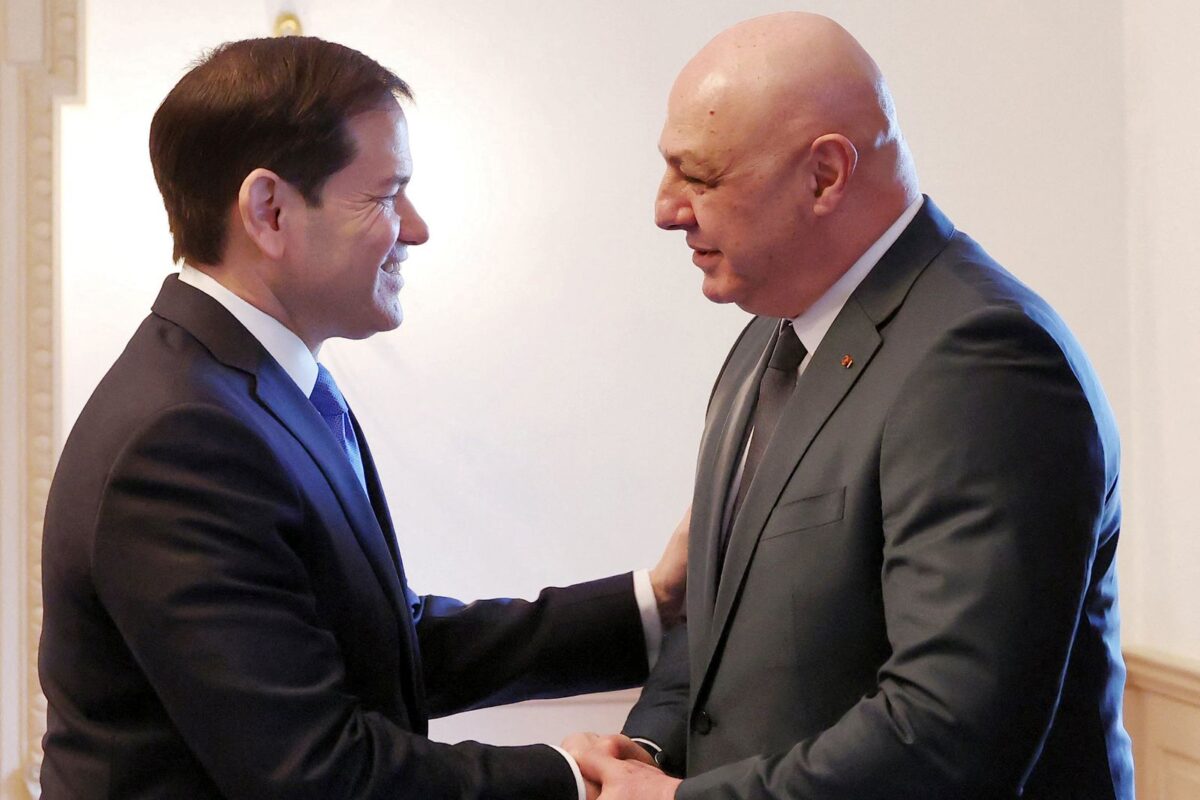
Washington, United States. Photo by- / LEBANESE PRESIDENCY / AFP
This handout photograph released by the Lebanese Presidency press office on July 19, 2026 shows Lebanon's President Joseph Aoun being received by US Secretary of State Marco Rubio in Washington, DC.
There is something almost suspicious about Lebanon remaining relatively quiet while the region begins burning again. The Islamabad negotiations have collapsed. Washington has resumed striking Iran, Tehran is retaliating, and the language of de-escalation is slowly being replaced by the familiar vocabulary of unfinished war. Yet Lebanon, at least for now, has not been dragged back in. For most countries, not entering someone else’s war would hardly qualify as a diplomatic achievement. For Lebanon, it may be the most important political development in years.
President Joseph Aoun arrives in Washington at precisely this moment. His visit will naturally be presented through the usual ceremonial language: strengthening bilateral relations, supporting the Lebanese Army, stabilizing the South and reaffirming Lebanon’s sovereignty. There will be handshakes, flags and carefully edited statements assuring us that the meeting was “excellent.” But the real purpose of the visit is larger. Aoun is going to test whether Lebanon can finally separate its fate from Iran’s wars without accepting Israeli occupation as the price. That is Lebanon’s separate peace.
Not yet peace with Israel. Not peace with Iran. Perhaps not even peace in the conventional sense. It is peace from the assumption that every regional confrontation must automatically become ours.
Not yet peace with Israel. Not peace with Iran. Perhaps not even peace in the conventional sense. It is peace from the assumption that every regional confrontation must automatically become ours. For decades, Lebanon has been treated as a military extension of negotiations taking place elsewhere. When Iran wanted leverage, Hezbollah’s weapons became useful. When Israel wanted deterrence, Lebanese territory became available. When Washington wanted a regional agreement, Lebanon appeared somewhere among the conditions.
Lebanon did not merely lose control over decisions of war and peace. It lost the right to have a separate political calendar. A speech in Tehran could change the security calculation in Beirut. An Israeli assessment of Iranian intentions could determine whether a village in South Lebanon would still exist the following morning. The significance of this moment is not that the region is calm. It plainly is not. It is that regional escalation has resumed without immediately producing a Lebanese front. This separation remains fragile. But it matters.
The opportunity inside the collapse
The collapse of the Iran negotiations would ordinarily be terrible timing for a Lebanese president visiting Washington. Israel can invoke renewed war to expand its security demands. Hezbollah may face pressure to demonstrate that it remains part of Iran’s regional deterrence. But bad timing in the Middle East occasionally creates better leverage than good timing. The Trump administration now needs to show that the collapse of one diplomatic track has not destroyed everything built around it. The Lebanese framework may be one of the few remaining places where Washington can still claim that military force produced a political result rather than simply more force.
Small states rarely obtain guarantees because powerful states discover their conscience. They obtain them by making their stability valuable.
That makes Lebanon useful. Aoun should not be embarrassed by this. Small states rarely obtain guarantees because powerful states discover their conscience. They obtain them by making their stability valuable. The June 26 framework offers the beginning of such a possibility. It connects the disarmament of non-state groups, Lebanese Army deployment and gradual Israeli withdrawal through designated pilot zones. On paper, the logic is straightforward: Hezbollah disarms, the Army deploys and Israel leaves. In Lebanon, anything that appears straightforward on paper is usually where the trouble begins.
Israel wants verified disarmament before completing its withdrawal. Lebanon needs withdrawal to make disarmament politically possible. Hezbollah cites occupation to justify its weapons; Israel cites those weapons to justify occupation. Each side’s argument reproduces the other’s. Aoun’s task in Washington is to break this circle.
Sovereignty cannot be an exam
Aoun should not return with another American demand that Lebanon disarm Hezbollah, accompanied by a vague expectation that Israel might eventually withdraw. That would make Lebanon responsible for delivering the most dangerous part of the agreement while Israel retains discretion over its own obligations. The Lebanese state cannot persuade a large part of its population to abandon armed resistance while occupation remains visible outside their windows. Nor can it ask the Army to confront Hezbollah without providing it with the resources, political protection and national legitimacy needed to replace it.
Disarmament cannot simply mean removing weapons. It must also mean removing the conditions that allow those weapons to present themselves as indispensable. That requires a reciprocal sequence: Lebanese Army deployment, verified weapons removal and Israeli withdrawal occurring together, zone by zone. It requires guarantees that territory vacated by Hezbollah will not remain occupied by Israel. It requires reconstruction that returns communities to their land. And it requires meaningful support for the Army, not admiration for it whenever Washington needs Lebanese institutions to absorb impossible risks.
The United States has spent years telling Lebanon that there can be no state while Hezbollah remains armed. This is largely true. But the reverse also deserves recognition: Hezbollah will not disarm because a weak state has been instructed to behave like a strong one.
State authority is built through capacity and credible political outcomes, not announcements.
Not neutrality, but ownership
Some will describe Lebanon’s current position as neutrality. That is not quite accurate.
Lebanon cannot be neutral toward occupied territory, displaced communities or weapons operating beyond state authority. What it needs is not distance from its problems, but ownership of them.
The future of Hezbollah’s weapons must become a Lebanese question, not a clause in an Iranian-American agreement. Israeli withdrawal must be treated as a Lebanese sovereign demand, not as a reward Washington might extract if Tehran behaves. The security of the South must be built around the Lebanese state, not divided between an armed party claiming to protect it and a foreign army claiming to protect itself from it.
Aoun deserves credit for insisting that the state negotiate and assume responsibility for the outcome. But negotiation is not automatically an achievement because the shooting temporarily decreases. The standard must be what the process produces. Does it return Lebanese territory? Does it allow displaced communities to go home? Does it transfer military authority to the state without transferring the South to permanent Israeli control? Does it prevent the next confrontation between Washington and Tehran from becoming another Lebanese funeral?
Aoun’s White House meeting – the first at this level for a Lebanese president in nearly two decades – will be presented as evidence of Lebanon’s restored relevance. But Lebanon has never suffered from insufficient relevance. It has suffered from being relevant for all the wrong reasons: as a battlefield, bargaining chip, pressure point and warning. The test is whether Lebanon can finally become relevant as a state.
A separate peace is historically a suspicious phrase in this region. It implies abandoning a collective struggle to purchase individual safety. Lebanon’s version should mean something different. Lebanon is not abandoning the region. It is abandoning the idea that solidarity requires its permanent destruction.
Aoun does not need to return from Washington having achieved peace. He must return having made one principle harder to reverse: when America and Iran fight, Lebanon does not have to; when Israel fears Iran, it does not acquire Lebanese territory; and when Hezbollah claims to defend Lebanon, Lebanon retains the right to decide whether it wants the defence.
For most countries, this would simply be called sovereignty. For Lebanon, it would be a revolution.
Ramzi Abou Ismail is a Political Psychologist, Researcher and Analyst.
The views in this story reflect those of the author alone and do not necessarily reflect the beliefs of NOW.