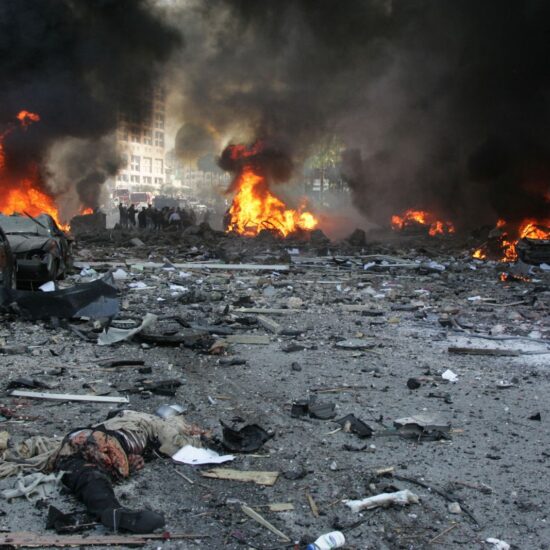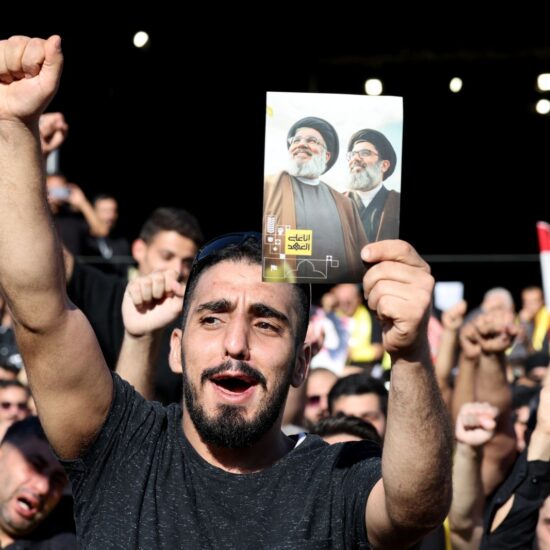

Photo by JOSEPH EID / AFP. Family members and relatives of the victims of the 2020 Beirut port explosion gather for an event commemorating the sixth anniversary of the incident outside the port area in Beirut on August 4, 2026.
On August 4, Lebanon marked six years since the largest non-nuclear explosion in recorded history. As every year, the commemoration did not belong exclusively to the families of the victims or to the Lebanese who endured the day’s physical, human, and psychological losses. Politicians, ministers, deputies, and officials of every description posted statements across every available platform, and the statements shared the same vocabulary: the indictment must not be delayed, there can be no settlement at the expense of justice, and there will be no cover for any official who is indicted.
To be fair and clear, the current Salam government did not put the ammonium nitrate in the port. But this government has been in office for a year and a half, and no indictment has been issued. There is a difference between a citizen asking for justice and a minister asking for it in the same words. The first is a demand addressed to authority. The second is authority describing its own paralysis in the vocabulary of the people standing next to the blast site. The state was not absent from the commemoration. On the contrary, it attended, spoke well, and took an activist position.
That divergence between holding authority and being willing to use power is the subject of this article. On the same day in Rome, the seventh round of negotiations with Israel took place, producing the same misalignment in a different context.
The negotiator we keep waiting for
The Rome round ended without agreement on the new pilot zone, without a final Israeli answer on controlled demolitions, and without a verification mechanism. One of the most repeated points made by Lebanese analysts and academics in Beirut, Washington, and elsewhere is that the framework and the rounds that followed were badly managed and executed, that the Lebanese diplomats involved are amateurs, and that Lebanese negotiating behavior will one day be taught in negotiation courses as an example of how not to do it. Everyone agreed the delegation was doing the wrong thing, though none agreed on what the right thing was.
Before accepting that diagnosis, it is worth remembering that we have been evaluating negotiators for a century, yet our record of learning from those evaluations is poor. Consider three cases:
The first was the King Crane Commission of 1919, sent to survey the peoples of the Levant what political future they wanted. Two Americans asked the questions and recorded the answers honestly. The report was filed, and the mandates were drawn up on entirely different maps. The commission failed not because it listened poorly, but because the balance of power and the priorities and interests of foreign capitals had already settled the matter.
The second is Reagen’s envoy Philip Habib in 1982, credited with negotiating the PLO’s departure from Beirut. He was a formidable negotiator, yet he was handed an outcome already decided by an invading army. His achievement was to arrange the execution with fewer casualties. That is a real achievement. It is not the same as producing an outcome.
The third is the Arab League’s Lakhdar Brahimi, still spoken of in Beirut with something close to reverence for his role at Taif in 1989, who resigned as envoy to Syria in 2014 after two years, apologizing to the Syrian people. Brahimi failed in Syria and succeeded in Lebanon because by 1989 the Lebanese war had exhausted its regional sponsors, the militias had run out of financing and rationale, and a settlement already existed in draft form within the balance of power. Taif needed a facilitator. Syria in 2012 needed a winner and a loser because every party still believed it was six months away from winning.
The pattern across the three is consistent. Negotiators convert the existing balance of power into text. They do not impose the balance. When we assess a negotiation by grading the negotiator, we are usually measuring the variable that mattered least.
The pattern across the three is consistent. Negotiators convert the existing balance of power into text. They do not impose the balance. When we assess a negotiation by grading the negotiator, we are usually measuring the variable that mattered least.
The misalignment between authority and power
The charge against the Lebanese delegation creates the perception that our negotiators represent themselves rather than the state. You are left with the impression that the delegation travels to Rome with one understanding and returns with another, improvising en route.
Nobody, however, wants to admit that even a perfectly trained and technically solid delegation would return with the same result. Lebanon sits at the American embassy in Rome and discusses the disarmament of a party that is not at the table, does not recognize the table, has declared the framework null and void, and has warned that pressing the file would mean chaos. Even after the government’s decision last March to disarm Hezbollah, no state institution has shown any willingness to enforce that decision or any decision made during the negotiations.
So where is the road map? Which methodology, which recipe, instructs a state on how to negotiate while holding authority but none of the power? What is it supposed to do when the non-state actor holds the power and answers to no institution, and when the state itself keeps declining to impose its rulings on that actor? Having answered none of this, we blame the negotiators and call them amateurs.
No delegation can negotiate its way out of that configuration. Not Habib, not Brahimi, not even a team of the most experienced professionals. The problem is not efficiency or experience. It is that one side arrived with a signature, and the other side knows that signature does not bind the party that matters.
No delegation can negotiate its way out of that configuration. Not Habib, not Brahimi, not even a team of the most experienced professionals. The problem is not efficiency or experience. It is that one side arrived with a signature, and the other side knows that signature does not bind the party that matters.
The technical objection, again
In one of my previous articles, I described three camps within the framework: those who support ending the war and say so, those who reject it ideologically and say so, and a third camp that never states a position and instead criticizes on technical grounds, always in polished vocabulary and always from a high moral ground. The argument about the negotiating team belongs to that third camp and performs exactly the same function.
Blaming the stalled negotiations on the delegation’s technical weakness and inexperience is not sound, objective, or independent analysis. This can be described as moving the goalposts. It diverts the conversation from where it belongs and does so at no cost to anyone, because a delegation can always be replaced while a structural challenge has to be confronted. A state without the willingness to assert its sovereignty will never succeed in any negotiation.
Blaming the stalled negotiations on the delegation’s technical weakness and inexperience is not sound, objective, or independent analysis. This can be described as moving the goalposts. It diverts the conversation from where it belongs and does so at no cost to anyone, because a delegation can always be replaced while a structural challenge has to be confronted. A state without the willingness to assert its sovereignty will never succeed in any negotiation.
Our diplomats may be inexperienced, and some of the criticism is likely accurate. But experience is not the binding constraint. When a state’s institutions behave as spectators at their own file, a bad framework agreement or no agreement at all is not a risk to be managed. It is the guaranteed outcome of the arrangement. Six years after the port, the families still do not know whom to blame, and I have stopped reading that as a failure of the system. It is the system working exactly as designed.
Khalil Gebara is an academic and researcher.
The views in this story reflect those of the author alone and do not necessarily reflect the beliefs of NOW.