A Syrian court’s decision to sentence former President Bashar al-Assad to death in absentia has opened a new chapter in Syria’s attempt to reckon with the crimes of his former regime. But this raises a question for Lebanon, could its judiciary also pursue Assad and former regime officials over crimes committed in Lebanon and against Lebanese victims?
The verdict comes at a striking moment for Lebanon, which has just abolished the death penalty raising questions over how it could pursue accountability for Assad-era crimes under its own laws.
For Lebanese lawyer and former senior advisor to Lebanon’s Human Rights Minister Farouk El Moghrabi, the answer to whether Lebanon can pursue cases against Assad depends largely on where the alleged crimes were committed and their legal classification.
Speaking to NOW, El Moghrabi said: “Where the crime was committed in Lebanon, Lebanese authorities have jurisdiction to investigate and prosecute it. The Public Prosecution can also initiate investigations into crimes committed on Lebanese territory.”
He added that the passage of time remains a key legal factor in older cases. “Ordinary offences may be subject to statutes of limitation,” he said, “while crimes against humanity and war crimes are not subject to prescription in the same way.”
That distinction could prove significant for victims of the Assad regime whose cases stretch back decades.
For years, the Syrian government maintained an extensive detention system in which opponents, activists and civilians were subjected to arbitrary detention, torture, enforced disappearance and execution. Among the most notorious facilities was Saydnaya Military Prison, north of Damascus, which became synonymous with the Assad government’s system of detention and torture.
The prison became one of the most powerful symbols of the regime’s repression. Investigations by human rights organisations documented mass executions, torture and systematic abuses inside the facility, while photographs and testimonies from former detainees helped expose the scale of the system.
The collapse of Assad’s regime brought the prison system back into focus. As Syrian opposition forces took Damascus in December 2024, prisons across the country were opened and detainees were released. Families rushed to search for relatives who had disappeared years earlier, while the fate of thousands remained uncertain.
For Lebanon, the issue has a particularly painful dimension.
Syrian forces maintained a military and security presence in Lebanon for decades, and Lebanese citizens were among those detained in Syrian prisons. The fate of Lebanese detainees and missing persons has remained one of the country’s most sensitive unresolved files.
As El Moghrabi noted, “the passage of time does not erase the legal possibility of accountability in cases involving serious international crimes,” a point that continues to resonate for families still searching for answers.
The fall of Assad created renewed hopes that Syrian prisons, archives and former officials could finally provide answers about those who disappeared.
But accountability for alleged crimes linked to the Syrian regime did not begin with Assad’s fall.
One example came in August 2013, when twin bombings outside the Al-Taqwa and Al-Salam mosques in Tripoli killed at least 47 people and wounded hundreds, making them among the deadliest attacks in Lebanon since the end of the civil war.
Lebanese judicial authorities later charged five people in connection with the attacks, including a Syrian army officer and a Sunni cleric described at the time as being close to the Syrian government. Two Syrian suspects, including Captain Mohammed Ali, were charged in absentia with placing the bombs. Lebanese judicial sources identified Ali as a Syrian security official based in Tartus.
The case is significant in the context of Lebanon’s current legal debate because Lebanese authorities pursued suspects linked to the Syrian security apparatus over alleged crimes committed on Lebanese territory. While the case does not establish criminal responsibility for Assad personally, it demonstrates that Lebanese courts have previously exercised jurisdiction in cases involving alleged Syrian involvement in crimes committed inside Lebanon.
The question now is whether that same legal principle could be applied to other unresolved cases involving former Assad-era officials.
Mohammad Sabra, a Syrian lawyer and former chief Syrian opposition negotiator, believes it can.
Speaking to NOW, Sabra said: “Lebanon is perhaps the country most affected by the crimes of the Assad regime after Syria itself.”
He argued that Lebanese law allows Lebanon to initiate judicial proceedings against Assad and other former Syrian officials in relation to crimes committed in Lebanon. He also said Lebanon could seek the extradition of former members of the Syrian security apparatus implicated in crimes committed on Lebanese territory, including political assassinations and terrorist attacks.
For Sabra, the central obstacle is not jurisdiction.
“The real issue is not legal capacity,” he said, “but whether the Lebanese state is willing to activate it.”
He pointed instead to what he described as the possibility that former Assad-era security officials implicated in crimes in Lebanon could be residing inside the country under the protection of Lebanese political actors.
If so, the question facing Lebanon would extend beyond whether its courts possess the necessary legal authority. It would be whether Lebanese institutions are prepared to exercise that authority against individuals who may still benefit from political protection.
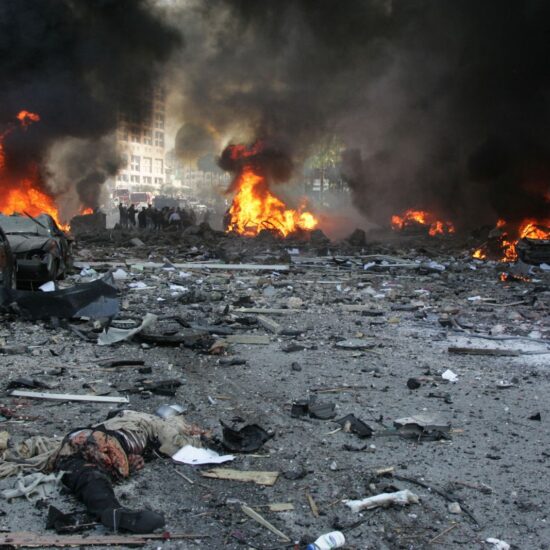
The most politically sensitive example remains the 2005 assassination of former Prime Minister Rafik Hariri.
Hariri was killed in a massive truck bombing in central Beirut on February 14, 2005, during a period when Syria exercised extensive political and military influence over Lebanon. The assassination led to an international investigation and ultimately to the creation of the Special Tribunal for Lebanon.
The tribunal convicted Salim Ayyash, a Hezbollah member, in connection with the assassination and related crimes. However, it did not establish the criminal responsibility of Assad or the Syrian leadership for Hariri’s killing.
But Hariri’s assassination was not the only case in which the Syrian security establishment became linked to violence in Lebanon.
The Samaha-Mamlouk case provides another example of Lebanese courts pursuing alleged links between senior Syrian security officials and crimes planned on Lebanese territory. In 2012, former Lebanese minister Michel Samaha was arrested after authorities accused him of transporting explosives from Syria into Lebanon as part of a plot to carry out attacks and assassinations. The case also implicated Ali Mamlouk, then a senior Syrian intelligence official, who Lebanese authorities accused of coordinating the alleged plot. Mamlouk was indicted in absentia.
The Tripoli mosque bombings and the Samara-Mamlouk cases illustrate how allegations involving Syrian officials reached Lebanese courts. They also provide a basis for examining whether Lebanon could revisit other unresolved cases now that the Assad regime no longer controls the Syrian state.
The Syrian court’s death sentence gives that question a new urgency.
According to Sabra, the ruling itself is historically significant but its immediate legal effect is more complicated because Assad was tried in absentia.
“An in-absentia conviction does not have full legal finality,” he explained. “If Assad were arrested or surrendered, the judgment would be set aside and a retrial would take place.”
Nevertheless, he said the ruling transforms Assad’s status from that of a former president living in exile into that of a fugitive from justice. It also provides the Syrian government with a judicial basis to seek his extradition and circulate arrest requests through international law-enforcement channels.
Its significance is therefore both legal and symbolic.
The case is the first major judicial ruling of its kind within Syria’s transitional justice process and concerns crimes committed in Daraa, the southern city where the 2011 uprising began. For Sabra, this symbolism is particularly important as Syria’s new authorities attempt to demonstrate a break with the institutions and practices of the Assad era and establish the rule of law as a foundation of the country’s transition.
For Lebanon, meanwhile, the abolition of the death penalty adds another dimension.
El Moghrabi stressed that abolishing capital punishment does not prevent Lebanon from prosecuting Assad or former Syrian officials. Rather, it changes the possible punishment.
“The abolition of the death penalty does not remove accountability,” he said, “it only changes its form.”
Sabra went further, arguing that Lebanon’s abolition of capital punishment could potentially make extradition requests easier in some cases, particularly when dealing with European countries where extradition can be restricted if an accused person risks facing execution.
The contrast is striking.
In Syria, Assad has been sentenced to death by a court in absentia, although the verdict could be revisited if he were arrested. In Lebanon, meanwhile, lawmakers have removed the death penalty from the country’s legal system.
The two developments nonetheless converge around the same question: what does accountability look like after the fall of Assad?
For Syria, the answer is beginning to emerge through a transitional justice process seeking to establish responsibility for the crimes of the former regime.
For Lebanon, the question is more complicated.
The country has its own unresolved history of Syrian intervention, political assassinations, alleged terrorist attacks, Lebanese detainees and missing persons. Some cases have already reached Lebanese courts, while others remain unresolved decades later.