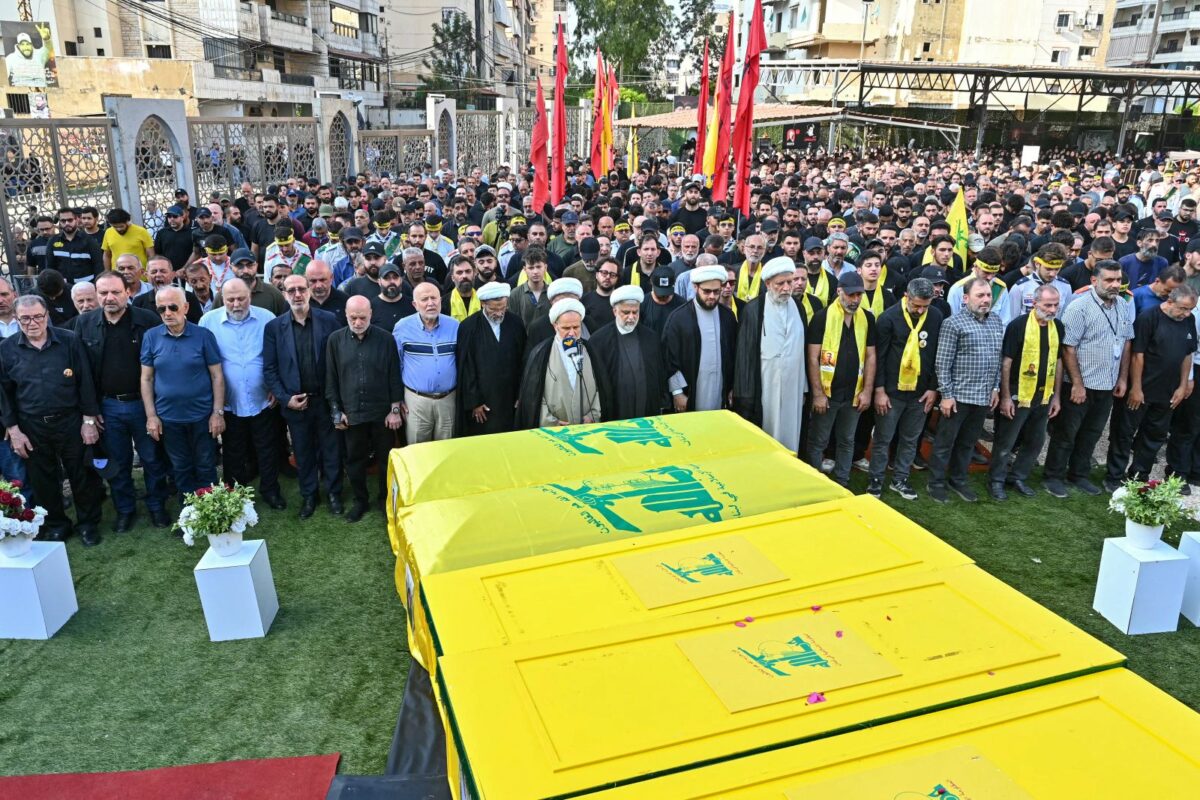
Photo by FADEL ITANI / AFP. Mourners pray next to the coffins of Ali Samir Al-Haj Hassan, a Commander in Hezbollah's elite Radwan Force, and his family members during their funeral in Beirut’s southern suburb on August 16, 2026, after they were was killed a day earlier in a strike carried out by Israel's military in the village of Ansar.
On Saturday, 11 people were killed in Southern Lebanon due to Israeli airstrikes. Among the victims were women and children. The attacks over the weekend mark one of the biggest escalations since June.
Israel’s military argued on Saturday that its attacks were a reaction to fights in the Ali al-Taher Ridge. The area has become one of the most contested territories between the two actors, as Israel’s military believes Hezbollah has underground infrastructure there. According to Israel’s military, a senior commander of Hezbollah’s Badder Unit and a battalion commander of the Radwan Force unit were killed over the weekend.
The situation in Ali al-Taher Ridge is intensifying. An Israeli military source has called it a “battle of wits”, according to Israeli media. Other reports indicate that Israel’s military will only accept Hezbollah fighters currently trapped underground to surrender or to be bombed.
Lebanon’s Prime Minister Nawaf Salam on Saturday condemned an Israeli strike on Ansar, saying that the seven people killed in the attack were “not ‘military infrastructure’”. He also demanded that Israel hold its escalation in Lebanon’s South.
Lebanese President Joseph Aoun has called the attacks a violation of the framework agreement between Israel and Lebanon. He also said striking and killing civilians is a breach of international law.
In Lebanon
Ben-Gvir threatens to bomb Beirut: Israel’s far-right National Security Minister said on Sunday in an interview with Israeli media that his country should “bomb Beirut, we need to put an end to this cat-and-mouse game and, instead, crush them”. He also criticized the Lebanese army for not doing enough.
Lebanon’s media law set to be revised: After the new Information law passed last week in parliament, it received major criticism for the possibility of imprisoning journalists. Lebanon’s Information Minister Paul Morcos is now working on a new draft to improve media freedom.
In The Region
US set up direct channels via Iraqi-Kurdistan with Iran: In mid-May, Washington created direct channels to Iran’s Revolutionary Guard to determine whether Iran’s negotiators were speaking on behalf of the regime. Axios reported on Sunday that Trump’s administration reached out to the president of Iraqi Kurdistan, Nechirvan Barzani, to establish this setup. Washington wanted to clarify whether Parliament Speaker Mohammad Bagher Ghalibaf and Foreign Minister Abbas Araghchi had the authority to negotiate. According to the report, Barzani established channels with Iranian General Ahmad Vahidi, who supported Ghalibaf and Araghchi.
Kushner met with Hamas in Egypt: On Sunday, Trump’s adviser Jared Kushner met with Hamas leaders like Khalil al-Hayya to talk about the disarmament process, Axios reported.
Kushner travels to Israel: Today, Kushner is set to meet Israel’s Prime Minister Benjamin Netanyahu to debrief about the negotiations and talk about the steps forward. Israel has largely been critical of Trump’s Board of Peace plan to disarm Hamas.
What We’re Reading
Umm el-Amed: Lebanon’s Forgotten Phoenician Temples? Now’s Charles H. Al-Hayek looks at Lebanon’s forgotten Phoenician heritage — and analyzes the temples, sites and inscriptions related to the archaeological site of Umm el-Abed. He explains why the site still matters today and why Lebanon’s archaeological heritage has long been overlooked.
Tripoli: Building Lebanon’s First Future-Ready City. Farid Fakherddin looks at the idea of Lebanon’s government, including Prime Minister Nawaf Salam, to redevelop Tripoli. Beyond building several major infrastructure projects such as an airport, a port and special economic zones, the project might render Tripoli into a major hub.
As Syria Sentences Assad To Death, Why Has Lebanon Not Pursued Its Own Case? Now’s author Rodayna Raydan looks at Syria’s judicial sentences against the Assad regime and examines how Lebanon could pursue justice for crimes committed by the Syrian regime against Lebanese or inside Lebanon.
Who Is Negotiating for Lebanon? Khalil Gebara analyses the negotiations Lebanon is currently dealing with in Rome as well as the power of the current Lebanese government. He argues that the negotiations themselves reflect the power balance of the actors involved and that no negotiator can achieve better results than the actual powers it has.
Rome’s Waiting Room. Now’s author Ramzi Abou Ismail examines the talks between Israel and Lebanon in Rome and argues that the results of future negotiations should be weighed upon actual outcomes, rather than atmosphere.