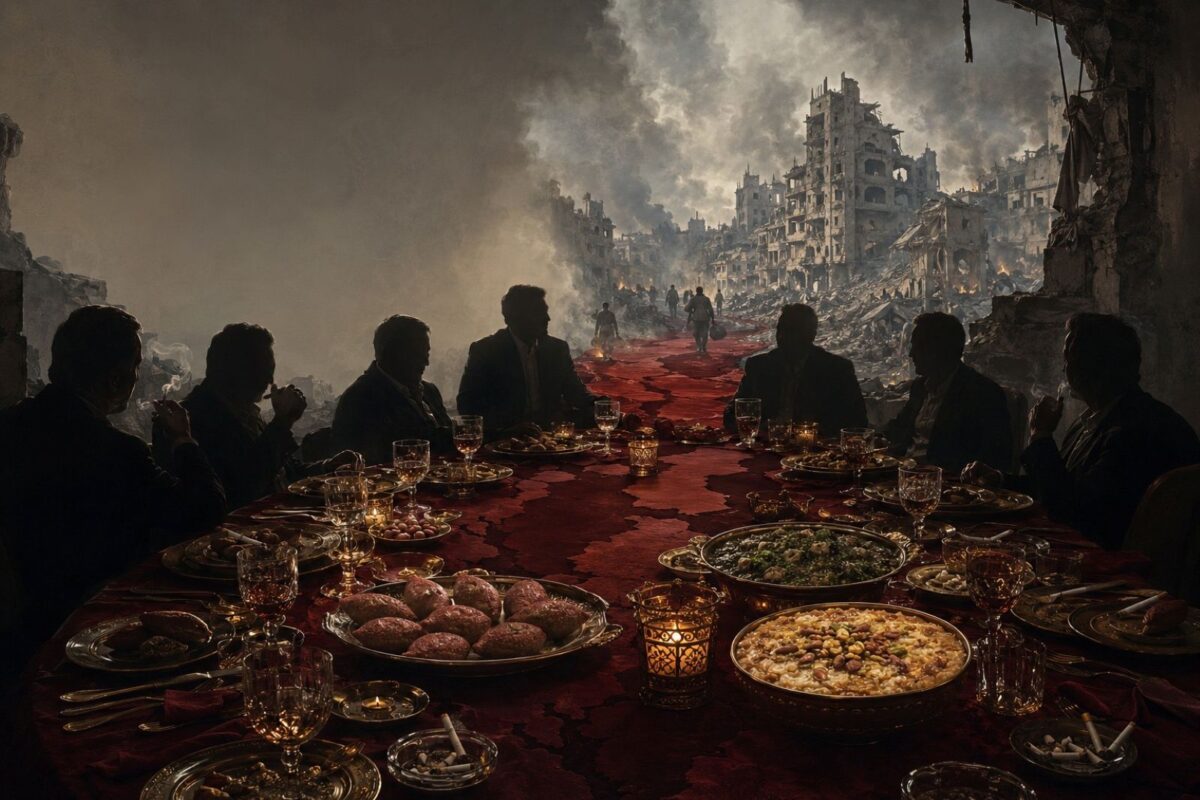
It took Al Mahatta Podcast three full hours to explain that the so-called “Axis of Resistance” has not been defeated; that the fall of Bashar al-Assad’s regime does not signify the failure of its project; that Lebanon’s devastation can somehow be filed under “steadfastness”; and that anything contradicting these conclusions is not reality but merely an “Israeli narrative” or the product of “Gulf media influence.”
The scene was more eloquent than the discussion. Radwan Mortada, Hassan Ahmadian, Ali Hashem, Jad Ghosn, Adam Shamseddine, Firas Hatoum and Qassem Qassem sat around a lavish table, sampling raw kibbeh and debating ghormeh sabzi and Umm Ali while discussing cities burned, villages erased, populations displaced and countries transformed into battlefields.
The food was real; the people were statistics. The meat on the table had flavor and history. The flesh of Lebanese, Syrians, Iraqis and Iranians was merely a “collateral damage” in calculations of deterrence.
There is nothing inherently wrong with eating or joking during a political discussion. The problem is that the table inadvertently revealed its guests’ hierarchy of values: Iran is a project, Hezbollah has a function, Israel is an enemy and America is a conspiracy. The human beings trapped between these grand abstractions are expendable. They may be killed or displaced and then instructed to remain patient because, as the Iranian guest explained, an Iranian dish requires time before its ingredients release their true flavor.
Perhaps this was the episode’s most accurate metaphor. The Axis, too, was slow-cooked. Yet the flavor it produced was not victory, but the smoke and ruin of Arab cities and a river of blood of the innocent.
The episode was presented as a discussion of the transformations reshaping the region. In practice, it resembled a group therapy session for people whose political universe had collapsed after they had spent years describing it as indestructible. Their support for Iran or Hezbollah is not the issue; that is a legitimate political position. The issue is that they dress loyalty in the language of “analysis,” as though changing the vocabulary could turn doctrine into information and wishful thinking into a balance of power.
Analysis begins with facts and asks where they lead. The Axis begins with a sacred conclusion—Iran cannot be defeated and the Resistance cannot be wrong—and rearranges the facts accordingly.
If Iran advances, it is victory. If it retreats, it is strategic patience. If it responds, it has imposed a new equation. If it does not, it is choosing the appropriate time and place. If an ally survives, it has triumphed. If that ally falls, it is because of a foreign siege. And if the country is destroyed while the organization survives, survival itself becomes an “image of victory.”
By this definition, the Axis cannot lose—not because it is powerful, but because it has abolished the word defeat.
Much of the discussion concerned Iran’s “strategic patience,” compared alternately to cooking and carpet weaving. But one simple question remained unanswered: who paid for this patience?
One participant acknowledged with unusual clarity that Iran had pushed confrontation away from its own territory, while no comparable patience was exercised in Syria, Yemen or Lebanon. This is not a minor observation. It is the definition of the entire project. The Axis was never an alliance of equal states sharing risks. It was a mechanism for distributing them: Iran accumulated influence while its Arab allies provided the geography, the population, the economy and the blood.
A Lebanese who refuses to burn his country for Gaza is accused of betrayal. Iran’s refusal to burn itself for Lebanon, by contrast, inspires lectures on sovereignty and strategic calculation.
When Beirut is attacked, the Lebanese are told that they belong to a “unity of fronts.” When Tehran is attacked, preserving the Iranian state and its capabilities suddenly becomes rational and necessary. A Lebanese who refuses to burn his country for Gaza is accused of betrayal. Iran’s refusal to burn itself for Lebanon, by contrast, inspires lectures on sovereignty and strategic calculation.
This is not a unity of fronts. It is a unity of invoices.
One of the episode’s most revealing admissions was that Hezbollah’s military survival constitutes “part of Iran’s image of victory.” Not Lebanon’s victory. Not the return of southerners to their villages. Not the protection of homes. Iran’s image of victory.
Here, the mask falls. Lebanon is not treated as a country with interests, citizens and a public life. It is a backdrop for the Iranian picture. If an armed fighter remains standing amid the rubble, victory may be declared—even if the homeowners are living in tents or exile. The collapse of deterrence, the decapitation of leadership, the destruction of villages and the expansion of occupation become secondary. What matters is that the weapon survives.
Yet armies and armed organizations are not measured by their biological survival. They are measured by whether they achieve their objectives and protect the people they claim to represent. If “resistance” produces more occupation, “deterrence” produces more bombardment, and the “unity of fronts” leaves Lebanon alone when it needs unity most, what kind of victory is this?
It is the only victory that requires an additional expert every time its losses grow.
Hezbollah had killed one million Syrians because the death toll was “only” around 600,000. This is how a destroyed country was discussed: like an accountant correcting an invoice rather than confronting the nature of the crime, as though the tragedy became less obscene if the number were 600,000 rather than one million.
The discussion reached its moral nadir when it turned to Syria. One participant objected to the claim that Hezbollah had killed one million Syrians because the death toll was “only” around 600,000. This is how a destroyed country was discussed: like an accountant correcting an invoice rather than confronting the nature of the crime, as though the tragedy became less obscene if the number were 600,000 rather than one million.
For a moment, the correct question was asked: Why were you in Syria? It quickly disappeared beneath the justifications. Hezbollah’s intervention, it was argued, gave it another decade to transfer weapons. This is not a defense. It is an indictment. Syria, its people and its borders were reduced to a logistical corridor for an Iranian-Lebanese military project.
When the discussion reached Lebanon, the word “state” was placed between quotation marks. This was one of the episode’s most honest moments. In the Axis’s discourse, the state is invoked when Hezbollah needs institutions, salaries and legal cover, then ridiculed when it demands authority over war and peace.
Hezbollah participates in government, grants it confidence and benefits from its institutions, only to describe it as a government of occupation when it makes an unwelcome decision. The party is inside the state when privileges are distributed and outside it when responsibility is assigned. It wants to be the government and the resistance, the authority and the opposition, the author of decisions and their victim.
Near the end, one participant said, “I am speaking as a human being.” The answer came quickly: you must speak according to Hezbollah’s logic.
That exchange summarized the entire problem. Human logic asks: How many homes remain? How many families returned? Is the child safer? Organizational logic asks: Does the weapon remain? Can the enemy still be made to pay a “price”? Does Iran still possess a negotiating card?
The episode ended with the story of Umm Ali, after which the guests rose to smoke. It was a fitting conclusion. After three hours of war, killing and displacement, the food, the story and the cigarette remained. Only those whose lives had been destroyed were denied a seat at the table.
The Axis promised victory, then downgraded victory to steadfastness, steadfastness to survival, and survival to the mere preservation of weapons above the ruins of society.
The Axis promised victory, then downgraded victory to steadfastness, steadfastness to survival, and survival to the mere preservation of weapons above the ruins of society.
Your table will probably remain abundant, and every dish upon it will retain its flavor, history and story. One can only hope that your moral sense might someday rise to the level of the food you so carefully savor—and that you might find in the faces of those displaced and killed by this logic something worthy of more than a passing remark between courses.
Until then, enjoy your feast: food rich in flavor, logic without taste, and morality that was never invited to the table.
Makram Rabah is the managing editor at Now Lebanon and an Assistant Professor at the American University of Beirut, Department of History. His book Conflict on Mount Lebanon: The Druze, the Maronites and Collective Memory (Edinburgh University Press) covers collective identities and the Lebanese Civil War. He tweets at @makramrabah
This article originally ran in Polyblog