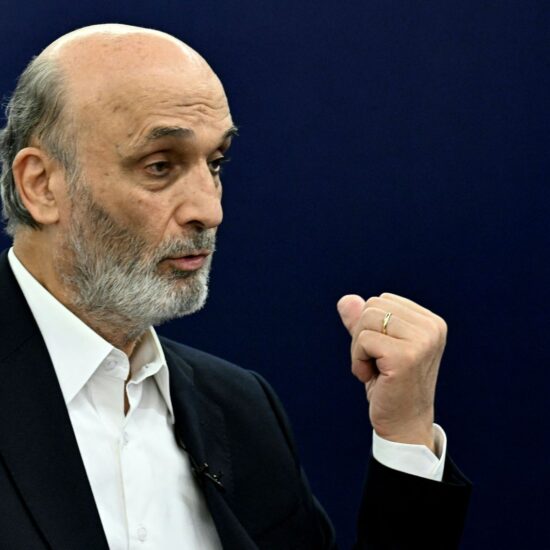
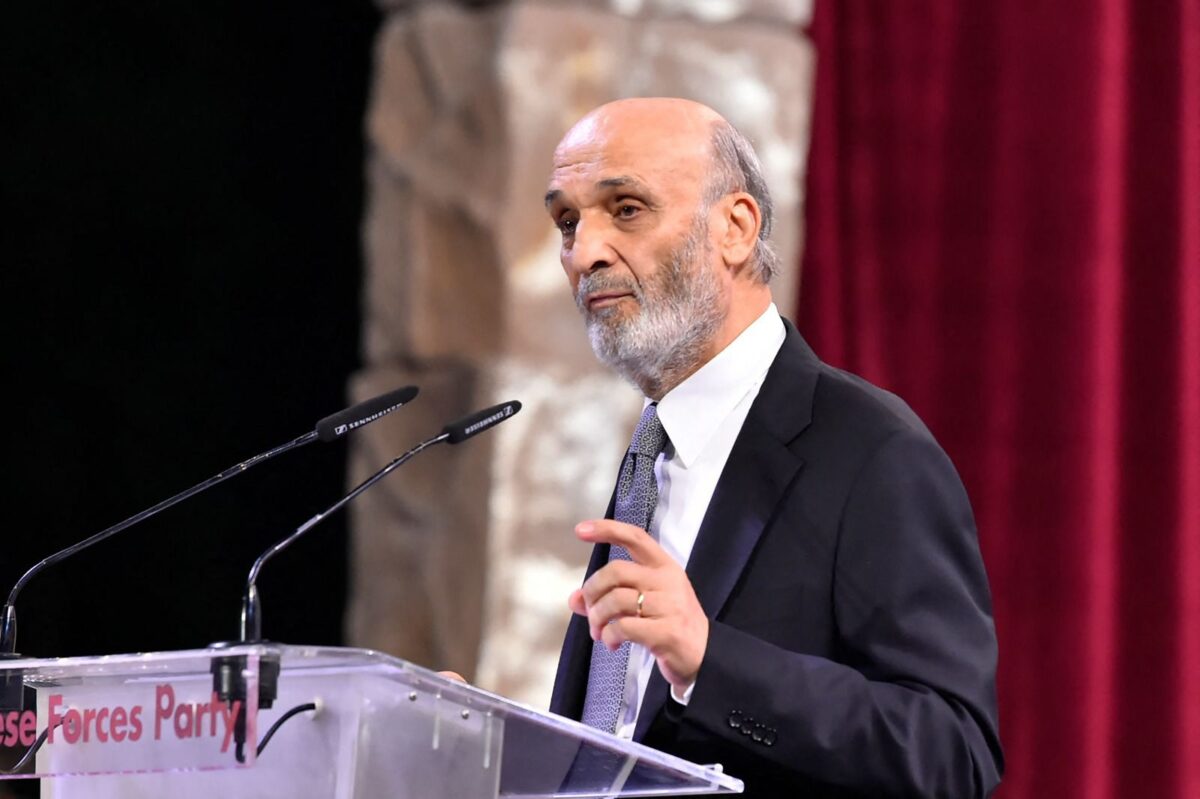
Photo by - / PRESS OFFICE OF THE LEBANESE FORCES / AFP. A handout picture provided by the press office of the Lebanese Forces (LF) shows the Christian Lebanese party's chief, Samir Geagea, addressing the media from his mountain base in Maarab, northeast of the capital Beirut on September 7, 2025
Samir Geagea’s speech at the fiftieth anniversary of the Lebanese Forces was, in the truest sense, a patriotic one. He aimed his arrows directly at the presidency and the government, demanding action rather than decisions and speeches, and criticizing the army’s inaction in implementing the government’s own decisions. This was not the language of a man protecting turf. It was the language of someone holding the state to its own stated commitments.
But patriotism that stops short of naming where the road actually leads is only half a position. Across a speech covering the war, the Framework Agreement, sovereignty, and ending “the cycle of wars,” one word never appears, not once, in reference to Israel, across some twenty-two pages.
But patriotism that stops short of naming where the road actually leads is only half a position. Across a speech covering the war, the Framework Agreement, sovereignty, and ending “the cycle of wars,” one word never appears, not once, in reference to Israel, across some twenty-two pages. He asks what Lebanon will practically do to stop the war. He insists Lebanon must fall in line with Arab and international consensus on disarmament. But he never names the actual endpoint that consensus is built around: normalization, a settlement, Peace.
Nor does he address the Taef Accord, or the growing calls, including from within his own broader political camp, for constitutional change, federalism among them, as a response to a war whose costs fell so unevenly across the country. A speech this detailed on institutions, on the army, on the presidency, had every opportunity to engage the question of what comes after the war constitutionally. It didn’t.
Neither silence is an oversight. A speaker this precise, who quotes Iran’s own parliament against itself, who distinguishes the State from the Statelet from the deep state, does not accidentally skip the one word that would complete his own argument, or the one structural question a war like this should have reopened. The two are related in a way that matters: both are questions the region’s power brokers, foremost among them Saudi Arabia, have their own settled answers to, answers that stop well short of an open peace with Israel or a redrawn Lebanese constitution. A speech this carefully built rarely leaves two such specific gaps by accident. It leaves them because saying either word out loud would put Geagea ahead of positions his regional backers have not yet taken publicly themselves.
That caution sits oddly next to the speech’s boldest material. His deep-state framing is genuinely sharp — not the usual binary of “state versus Hezbollah,” but a residue Syrian tutelage left behind: a network of loyalists embedded inside the judiciary, security services, and state institutions, now repurposed to serve Iran’s proxy. He backed it with specifics: Hezbollah using Raouche Rock for a partisan rally days after the Prime Minister restricted use of symbolic public sites; the Foreign Minister excluded from official visits; a former Iranian ambassador granted residency by one government body months after being declared persona non grata by another. His sharpest weapon was borrowed from Tehran itself: citing Iran’s own parliament speaker, who put Hezbollah’s toll at over four thousand dead fighting for Iran, against Iran’s own thirty-eight days in the war. It’s devastating precisely because Geagea didn’t have to argue it, Iran said it.
But the substance is not new, and that raises the harder question: what follows this criticism? He delivered a comparably forceful version of this same warning at the 2024 martyrs’ mass, declaring then too that the situation could not continue as it was. Two years on, the diagnosis is identical, and the deep state he describes is, by his own account, still fully intact. A warning repeated on schedule stops being a warning and becomes a ritual. If a year of unmet demands produces only another year of demands, the question is no longer whether Geagea is right. It’s whether being right is doing any work at all.
The speech is also almost entirely black-and-white, except once. On Hezbollah and the deep state, Geagea does not hedge. But on Haykal, as on the presidency and government, he pairs criticism with reassurance, needling the Army Commander’s pace of reform while still standing behind the institution and the man leading it.
The speech is also almost entirely black-and-white, except once. On Hezbollah and the deep state, Geagea does not hedge. But on Haykal, as on the presidency and government, he pairs criticism with reassurance, needling the Army Commander’s pace of reform while still standing behind the institution and the man leading it. It’s the one real seam in an otherwise uncompromising speech: full bluntness for the adversary he names outright, a cushioned version for the institutions, and the allies, he still needs.
None of this makes Geagea wrong. The deep state is real and the criticism of state inaction is fair. But a diagnosis this precise, paired with silences this deliberate, is not an oversight to be corrected in next year’s speech. It is a choice about how far Geagea is willing to go alone, and it is a smaller choice than it should be. The Lebanese Forces are, by any regional measure, the largest and most organized Christian political force in the Middle East, a status that could carry a vision for Christian presence and influence across the region, not just Lebanon’s cabinet math. A speech this consequential, from a party with that much regional weight, chose to sound like a local party defending its ministries rather than a movement speaking to the historic role it claims for itself.
Elissa E Hachem is a journalist and political writer specializing in regional affairs and governance. Former Regional Media Advisor at the U.S. State Department’s Arabic Regional Media Hub, with broad experience in strategic communication across government and private sectors.
The views in this story reflect those of the author alone and do not necessarily reflect the beliefs of NOW.