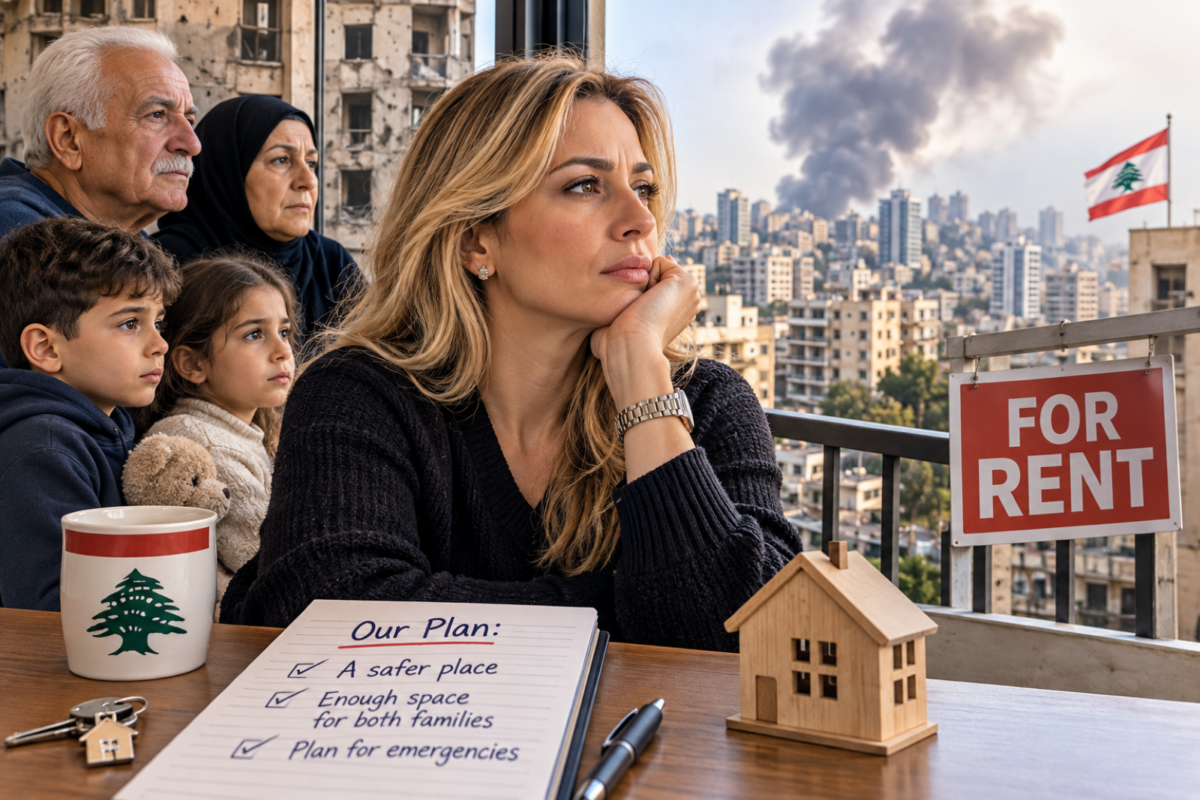
When Nadia Khoury chose the apartment where she would begin married life, she had to decide how much room to leave for a war. Khoury, who had lived in Beirut’s southern suburbs, told Asharq Al-Awsat that she chose a place in Bchamoun large enough to take in her parents and her husband’s family if they had to flee. She was willing to pay more so neither family would have to look for shelter when the time came. aawsat.com
There is something generous in that decision. There is also a public failure in how much depends on her generosity. A young woman starting a household has taken on part of the work of protecting two others. She will pay for that protection every month, including the months when the room stands empty.
The same report, published on November 1, described a retiree who left an undamaged home in the southern suburbs and moved with his wife to Khalde. He wanted to be near his children. He also wanted to spend his retirement without having to wonder where they would go if the bombing resumed. The rent is $600 a month. On an assessment of physical damage, his home would count among those that survived. On the couple’s budget, the war costs them another $7,200 a year for as long as they keep renting. aawsat.com
These families made different decisions for reasons that deserve to be taken seriously on their own terms. What they share is an understanding of how little time a family may have once danger arrives. By then, rents may be beyond reach, relatives may themselves be looking for somewhere to stay, and a decision that was difficult yesterday may have become impossible. Planning early makes sense. It also means that the possibility of another Israeli strike can change where people live long before anyone issues an evacuation warning.
That matters for how we interpret the choices of those who stay. Imagine two households in the same building, equally concerned about another round of fighting. One can afford a deposit and a second rent. The other needs its entire income to keep the first home running. A month later, one apartment is empty and the other is occupied. What have we learned about the political convictions of either family?
Lebanon’s political vocabulary supplies answers too readily. A neighborhood still inhabited can be held up as evidence of steadfastness. Someone who moves away can just as easily be claimed as evidence that a community has turned against Hezbollah. Both interpretations allow observers to assign a political meaning to a decision whose most important detail may be the price of an apartment. A resident can support Hezbollah and want her children to sleep elsewhere. Another can oppose its decisions and have nowhere else to go. Neither owes the public a declaration of allegiance to explain an address.
There are families who stay because they love the place, because their work is there, because an elderly parent refuses to leave, or because they have made a deliberate choice to remain
There are families who stay because they love the place, because their work is there, because an elderly parent refuses to leave, or because they have made a deliberate choice to remain. Their attachment deserves respect. So does the person who has calculated what leaving would cost and quietly put the idea aside. When a politician praises everyone who remains for their courage, that second person disappears inside the compliment. It becomes harder to ask what choices the state actually made available to them.
Beirut cannot promise a family that Israel will never strike its neighborhood again. It can tell residents where they can go, who will help an older person get there, and what assistance a household can expect if it has to leave. Municipalities can make those arrangements known while people still have time to plan. And when the government assesses recovery, it can ask families who own habitable homes why they are paying rent somewhere else. Their answers belong in the public account of what this war has cost.
The question for the Lebanese state is where they could go if their daughter could afford only one bedroom
Nadia Houry has already answered the question of where her parents can go. The question for the Lebanese state is where they could go if their daughter could afford only one bedroom.
Ramzi Abou Ismail is a Political Psychologist, Researcher and Analyst.
The views in this story reflect those of the author alone and do not necessarily reflect the beliefs of NOW.