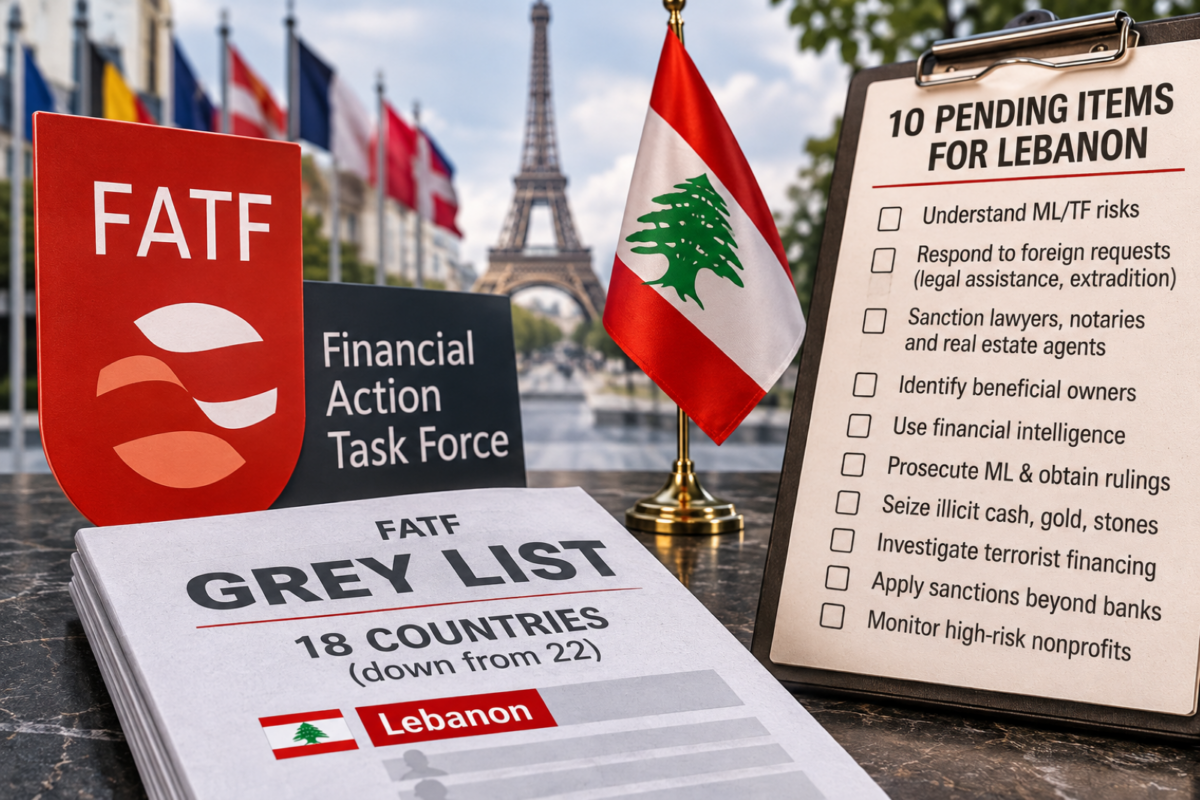
On October 30, the Financial Action Task Force (FATF) concluded its plenary in Paris. Four countries left the grey list: Bulgaria, Côte d’Ivoire, the Democratic Republic of the Congo, and Monaco. No country was added, and the list shrank from 22 to 18. Lebanon remained. Two years later, the list has become routine.
A statement written in diplomatic language
In the traditional language of international organizations, it never says a country failed; it says the country should continue working.
The FATF is the intergovernmental body that sets global standards against money laundering and terrorist financing. It does not impose sanctions. It publishes lists that financial institutions worldwide consult. In the traditional language of international organizations, it never says a country failed; it says the country should continue working.
The paragraph on Lebanon recalls the political commitment Lebanon made in October 2024 “in spite of the challenging social, economic and security situation within the country.” It then lists what Lebanon has achieved since. Two years of work are summarized in one sentence: Lebanon issued instructions on how to apply targeted financial sanctions without delay and organized training for institutions and professionals who were unfamiliar with their obligations.
Of the 18 countries on the list, only one other, Vietnam, has as many pending items
Then come the ten items that remain undelivered. In simple terms, Lebanon must understand its money laundering and terrorist financing risks; respond to foreign requests for legal assistance, extradition, and asset recovery in a timely manner; sanction lawyers, notaries, and real estate agents who break the rules; identify the true owners of its companies; use its own financial intelligence; prosecute money laundering and obtain court rulings; seize illicit cash, gold, and precious stones crossing its borders; investigate terrorist financing with foreign partners; apply sanctions beyond the banks; and monitor high-risk nonprofits. Of the 18 countries on the list, only one other, Vietnam, has as many pending items.
Only promises
The statement does not say that nothing is moving in Lebanon. Last week’s statement says this implicitly
When Lebanon was placed on the list in October 2024, the action plan contained the same ten items in the same order. Two years later, not one has been removed. The statement does not say that nothing is moving in Lebanon. Last week’s statement says this implicitly.
One could argue that Lebanon did something. The central bank issued circulars. In February 2025, the Justice Minister formed a committee to address the gaps, and the committee submitted a comprehensive report. But the FATF does not count circulars, committees, or reports. It counts investigations, prosecutions, rulings, and seized assets. On that ledger, Lebanon has nothing to show.
The FATF gave Lebanon more time in 2024 because of the war. As Reuters reported at the time, the deadline was moved to 2026. It is now November 2026.
Every idea except the obvious one
Since 2019, Lebanon has discussed nearly every monetary and financial idea in the textbook
Since 2019, Lebanon has discussed nearly every monetary and financial idea in the textbook. A currency board, backed by prominent international figures, remains presented as an alternative to the current monetary regime. Others are spending their energy trying to convince the IMF to rethink its principles. Last week, it was reported that the central bank told banks it would reclassify $3 billion of their mandatory reserves to reflect payments already made to depositors.
None of these debates answers a simple question. How will Lebanon attract investment and rebuild its deposit base while it remains on the grey list? A compliance officer in any foreign capital reads the same statement, sees ten open items and two years of no progress, and reaches a conclusion. The European Union reached that conclusion in 2025, adding Lebanon to its high-risk list.
So in the meantime, we do what we do best. We play the waiting game, hoping for better results or for the stars to align in our favor.
The usual answer in Beirut is that all this will come after Hezbollah is disarmed. Disarmament is essential, but it is not sufficient. It will not update the commercial register, issue a money-laundering ruling, or seize a bag of cash at the airport. And we are nowhere near disarmament anyway. So in the meantime, we do what we do best. We play the waiting game, hoping for better results or for the stars to align in our favor
Is it really that difficult?
Monitoring high-risk nonprofits leads directly to Al Qard Al Hassan, yet despite the Ministry of Justice’s request, investigations have stalled as regulatory and judicial bodies deflect responsibility onto one another
Some items are administrative. Updating the commercial register or training notaries requires will and a follow-up mechanism. Other items are political. Answering foreign requests for legal assistance or for terrorist financing investigations shared with foreign partners. Monitoring high-risk nonprofits leads directly to Al Qard Al Hassan, yet despite the Ministry of Justice’s request, investigations have stalled as regulatory and judicial bodies deflect responsibility onto one another. Seizing cash at the borders affects an economy that runs on cash, and too many people benefit from it.
FATF is not asking Lebanon to invent anything. It is asking Lebanon to apply its own laws to people who are not accustomed to them.
FATF is not asking Lebanon to invent anything. It is asking Lebanon to apply its own laws to people who are not accustomed to them. The ten items remain because of a lack of will to address them. Leaving the gray list would not require new laws, new committees, or new promises. It would require prosecutions, rulings, and seizures, which is exactly what is currently described as a difficult task.
Khalil Gebara is an academic and researcher.
The views in this story reflect those of the author alone and do not necessarily reflect the beliefs of NOW.